— KEY TAKEAWAYS
Inclusive strategic planning gets its value from bringing people together to share perspectives, build a vision, and create doable goals—the conversations matter as much as the plan.
- Nonprofit leaders face rising demand alongside billions of dollars in cuts to federal grant funding, and board members feel it too.
- Participants fall into three concentric circles: Deciders hold decision-making authority, Builders weigh in on the vision and goals, and Sharers contribute perspective through interviews, focus groups, or surveys.
- Traditional planning includes only Deciders and Sharers, so adding Builders is the innovation: the people doing a nonprofit’s on-the-ground work help create its vision and goals.
- Discovery works best when leaders bring curiosity and openness to feedback, guided by straightforward questions about the value you add, what you could improve, which opportunities to watch, and where risk exists.
- Implementation planning keeps the plan from gathering dust on a shelf: work backwards from a one-year goal, map the quarters, name a team captain, and confirm a year is enough time.
Over the past few years, the nonprofit landscape has shifted.
Leaders are under tremendous pressure. Many report increased demand for services, while navigating billions of dollars in cuts to federal grant funding. It’s not just nonprofit executives facing that pressure; board members feel it, too.
Even in the best of times, strategic planning plays an important role in determining an organization’s future direction. In harder times? It’s imperative.
Which begs the question: What does it take for strategic planning to feel successful, strengthen and inspire your organization’s work, and lead to clear next steps?
At The Ross Collective, we created our Inclusive Strategic Planning process to address exactly those questions. In this article, I’ll lay out three key practices that help form the foundation for this process—and that nonprofit leaders can use to do the kind of truly impactful planning that’s needed to meet these difficult times.

Looking for Better, Safer Ways to Use AI?
The AI Xchange, by Neon One, is a resource hub that helps you use AI efficiently and safely—so you save time without risking donor trust.
1. Get the right people in the room
We’re living in a time when anyone could use AI to generate a strategic plan…within a few seconds! Given that, what does it mean to create a strategic plan that actually motivates action?
The value of the Inclusive Strategic Planning process lies in bringing people together to share their perspectives, build a vision for the organization, and create doable goals. In other words, the conversations during the process matter as much as the product that is created at the end.
When staff and board members participate in these conversations, weigh in on the vision for the organization, and build goals together, they all understand the rationale behind the plan and feel invested in moving it forward.
You might be wondering, who should participate in planning? The Inclusive Strategic Planning process uses a framework composed of three concentric circles: Deciders, Builders, and Sharers:
- Deciders (the center circle): They have ultimate decision-making authority. During planning, this group meets every other week to keep the process on track.
- Builders (middle circle): At the Strategic Planning Retreat and in other meetings, this group weighs in on the vision for the organization and the goals the team will take on.
- Sharers (outermost circle): These partners, volunteers, clients, community members, and funders share their perspective in interviews, focus groups, or surveys.
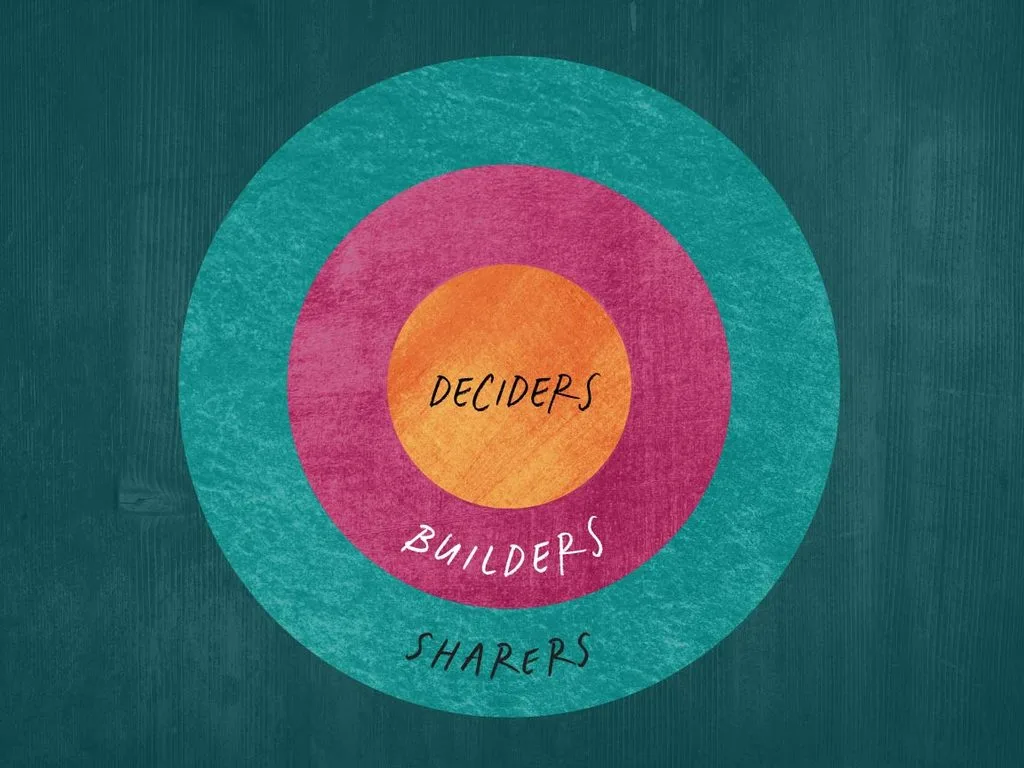
Most traditional strategic planning processes include Deciders and Sharers; the innovation in Inclusive Strategic Planning is adding the Builders.
This group may include the whole staff and board of an organization, or the whole board of a mostly-volunteer organization.
The point is to include the people who will be doing a nonprofit’s’s on-the-ground work in the creation of that org’s vision and goals.
For example, a recent strategic planning process for a workforce development organization included:
- Deciders: Three members of the leadership team,
- Builders: All staff (twenty individuals), and
- Sharers: Partners, staff, and clients participating in focus groups and individual interviews.

Buying Donor Management Software? First, Interview Stakeholders
2. Use the discovery process to learn and reflect, bringing curiosity and openness
Strategic planning, done right, is an opportunity to be in conversation with community members, clients, volunteers, staff, donors, and partners. The questions you ask them can be fairly straightforward.
Here are some questions to start with and customize to the organization:
- How are we adding value as an organization?
- What might we improve or do better?
- What opportunities should we pay attention to?
- What areas of risk exist?
This process works best when it starts with curiosity and openness to feedback about the organization’s work. Sometimes, much of what people share in the discovery is already “known” by the organization’s staff and board.
Even so, as people share their perspectives, take the opportunity to reflect on these two ideas: Do we agree with what is being shared? What new information are we hearing?
Make sure to solicit this information and capture it in a way that helps the board and staff easily review responses and reflect on what was learned. We use a shared document, such as a document or slide deck, to take notes and analyze themes.
There is often a lot of positive feedback that emerges from these questions in discovery, and there can be suggestions for improvement as well.
3. Plan for how you’ll implement your new strategy
High-level goals and strategies are inspiring. And, after creating them, staff and board members usually want to know: How does this plan impact what we are doing next month, or next week, or even tomorrow?
Including implementation planning in the process brings the plan to life by ensuring that it doesn’t just sit on a shelf, gathering dust.
What is implementation planning? It starts by working backwards from a one-year goal:
- First, ask, “What would success look like for this project—or what do we want to accomplish a year from now that we have not accomplished yet?”
- Then, determine what will happen each quarter, and who the “team captain” is for this initiative.
- Lastly, review all one-year goals and benchmarks together, and reflect on whether this work is doable! At this step, leaders sometimes realize that not all of this can be done in one year, and some of the work needs to move to the second year.

An 8-Step Plan for Nonprofit Change Management
More voices lead to better planning
It’s simple—not easy—to embark upon an Inclusive Strategic Planning process that’s successful, strengthens and inspires your organization’s work, and leads to clear next steps.
When you get the right people in the room, use the process to reflect on your work and plan for implementation in addition to strategy, giving your org a roadmap to the future that it can follow with confidence.
And in these challenging times, that confidence in the future is more important than ever.
Do You Know Your Donors?
They’re more generous than you might think … and we have proof. Download The Generosity Report today!

Author Bio
Dr. Renee Rubin Ross, The Ross Collective
Dr. Renee Rubin Ross is Founder & CEO of The Ross Collective. Based in the San Francisco Bay Area and serving nonprofits, funders, and government entities locally and nationally, The Ross Collective guides leaders to make better decisions and plan together, using Inclusive Strategic Planning and equitable governance to bring the right people into the conversation, make power and decision-making visible, and create the ownership and alignment needed to move from conversation to action. This material is based on Dr. Ross’ new book, Inclusive Strategic Planning For Nonprofits.