

Having a strong, engaged board is one of the most underappreciated keys to nonprofit success, but building one is no easy task. According to a 2021 report from BoardSource, almost half (49%) of nonprofit executives feel that they do not have the right board members to “establish trust with the communities they serve.”
While there is a ton of effort and thought that goes into creating a strong, thriving nonprofit board, it’s always good to start with the basics. And one of the best ways to build a solid foundation for your nonprofit’s board is for everyone involved to understand the fundamental nonprofit board responsibilities that they should be carrying out.
In this article, we will cover the six areas that any nonprofit board should be overseeing and provide some basic tips on proper board governance. Let’s get started!
Build the Board Your Mission Deserves
This checklist will help you recruit the right people, clarify responsibilities, and lay a foundation for effective governance and long-term impact.
What is a Nonprofit Board?
A nonprofit board is a group of people committed to the organization’s mission who oversee the long-term direction of the organization. Board members are fiduciaries, which means they are bound to make decisions that are in their nonprofit’s best interest.
A nonprofit’s board is not in charge of essential day-to-day nonprofit operations. That responsibility falls to the lead executive(s). But the board is responsible for ensuring that the nonprofit has all the necessary legal, ethical, financial, and overall good governance policies in place to succeed long-term.
Boards are also charged with making sure their nonprofit has all the resources it needs to live out its mission—which, to be blunt, is the polite way of saying fundraising is an important part of their job description. For all but the largest organizations, board seats are filled by volunteers.
Nonprofit boards bear the ultimate responsibility for the success (or failure) of the organization. In the next section, we’ll cover the six basic areas of oversight that make up that responsibility.
Nonprofit Boards Are Responsible for These 6 Things
All nonprofits are going to have certain processes for doing things that are particular to their organization. That sort of flexibility is key to finding their niche within their specific sector and to best serving the needs of their community.
But when it comes to a board of directors, there is actually quite a bit of inflexibility in terms of their roles and responsibilities. In order for any nonprofit organization to succeed, there are certain key areas where its board is going to have to weigh in and provide oversight.
Here are six responsibilities that every nonprofit board should be fulfilling…
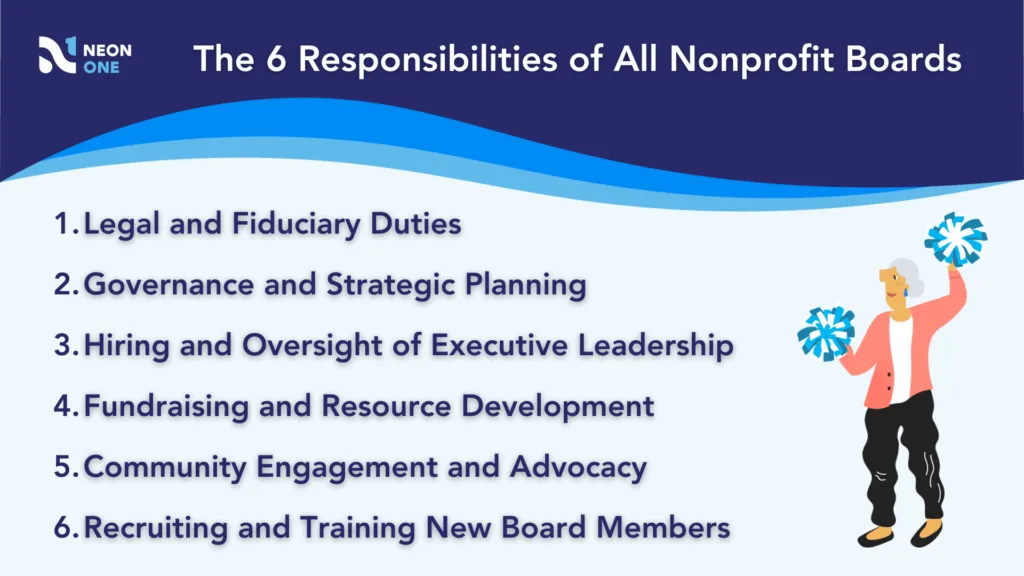
1. Legal and Fiduciary Duties
There are lots of duties and responsibilities that your nonprofit’s board needs to perform. But fulfilling their legal and fiduciary duties to the organization might well be their most important job of all.
As fiduciaries, board members have three key legal duties to the nonprofit:
- Duty of Care: Board members are obligated to be thoughtful and committed as they execute their duties, and they must exercise their best judgment when making decisions on behalf of the organization.
- Duty of Loyalty: The interests of the organization come first, full stop. Under this duty, board members are required to put aside their own self-interest when making decisions and to disclose any conflicts of interest that may arise.
- Duty of Obedience: It is the board’s job to ensure that their organization follows all applicable local, state, and federal laws. Additionally, the board must make sure that all of a nonprofit’s actions are in service of fulfilling its mission.
That third duty, “Obedience,” is where specific legal expertise is going to come in handy. Scratch that, it’s going to be pretty much essential to the success of your organization. All nonprofits should have at least one attorney on their board who is willing and able to oversee these duties.
2. Governance and Strategic Planning
As we mentioned earlier in this article, your nonprofit’s board shouldn’t really be involved in the nitty-gritty day-to-day operations of the organization. But your nonprofit’s board should always, always, have its eye on the nonprofit’s big picture.
For brand-new nonprofits, your board will have an important role in setting the organization’s mission and vision. And, for nonprofits of all ages, they will play a key role in setting, monitoring, and advancing your nonprofit’s strategic direction.
Determining strategy for a nonprofit involves a little bit (or a lot) of everything. It means determining programs and activities, managing supporter acquisition and retention, staffing, facilities, resources, and plans for future growth, all in service of your core mission.
Your board will have a hand in establishing and monitoring policies and procedures for your organization. These procedures should cover the handling of financial resources, management of employees, and handling and safeguarding of supporter and donor data, to name a few.
Finally, your board will oversee your nonprofit’s financial management and budgeting, which includes making sure your organization’s bills are paid on time in the short term and creating plans for sustainable funding in the long term.
3. Hiring and Oversight of Executive Leadership
Hiring a strong executive leader is critical for the success of any nonprofit. And that’s a task that will fall to your board.
The board will oversee the hiring process from beginning (creating a job description and setting the salary) to end (interviewing candidates and tendering an offer). Once the new leader has accepted the offer, it’s also your board’s duty to oversee that person’s onboarding.
Throughout that leader’s tenure, your board should be providing guidance as well as oversight. They should implement a review process (usually an annual review) that objectively assesses the executive’s performance in their role and sets new goals and incentives for future performance.
A board should always have confidence in its executives, as ensuring the organization has effective leadership in place is an important part of this role. In many organizations, executive leaders also have a seat on the board so that they can take part in big-picture decisions.
It is important, however, that your board be able to function independently of your executive leader. While it might make for easier and faster decision-making in the short term, a rubber stamp committee helps no one in the long run.
4. Fundraising and Resource Development
Were you wondering how long it would take us to get to this item? No wonder! Fundraising is a huge part of a board’s duties. Rolling up their sleeves and getting into the fundraising game reflects the fact that it’s ultimately your board’s duty to ensure your nonprofit’s financial sustainability.
This is one area where it’s better for a board to be involved in the details. The more your board knows about the strategy and progress of your various fundraising campaigns, the better guidance they can provide. Regular, reliable reporting is key.
Not only should your board be participating in fundraising efforts, but they should be taking a leading role in cultivating larger dollar donors. Board members are usually people with some measure of status in your local community. They should be using that status to build these critical relationships.
Be careful, though, that your board does not rely too much on major donors drawn from their networks. While a reliance on big donors might be tempting, especially if those donors overlap with your board’s social and professional networks, a keen focus on diversifying your funding sources will prove more sustainable.

5. Community Engagement and Advocacy
Your nonprofit’s board members should be some of your organization’s biggest and loudest cheerleaders. If they aren’t, then they are ignoring a vital aspect of their role.
It is the duty of all board members to represent your organization in the community and promote its mission. While this duty goes hand-in-hand with their duties as fundraisers, it also goes beyond that.
Speaking about your work and your mission at other community functions or at personal and professional gatherings cuts through the noise to raise your nonprofit’s profile and engage new audiences.
This same strategic vision also applies to your organization’s current constituents. A solid, functioning board will also spend time building relationships with stakeholders, partners, and donors.
When the people overseeing your nonprofit’s work understand how that work is impacting all those involved, it helps them better craft your strategic vision.
6. Recruiting and Training New Board Members
Nothing lasts forever, least of all a seat on your local nonprofit board. Your board should always have an eye on turnover and succession planning, both internally and externally. Much like with fundraising, their personal and professional networks are going to be key sources to draw from.
A nonprofit’s board should always have a clear understanding of which board members are planning to step down or have reached their term limit, plus what areas of expertise the board currently lacks.
Once a new board member has decided to join, it is also the board’s duty to onboard them professionally. They should have documentation laying out current duties, roles, and board procedures. It’s also a good idea to pair the new member with a more seasoned “buddy” who can guide them as they get up to speed.
The same commitment applies to the various roles like President, Vice President, Secretary, Treasurer, and important committee chairs. As a member approaches the end of their time in a certain role, they should be heavily involved in helping their replacement hit the ground running.
6 Effective Nonprofit Board Governance Practices
A nonprofit board can have all the strategic vision and sector expertise in the world, but they aren’t going to be able to execute on any of it if it lacks good governance practices. Anyone who has watched as Robert’s Rules of Order were wielded in anger knows exactly how this goes.
Here are six effective governance practices that your board can implement to help its members stay on task and focused on your mission.

1. Regular Board Meetings and Communication
An effective nonprofit board is one that meets and communicates regularly. Monthly or twice-monthly meetings are standard, and a weekly email update is also a good idea. (Depending on your board’s tech-savviness, we might also recommend a group chat.) Board meetings should always include an agenda covering both old business and new to prevent conversations from going off the rails.
2. Documenting Decisions and Maintaining Records
During board meetings, it is the Secretary’s job to take detailed minutes. After every meeting, those minutes should be sent out for review and approved at the beginning of the next meeting. Minutes should contain records of all decisions made and the discussions (including dissents) that went into making them. To ensure transparency for all board members, keep board minutes and records in a shared drive that all members can easily access.
3. Establishing Committees and Assigning Responsibilities
Areas of responsibility, like major fundraising campaigns, events, facilities, etc., should be overseen by committees that then report to the full board. Within those committees and on the board as a whole, all responsibilities should be clearly defined and then individually assigned to specific members. That way, it is much less likely that any major issue or need will fall through the cracks.
4. Conducting Performance Evaluations
Your nonprofit’s board should conduct annual reviews of both the board as a whole and of individual members. By setting clear goals and expectations, the board will be able to measure its progress and adjust its strategy accordingly. And, if individual responsibilities are clearly assigned to specific board members, that will help the board assess performance more accurately.
5. Providing Ongoing Education and Development
There are always going to be new nonprofit best practices that your board would do well to incorporate. Setting up regular opportunities for continuing education and development will help your board bring new ideas to the table and gain additional expertise and skills. As these are almost entirely volunteer positions, a chance to learn more about the specifics of nonprofit finance, fundraising, governance, or legal liability will always be appreciated.
6. Ensuring Diversity, Inclusivity, and Representation
A nonprofit board that boasts a diverse array of experiences and points of view is one that will make better, more thoughtful decisions. And, if your nonprofit works with members of an underrepresented community, it is vital that your board contain representatives from that community.
But creating a genuinely diverse and inclusive board is challenging! If you’d like to learn more about how to do it effectively, check out this Neon One webinar on creating a kind and inclusive board culture hosted by The Board Pro CEO Christal Cherry and Dr. Renee Rubin Ross of The Ross Collective.

Improve Board Reporting with Neon CRM
Nonprofit boards are responsible for overseeing the long-term direction and success of their organization. But it’s hard to make decisions on your nonprofit’s future if you don’t have all the information you need. That’s why regular and insightful board reports are an important key to nonprofit success.
Neon CRM is a comprehensive donor management system with a wide variety of reporting features and board-specific templates. With just a few clicks, you can create informative, easy-to-read reports for your nonprofit’s board members that give them the full picture.
Want to learn more about Neon CRM? Check out one of our self-guided product tours. See all the ways we can help your nonprofit streamline your day-to-day and put your energy towards what really matters: building the kinds of genuine, personal connections that fuel long-term growth.

See Neon One in Action!
Check out these 12 self-guided tours and learn how Neon One’s tools empower nonprofits to connect with their communities, move their supporters to action, and simplify their operations.