
— KEY TAKEAWAYS
Fundraisers worry about asking for too much. The bigger risk is asking too little, and every donor’s record already says how much to ask.
- Suggested donation amounts set a donor’s expectations. A low default brings in more gifts but smaller ones, and what you gain on the low end never covers what you lose on the high end.
- Raising every number won’t work either. A 20% to 40% bump across the ask string dropped the odds of any gift by about 15%, with no bigger gifts to show.
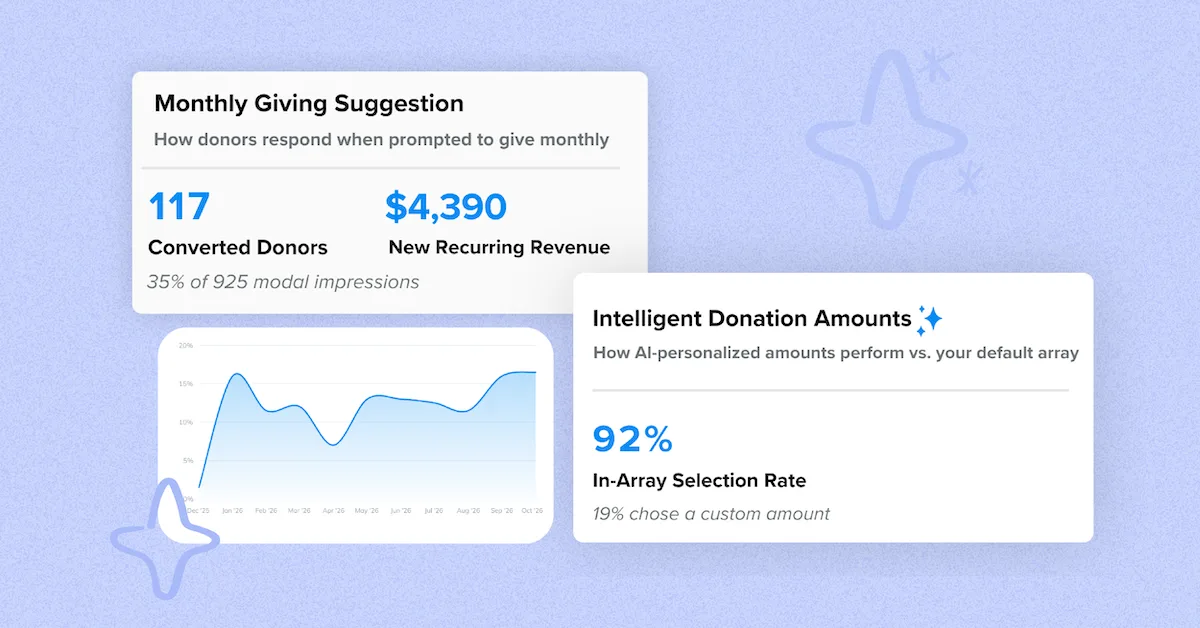
- Intelligent Donation Amounts in Neon CRM read each donor’s giving history and seasonality, then build the array around it. In beta, the median gift doubled, from $52 to $100.
- The model works from your first-party data: the gifts a donor actually made you. No purchased wealth screen, and no donor data leaving Neon CRM to train public AI models.
- Whatever your array, attach impact statements, offer recurring on the form, keep “Other” obvious, and don’t be afraid to actually make the ask.
Every fundraiser has some version of the same fear: Ask for too much, and you’ll scare the donor off. It’s not a silly thing to worry about! Nobody wants to be the org that asked a $50 donor for $150 and got an unsubscribe for the trouble.
But playing it safe has its downsides, too. Namely, that you’re leaving fundraising dollars on the table, and, in return, you’re getting… nothing. No benefits whatsoever. It’s not like most of your donors are strangers. They support your work; they love your mission; if you asked them for more, they would say yes. But first you had to ask. And you didn’t. So they didn’t.
There’s a right balance between asking for too much and settling for too little. And nowhere is this push and pull more obvious than the suggested giving amounts on an org’s donation forms.
Looking for Better, Safer Ways to Use AI?
The AI Xchange, by Neon One, is a resource hub that helps you use AI efficiently and safely—so you save time without risking donor trust.
Suggested Donation Amounts Set a Donor’s Expectations
Do you actually remember when your org’s suggested donation amounts were established? For many orgs, the answer might as well be “long ago, in the great before times,” which is another way of saying “I dunno, 2019?”
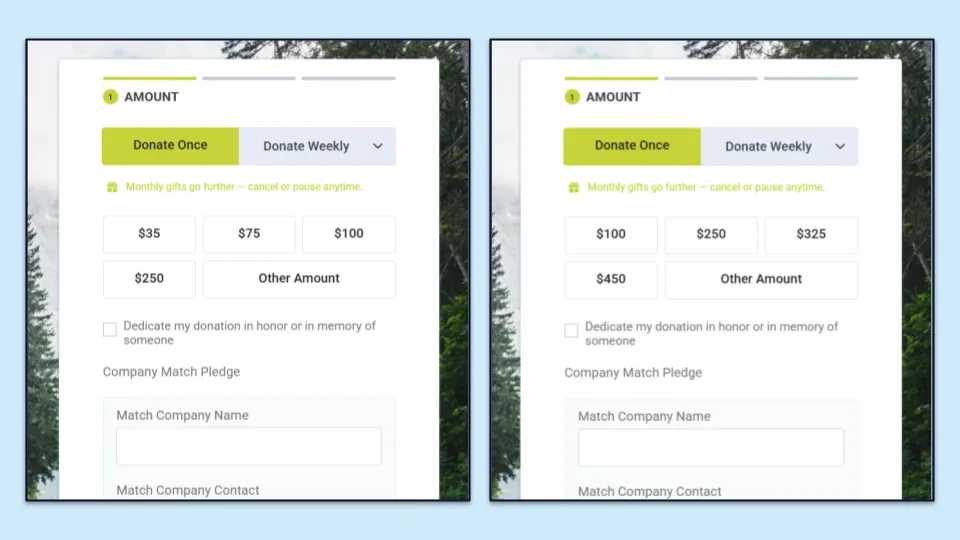
If your answer is in that range, it’s a fair assumption that your form is only displaying one, uniform set of suggested amounts for everyone. That includes the person who found you through a Facebook post yesterday as well as the person who’s given $500 every December for the past twelve years.
The thing is, those suggestions are also setting certain expectations. A donor who was only going to give “$20” might up their giving if they see “$25” as the lowest option; on the flip side, a donor who would have been willing to give “$500” might just click “$300” if that’s your largest suggested option.
You want to know the most annoying part? Whatever dollars you gain on the low end don’t add up to the larger amounts you’re losing on the other end.
Introducing Intelligent Donation Amounts in Neon CRM
This is the problem with a one-size-fits-all approach to suggested giving amounts—one size actually does not fit all. A much better approach would be to tailor those amounts to how much a person has given to your organization previously, right?
Exactly. That’s why we’re announcing a new tool that does exactly that: Intelligent Donation Amounts, now available in Neon CRM.
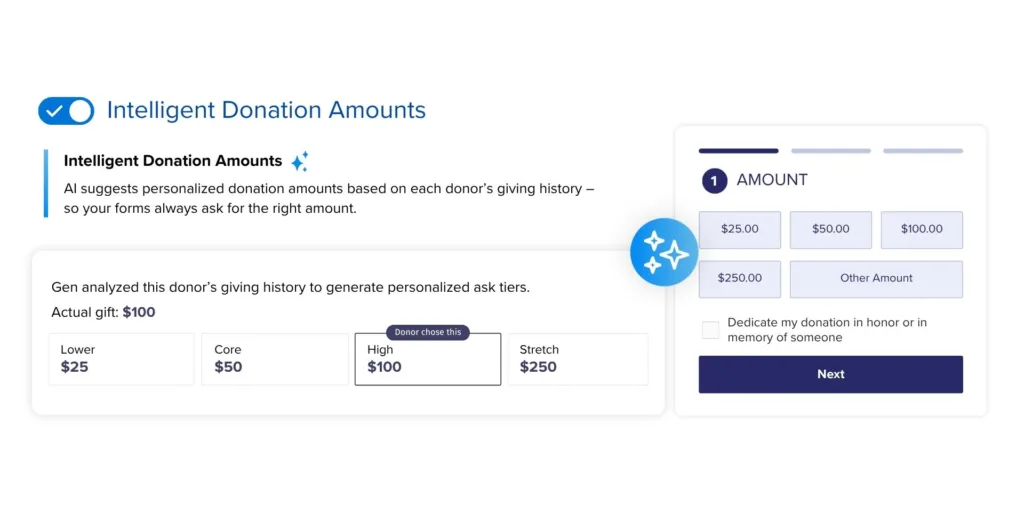
It’s a machine-learning-powered AI feature that looks at what a donor has actually given you before and personalizes the suggested amounts on your donation form to match. You don’t need to create extra forms, manually segment your lists, or perform an extra data analysis. It just… happens!
Let’s get into how it works—and why the research says the ask you’re worried about is probably too small, not too big.
Smarter Asks, Bigger Impact: How Intelligent Donation Amounts Take the Guesswork Out of Giving
How Do Suggested Donation Amounts Change What People Give?
Suggested donation amounts affect giving because they work as an anchor. The numbers on your form become the reference point a donor uses to decide what’s normal, expected, and generous—even the donors who end up typing their own number rather than selecting one of yours.
In other words, suggested amounts don’t just capture a decision the donor has already made. They actively shape the decision itself.
The most thorough work on this comes from Goswami and Urminsky, who ran eight studies with more than 11,000 participants on what happens when you change the default amount on a donation form. They found three effects worth knowing:
- A low default raises your response rate. More people give, because giving feels accessible.
- A low default also shrinks your average gift, because donors who would have given more scale down to meet the number you showed them.
- The presence of a default distracts donors from everything else on the page—your impact story, your mission, your reputation—while they resolve the numbers question.
It’s that middle finding that tailored donation amounts are trying to overcome. And it’s why you don’t have to worry—within reason—about showing donors a larger default gift.
As researchers writing in Harvard Business Review put it—and put it bluntly—fundraisers tend to be more nervous about higher suggested amounts than the evidence justifies.
Why You Can’t Just Raise All Your Amounts
Here’s the shortcut that seems obvious once you’ve read all that research (you did read it all, right?): You bump up every number on your form and watch the money start rolling in.
The only problem is that it won’t actually work. In field experiments with public television donors, De Bruyn and Prokopec raised the entire ask string by 20% to 40% and found that the probability of getting a gift at all dropped by about 15% with no increase in the size of the gifts that did come in. They not only did worse; they did worse on both counts!
The same research found that aggressive multipliers hit first-time donors hardest, since they haven’t built the habit yet and read a steep ask as presumptuous. Long-time donors were the opposite problem: They knew what they wanted to give, and if that number wasn’t easy to select, a meaningful share of them abandoned the form rather than hunt for it.
(Of course, you knew all of that already, because you read all of the research. Right?!)
Anyway, those studies made it clear that a blanket increase fails, while a uniform average leaves money on the table. What’s left is doing it per donor—which, done by hand, is completely infeasible.
Enter: intelligence of a distinctly artificial vintage.

A Nonprofit’s Guide to AI in Fundraising
How Intelligent Donation Amounts Work in Neon CRM
When you have Intelligent Donation Amounts enabled on your Neon CRM donation forms, they will review each donor’s giving history and engagement signals, then personalize the suggested gift array on your form for that specific person.
A donor who typically gives $500 sees options built around $500. A donor whose history is lower than that—which is probably most of them—sees something that fits where they actually are.
Here is how this feature works in practice:
- It weighs capacity first. The model looks at the highest amount a donor has given you historically, alongside seasonality, aka the time of year they tend to give.
- It retrains weekly on new donation data, so it keeps up as your donors change.
- It needs some history to work with. A donor has to be logged in or email-authenticated with at least two prior donations.
- It falls back to your default array when a donor’s history is limited. Nobody’s going to get a blank form or (worse) a wild guess.
- You can check its work. Admins can view the suggested array for any donor and flag it as too high, too low, or about right.
Neon CRM users will find Intelligent Donation Amounts in their Settings menu under Giving Optimization, and you can turn it off whenever you want.
As for whether it works: In beta testing, donation forms using Intelligent Donation Amounts saw the median gift double from $52 to $100. The share of gifts at $100 or more grew from 36% to 52%, a 44% relative increase. So… yes! It works!
It Uses Your Own Data, Not a Wealth Screen
There’s a version of “personalized asks” that works very differently from this one because it sizes up a donor using third-party data, including purchased records on real estate holdings, corporate affiliations, stock ownership, etc.
These features are more akin to wealth screening, because they assess (or at least attempt to assess) what someone could give based on their life outside your organization.
Neon CRM’s donation forms won’t do that. Our Intelligent Donation Amounts are based on your donor’s history with you—gifts they made, engagement they chose, a relationship they built on purpose.
That’s first-party data, and it has three advantages over the kind of third-party data that’s used during a wealth screen:
- First-party data measures affinity, not just capacity. Someone with a big house and no connection to your mission is often a bad ask no matter what a screening tool says. Someone who’s quietly raised their gift three years running, on the other hand, is a great one.
- It catches donors a wealth screen misses. Plenty of people with real capacity live modestly and never register on external data. Their giving pattern with your organization is going to tell you what their ZIP code—or their lack of a subscription to The Expensive Boats and Whiskey Literary Supplement—won’t.
- It doesn’t import somebody else’s bias. Generational wealth is distributed along lines that have nothing to do with who loves your work. An algorithm trained on your donors’ actual behavior treats a loyal $15-a-month supporter with the same seriousness as a major donor.
And on the question everyone asks about AI: Your donor data stays inside Neon CRM and is never used to train public AI models.
How Do You Get Donors to Give More Than the Suggested Amount?
Mostly, you don’t talk them into it. You don’t beg or cajole or plead; you don’t implore, beseech, or supplicate—whichever easily Google-able synonym of ask you can think of—you simply don’t do it.
Instead, you make the bigger number the more enticing one to click on. Here are a few things that will help you do that:
- Set the array high enough to matter. If your top suggestion sits below what a donor gave you last year, you’ve capped them.
- Attach impact statements to each amount. “$100 covers a week of after-school meals” gives a donor a reason to move up a rung instead of just a bigger number to squint at.
- Offer recurring right on the form. A $20 monthly gift is a $240 commitment that feels smaller than a $100 one-time gift.
- Keep “Other” obvious. It sounds backwards, but donors relax when they can see the exit.
But the most underrated thing you can do to increase your giving—something we came across when doing the research for our Recurring Donor Report—is to just… actually ask them.
In that survey, 71.2% of recurring donors said they gave without being asked. We’d love to make this as simple as “you lose 100% of the appeals you never make,” but the data suggest that, in fact, you will still win some of them!
Now imagine how many you could win if you actually made the asks? 80%? 90%? 115%?! Statisticians are enraged at the thought. Go out there and prove them wrong.
The Recurring Donor Report: Key Findings
Ask Your Donors Like You Know Them, Because You Do
The donors on your file have already told you what they can give. They told you last December, and the December before that. The only thing standing between that information and your donation form has been the hours it would take to act on it.
That’s the work Intelligent Donation Amounts in Neon CRM takes off your plate.
Want to see it in action? Join Sam Nyland and Cherise Arrendale for our upcoming webinar, Smarter Asks, Bigger Impact: How Intelligent Donation Amounts Take the Guesswork Out of Giving. They’ll walk through how the feature works, how your donor data stays protected, and what personalized asks did to average gift size during our testing with real nonprofits!
FAQs about Intelligent Donation Amounts
Base them on what each donor has actually given you, not on a single average applied to everyone. A uniform gift array asks your most committed supporters for less than they already give while asking first-time visitors for more than they’re ready for, and the dollars you gain at the low end don’t make up for what you lose at the high end.
One rule to follow is that your top suggested amount should never sit below what a donor gave you last year. If it does, you’ve capped them.
Start by setting your array high enough to matter, since a top suggestion lower than a donor’s last gift puts a ceiling on them. From there, attach an impact statement to each amount — something like “$100 covers a week of after-school meals” — so a donor has a reason to move up a rung instead of just a bigger number to squint at.
Offer recurring giving right on the form, too. A $20 monthly gift is a $240 commitment that feels smaller than a $100 one-time gift. And keep your “Other” field obvious. It sounds backwards, but donors relax when they can see the exit.
They work as an anchor. The numbers on your form become the reference point a donor uses to decide what counts as normal and generous, which means they shape the decision rather than just capturing one the donor already made. This holds even for people who end up typing their own number.
Research by Goswami and Urminsky, across eight studies with more than 11,000 participants, found three effects. A low default raises your response rate. A low default also shrinks your average gift, because donors who would have given more scale down to match it. And the presence of a default pulls attention away from everything else on the page.
Intelligent Donation Amounts is a machine-learning feature that personalizes the suggested gift array on your Neon CRM donation forms for each individual donor. It reviews that donor’s giving history and engagement signals, then displays amounts that reflect their actual relationship with your organization. A donor who typically gives $500 sees options built around $500. You don’t need to create extra forms, manually segment your lists, or run a separate data analysis.
The model weighs donor capacity first — the highest amount that donor has given you historically — alongside seasonality, meaning the time of year they tend to give. It retrains weekly on new donation data, so the suggestions keep pace as your donors’ giving changes.
Intelligent Donation Amounts appear for donors who are logged in or email-authenticated and who have at least two prior donations on file. Everyone else sees your organization’s default gift array, so no one lands on a blank form or gets a wild guess. During Beta, the feature supports one-time donation forms.
No. It uses first-party data only—the gifts a donor made to you and the engagement they chose—rather than purchased third-party records on real estate, corporate affiliations, or stock ownership. That means it measures affinity for your cause rather than estimated capacity from someone’s life outside your organization.
Your donor data stays inside Neon CRM and is never used to train public AI models.
Yes to both. The feature lives in your Neon CRM Settings menu under Giving Optimization and can be switched off at any time. Admins can also view the suggested array for any individual donor and flag it as too high, too low, or about right.
In the beta test Neon One ran with real nonprofits for our Intelligent Donation Amounts, we found it did! Donation forms using Intelligent Donation Amounts saw the median gift double, from $52 to $100. The share of gifts at $100 or more grew from 36% to 52%, a 44% relative increase.

Author Bio
Alex Huntsberger, Content Marketing Manager
Alex Huntsberger is Content Marketing Manager at Neon One, where he brings his expertise in nonprofit fundraising, events, and memberships to the Neon One blog. Alex has spent over a decade as a content writer, search marketer, and communications pro. He’s also an experienced theater critic and arts writer, having covered plays and musicals across Chicagoland since 2010 for the Chicago Sun-Times, Time Out Chicago, and Newcity Stage. Like every other liberal arts grad in the Chicago area, Alex once worked for Groupon. He currently lives in Mundelein, IL, with his wife and their two children.