

30 years ago, very few people had email. For nonprofits back in 1995, everything centered on direct mail, phone calls, and galas. Those were their most effective fundraising channels.
But now, email is so commonplace that it’s not even on the cutting edge of fundraising techniques anymore. For modern nonprofits, email fundraising isn’t a nice-to-have; it’s a must.
That’s why knowing how to write an effective fundraising email is such a critical skill. If you can master this communication form, you can set your organization up for consistent campaign returns that yield a stable and reliable source of revenue.
That’s why we’re here: To give you the basic building blocks and best practices you need to craft a compelling, impactful fundraising email no matter your budget, your mission, or your audience. We’ve even got a series of free fundraising email templates that you can download, plug your details into, and send (or you can just use them as inspiration—that’s fine too).
All right, let’s get started!
The Anatomy of an Effective Fundraising Email
We all know that the hardest part of starting any writing project is, well, actually starting it. The curse of the blank page (or blank Google Doc) is real. And it’s real because creating something out of nothing is never not going to feel like a monumental task.
Writing a fundraising email that works—one that gets opened, read, clicked, and acted on—doesn’t require being a creative genius. It requires understanding the building blocks that make your message clear, compelling, and irresistible to the right people.
Think of it this way: it’s less like producing David from a lump of marble and more like remixing your favorite song. Once you understand the building blocks of a good email, you don’t have to start from scratch ever again. You can build an email framework that works every time.
A great fundraising email should have all (or at least most) of the parts listed below. We’re going to (briefly) dive into each one to see how you can use it most effectively. Here’s the full list:
- Subject Line
- Greeting
- Opening Line
- Body Copy
- Design & Layout
- Visuals
- Call to Action (CTA)
- Signature
- Postscript
- Footer
Let’s take a look at each element, what it entails, and what you should do with it.
Subject Line: Stay Positive, Earn The Click
In order for your fundraising email to inspire people to donate, they have to open it first. That’s why your subject line is so incredibly important. Without it, the rest of your email can’t work.
A great subject line is short, emotionally resonant, and specific. It doesn’t try to explain everything. It teases just enough to spark curiosity or tug at the heart.
According to Neon One’s Nonprofit Email Report, emails with emotionally positive subject lines significantly outperform the rest. Gratitude, pride, optimism, and even surprise all work better than fear or urgency alone.
Using those insights, try for subject lines that are like the following:
- “You made this miracle happen!”
- “Meet the cat you helped save.”
- “The surprising truth about GivingTuesday…”
On the opposite side of the coin, avoid using subject lines like these:
- “Reminder: Q4 Appeal”
- “Support Us”
- “Time-Sensitive Fundraising Update”
Lastly, don’t forget your preview text! This little snippet can increase your open rates and your revenue—but, too often, it’s an afterthought. Use it to expand on your subject line, build emotional momentum, or add clarity.
For a subject line that reads “We’re down to the last $500”, a great preview text might read “Help us cross the finish line and unlock a 2x match!” You’ve given the reader an additional incentive to open your message and learn more. Your open rates will thank you.
Greeting: Sound Like a Person, Not a Platform
Also known as your “salutation,” this one’s easy to get right—and surprisingly easy to overlook.
The key to a good greeting is to sound personable, instead of robotic. Skip “Dear Friend” or “Valued Supporter.” If you have the donor’s name, use it. If you don’t, at least speak like a human and open the message with a greeting like “Hey there.”
This feels more friendly than a generic opening and sets the tone for the rest of the email. Remember: you’re not writing into the void. You’re writing to a human being! Even more so, you’re writing to someone who already cares. They wouldn’t have opted into receiving your emails if they didn’t!
Opening Line: Hook Them Before They Bounce
Your first sentence is doing more than introducing the topic of your appeal—it’s either pulling your reader in … or giving them an excuse to bail and focus on the one million other shiny digital things screaming for attention.
The best way to start is to drop readers into a story, like “When Ella opened her fridge last winter, she found nothing but a half-empty jar of peanut butter and a block of cheese.” When you read that, you instinctively want to know what happened to Ella and how you can help.
There is no perfect hook, no one stat or anecdote to rule them all. But an opening like this—something specific, emotional, human—grounds your email in real impact. That’s what turns readers into donors.
Body Copy: Make the Impact (and the Ask) Crystal Clear
Once you’ve pulled your reader in with a compelling story, the body of your email should transition into the heart of your message: how your reader can make an impact on the community you serve.
This is where clarity matters most. Use simple, emotional language to show exactly what’s at stake and exactly how your reader can help.
Here’s what to make sure you include:
- Who’s being helped: Introduce the person, family, or community your donor can support. Keep it human and specific. The more your reader can picture the person they’re helping, the more likely they are to act. Animals can work here, too!
- What the problem is: Clearly describe the barrier or challenge that needs to be solved for your character. Avoid jargon. Keep it focused on the need—not your organization’s programs.
- How the donor can be the solution: Tie their gift to a tangible outcome. Be specific about the dollar amount, what it will fund, and when it’s needed. “Will you give $35 today to provide a week of meals for a neighbor like Ella?”
Tell your story clearly—who needs help, and why they need it—and make your ask confidently (and, for good measure, make it more than once). Make it easy for your donor to get to “yes.”
Design & Layout: Imagine Your Donor In the Grocery Line, Not the Office
Speaking of “making it easy to get to yes,” let’s have a quick discussion about when and where your readers are actually going to be reading your email.
We all know that they aren’t doing it in a quiet office with a latte and a full-sized monitor. They’re on their phones, skimming while waiting in line at the grocery store or between meetings.
It’s super important that your layout and ensign take that into account. If your message isn’t easy to scan and act on right now, it’s going to get skipped.
Here’s how to make sure your email gets read—and clicked:
- Use a legible font size. Stick with 16-20 pt body text. Anything smaller becomes a squint-fest on mobile.
- Keep paragraphs short. One to three lines max. No one wants to read a block of text on a screen the size of a granola bar.
- Use high-contrast colors. Black text on a white background? Great. Red text on yellow? Not so much.
- Include one or two meaningful images. Show the people you serve or the impact of a donation—avoid decorative or stock-y filler.
- Place a CTA button near the top and another at the end. Make it easy to take action without scrolling forever.
- Include multiple links. Use a mix of buttons, text links, and hyperlinked images that all take readers to your donation form. The goal should be for someone to be able to tap on a link to donate at any point as they read your appeal without needing to scroll back up looking for a link.
It’s important to know what to avoid, too. So what’s on that list?
- Walls of text. Break things up with short paragraphs, bullet points, and white space to improve readability.
- SHOUTY SUBJECT LINES. Subject lines written in all caps can feel aggressive or spammy and may land your message in the junk folder instead of a donor’s inbox.
- Buttons in unreadable colors. If your call-to-action buttons don’t stand out—or worse, blend into the background—donors may not know where to click to give.
- Images with baked-in important text that won’t display if they don’t load. If your key message is embedded in an image and that image doesn’t display, your audience may miss the entire point of your appeal.
We’re not even going to get into how absolutely shot everyone’s attention spans are. We don’t need to, because the advice would still be the same: Make your email scannable, and you’ll make it successful.
Visuals: Real Faces Beat Polished Photos (or Logos)
If storytelling is the heart of a fundraising email, a powerful photo is its face.
Literally.
Donors are drawn to people, not logos. A compelling image can instantly convey emotion, urgency, and connection faster than any paragraph ever could. That’s why one of the most effective things you can do is include a photo of a real person that will help your supporter imagine the impact they’ll have when they give..
Use a single relevant image that reinforces your story. It shouldn’t feel staged, stocky, or generic. If it looks like it came from a marketing brochure, your donor’s guard will go up. People have a really good radar for that kind of thing, even if they don’t consciously realize it.
Keep it natural, focused on humans (or pets), and related to your mission. Real moments beat high-gloss production every time.
Call to Action (CTA): Make It Easy to Say “Yes”
Your email’s goal is not to get opened. It’s to inspire action! That’s why your call to action (CTA) needs to be clear, prominent, and donor-centered. If someone is ready to give, don’t make them hunt for the button.
Place one large, high-contrast button early in the email, ideally right after your first ask. This ensures donors who are already convinced don’t have to scroll. Then, include a second CTA near the end for readers who want to learn more before clicking.
Make sure these buttons stand out visually on both desktop and mobile. As a backup, add some hyperlinks in the text, as some readers prefer to click those! And make sure that these CTAs are linking to a friction-free landing page with suggested donation amounts, impact descriptions, and zero distractions.
What should your button say? Skip the vague stuff like “Click Here” or “Learn More.” Instead, use specific, donor-focused action verbs:
- “Donate $25 Now”
- “Feed a Family This Week”
- “Help Build a Safer Playground”
- “Make My Gift”
The more your CTA sounds like a solution, the more likely your donor is to take that first step.
Postscript: Your Most-Read Line (No, Seriously)
Here’s a secret that email marketers have known for years: The P.S. at the end of your message isn’t just some humanizing add-on. It’s prime real estate. Use it wisely!
A good P.S. should restate your ask in plain, urgent language. Keep it short, emotional, and action-oriented. This is not the place for a mission statement or a thank-you—it’s your second chance to inspire action.
A good P.S. looks something like this:
P.S. Just $10 today can make sure a family doesn’t go to bed hungry this weekend. [Click here to give now.]
If you want to have your postscript stand out from your primary ask, here are a couple of different things you can do with it:
- Create urgency (“We’re just $2,000 away from our goal.”)
- Reinforce the donor’s role (“You can be the reason someone gets help tonight.”)
- Drop a quick bonus (“Every gift made by midnight will be doubled.”)
Why are postscripts so valuable? It’s mostly a quirk of human psychology. There’s something about this extra bit that many people gravitate towards instead of simply reading the main message.
Oh, well. People are weird. Use it to your (and your mission’s) advantage.
Signature: Show the Person Behind the Message
Donors don’t want to feel like they’re getting a mass email from a nonprofit’s fundraising department. They want to hear from someone. That’s why your sign-off matters more than you might think.
When you close your email with a name—and, ideally, a role tied directly to the story or impact—you give your message a human face. And don’t just give a name! Give a title, too. You could even go as far as to include a small headshot in the signature block. All of this helps your donor understand who they’re hearing from and why this message matters.
The best signatory probably isn’t your development director, either. Mix it up a little by having your message come from other people, like:
- Staff members who are close to the work
- Board members
- Volunteers with personal insights
- Executive leaders who can speak with credibility and vision
Which one works best depends on what kind of appeal is being made! This is a great thing to A/B Test.
Footer: Small Space, Big Responsibility
Your email footer is more than just where the legal stuff and links to your site can go—it’s where you can quietly reinforce your credibility.
Yes, you need to include your organization’s name, address, and unsubscribe link to meet email marketing compliance requirements (especially for platforms like Mailchimp, Constant Contact, and others).
But, beyond the basics, your footer can a trust-building tool. It tells your reader: we’re real, we’re transparent, and we respect your time.
A strong footer includes:
- Your org name and EIN
- Social media links
- Basic contact info
- A clear unsubscribe link
Even though it’s tucked away at the bottom, this section matters.
You Don’t Have to Start From Scratch (Free Templates)
This may feel like a lot—and, truth be told, it is. That’s why we went ahead and created a series of fundraising email templates that come with all these elements already built in. They cover a series of different appeals, from one-time donations to monthly gifts, pledges, and capital campaigns.
To download the full pack, which comes complete with best practices and examples for you to use, just click the button below.
Get My Free Fundraising Email Templates
Here’s What a Great Fundraising Email Looks Like (Example)
By now, we’ve talked about all the pieces that make a fundraising email effective: the subject line, story, structure, tone, and ask. But let’s take it a step further.
Here’s an example of a real email (adapted from one of our templates) that brings all those best practices to life and a breakdown of why it works.
Example #1: One-Time Donation Email
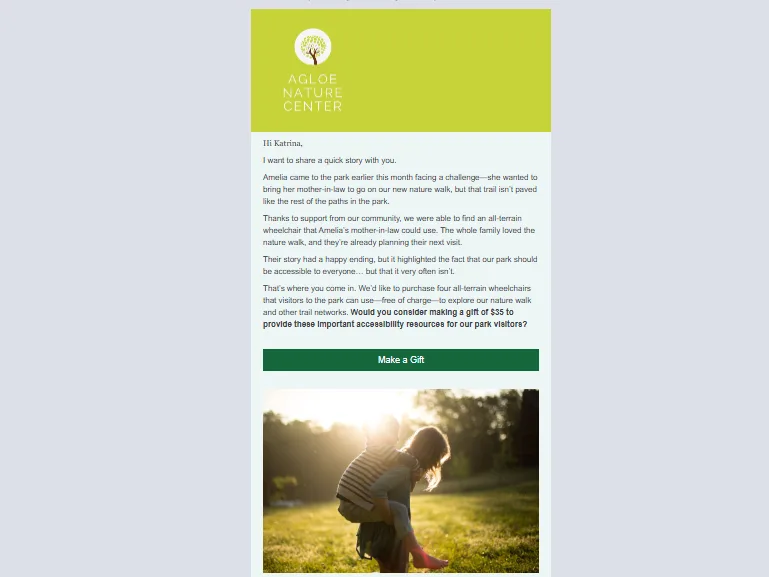
Subject Line:
Will you make the outdoors more accessible today?
Preview Text:
Your gift can make our local parks more accessible. Here’s how.
Body Copy:
Hi Katrina,
I want to share a quick story with you.
Amelia came to the park earlier this month facing a challenge—she wanted to bring her mother-in-law to go on our new nature walk, but that trail isn’t paved like the rest of the paths in the park.
Thanks to support from our community, we were able to find an all-terrain wheelchair that Amelia’s mother-in-law could use. The whole family loved the nature walk, and they’re already planning their next visit.
Their story had a happy ending, but it highlighted the fact that our park should be accessible to everyone… but that it very often isn’t.
That’s where you come in. We’d like to purchase four all-terrain wheelchairs that visitors to the park can use—free of charge—to explore our nature walk and other trail networks. Would you consider making a gift of $35 to provide these important accessibility resources for our park visitors?
[Make a Gift]
Thank you so much for your support of our park and all of the people who visit us. You really are an indispensable part of making Polk County a beautiful place to be!
Thank you again,
Darlene Springer
Board Member, Agloe Nature Reserve
Why This Fundraising Email Works: Best Practices in Action
Every element in that message is doing a specific job. It’s designed to grab attention, build emotional momentum, and make it as easy as possible for the donor to say yes.
Here’s how that email put a whole host of fundraising best practices to work: .
- The subject line is emotional, specific & action-oriented: “Will you make the outdoors more accessible today?” is short, clear, and taps into the donor’s values. It makes a direct ask but frames it as an invitation, not a demand.
- The preview text adds curiosity and reinforces impact: “Your gift can make our local parks more accessible. Here’s how.” offers a compelling benefit and promises more information if the email is opened.
- The salutation is personalized and human: Addressing the reader by name (“Hi Katrina,”) instantly creates a sense of connection and makes the email feel like it was written just for that reader.
- The opening leads with a vivid, human-centered story: The first line introduces Amelia’s challenge in a relatable, real-world moment. It quickly pulls the reader into the narrative and shows the stakes.
- The donor’s impact is clearly tied to the story’s outcome: “Thanks to support from our community…” shows the donor that their giving is what makes solutions like this possible.
- The problem is clear, and the donor is positioned as the solution: “Our park should be accessible to everyone… but it very often isn’t. That’s where you come in.” This transition moves naturally from the story to the call for help.
- The ask is specific, tangible, and dollar-based: “Would you consider making a gift of $35 to provide these important accessibility resources…” ties the donation amount to a concrete result—purchasing all-terrain wheelchairs.
- The CTA is clear, clickable, and easy to act on: A bold “Make a Gift” button right after the ask gives donors an immediate way to say yes—no scrolling required.
- The tone throughout is warm, grateful, and community-focused: Phrases like “thank you so much” and “you really are an indispensable part…” emphasize appreciation, not urgency or guilt.
- The signature comes from a real person with a relatable role: Signing off as “Darlene Springer, Board Member” adds authenticity, credibility, and a personal touch.
Together, these elements form an email that doesn’t just get opened. It gets read, remembered, and acted upon.
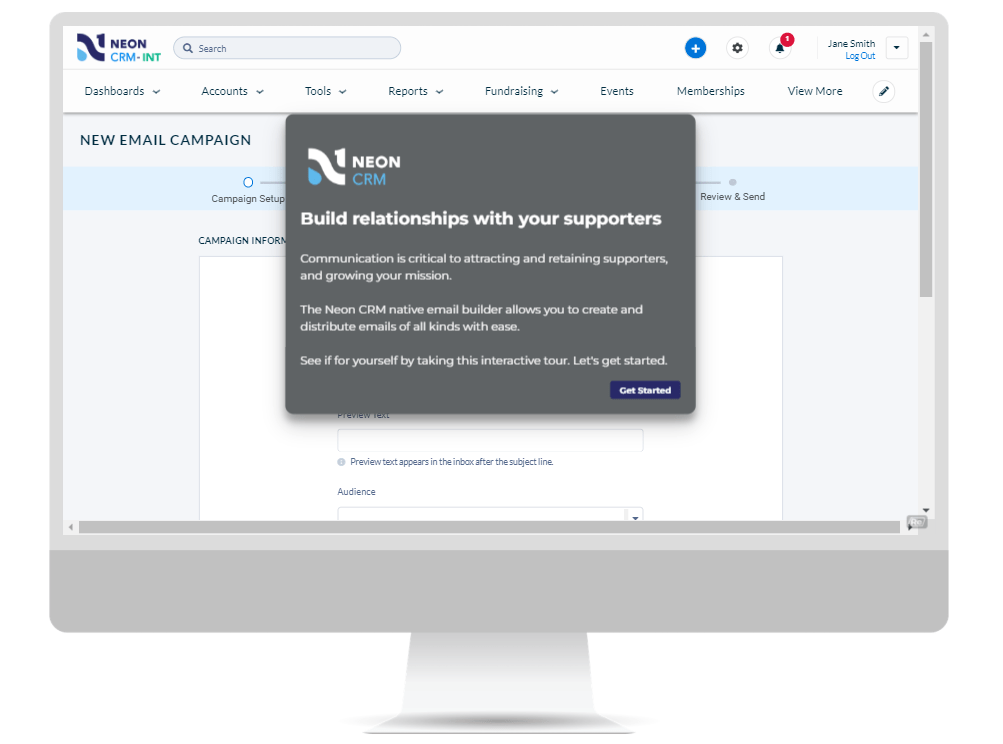
This text was pulled directly from our fundraising email templates, and that example you see above was built using Neon CRM’s email builder. If you’d like a behind-the-scenes peek at the tool in action, take our self-guided tour!
Send Emails That Don’t Get Ignored
Building a stable base of loyal, passionate supporters starts with great communication! With Neon CRM’s integrated email builder, creating compelling, impactful messages is as simple as drag, drop, and send.
Different Campaigns Need Different Emails (4 Examples)
Every fundraising email follows the same structure: tell a compelling story, make a clear ask, and invite your donor into something meaningful. But how you frame that message changes depending on your campaign.
Let’s explore how to write strong, strategic emails for four common scenarios, complete with real examples adapted from our template pack.
Monthly Gifts: Build Something Bigger, Together
Monthly giving programs are more than a donation mechanism—they’re communities of shared commitment. Your email should reflect that by offering a sense of identity and purpose, not just convenience.
Example #2: Monthly Gift Email
Subject Line:
Will you become a Nature Keeper for just $30 a month?
Preview Text:
Your monthly gift can protect local habitats—every single day.
Body Copy:
Hi Sam,
Our monthly supporters—who we call Nature Keepers—are the foundation of everything we do here at the Agloe Nature Center.
Every $30 monthly donation helps maintain a mile of trail, restore native plants, and provide educational programming for kids and families. That means your gift doesn’t just preserve the park today—it helps protect our local environment for generations to come.
Would you consider becoming a Nature Keeper with a monthly gift of $30 today?
[Join the Nature Keepers]
Your support helps us care for these wild places, plan for the future, and inspire more people to fall in love with nature. Thanks for being part of our community.
Stephanie Nguyen
Development Director, Agloe Nature Center
Why This Monthly Gift Email Works
There’s something uniquely powerful about a gift that shows up month after month. This example taps into that quiet consistency—not as a financial convenience, but as a way for donors to deepen their connection and grow their impact over time.
- It creates identity and belonging. Naming your recurring donor program (“Nature Keepers”) transforms giving into group membership. It’s not just “monthly giving,” either—it’s joining the cause.
- It ties small gifts to big, ongoing impact. The $30/month ask isn’t abstract. It provides a concrete, repeatable result—protecting an important habitat. That’s the magic of monthly giving: manageable gifts that feel powerful.
- The language is future-focused. Terms like “maintain,” “restore,” and “protect our local environment” show that monthly donors aren’t funding emergencies—they’re building resilience.
- It leads with gratitude, not desperation. There are no alarm bells here. Just warmth, clarity, and respect. That’s exactly the tone that converts one-time givers into lifelong supporters.
Think of monthly giving as a relationship, not a transaction. You’re inviting someone to be part of an ongoing mission—one that unfolds month by month, impact by impact. When you offer supporters a way to belong to something meaningful and lasting, they’re more likely to stick around for the long haul.
Lapsed Donors: Reignite the Connection
Your lapsed donors gave for a reason, and their stopping their support could be because of any number of reasons. When you ask them to get involved again, use your email to reconnect, not reprimand.
This example rebuilds the bridge with warmth, gratitude, and an invitation to reengage with a cause the reader cares about.
Example #3: Lapsed Donor Email
Subject Line:
We miss you! Here’s what we’ve been up to lately.
Preview Text:
A lot’s been going on!
Body Copy:
Hey Sam,
You’ve played an important role in our work at the Agloe Nature Center, and I wanted to share just a little of what your past support made possible:
In the last year, we restored over 20 acres of native habitat, welcomed more than 500 students to our outdoor education programs, and reopened the wetlands trail after months of conservation work. That’s the kind of impact your gift made possible.
It’s been a little while since we’ve heard from you. But, as we head into a new season of restoration and discovery, we’d love to have your support. A gift of $50 today can help plant pollinator-friendly species, repair storm-damaged trails, and bring more kids into the field.
[Give Today]
Thanks for everything you’ve already done—and for considering helping us do even more.
With gratitude,
Rina Gomez
Programs Manager, Agloe Nature Center
Why This Lapsed Donor Email Works
There’s a fine line between reconnecting and reprimanding. This email walks it well, choosing appreciation over accusation. It reminds past donors what they made possible—then gently opens the door for them to do even more.
- It starts with impact, not absence. The donor isn’t scolded for disappearing. They’re thanked for showing up in the first place. That sets a respectful tone from the very first line.
- The story proves their past support mattered. Specific outcomes (“restored over 20 acres of native habitat”) connect past donations to real, human results. It’s not a guilt trip—it’s a reminder of the fact that their support can make a real difference.
- The tone is personal and forward-looking. Phrases like “we’d love to have you back” and “write the next chapter” keep the energy positive. This email says, “We remember you. We value you. Let’s do more together.”
- The ask is gentle but clear. $50 is a reasonable request tied to a meaningful goal. It doesn’t push—it invites. That’s what unengaged donors need to hear.
You don’t need to win lapsed donors back—you just need to welcome them back. A message rooted in gratitude, not guilt, goes a long way. Many supporters drift simply because life gets busy. Remind them they’re still part of the story, and you may be surprised by how eager they are to rejoin the work.
Pledge Campaign: Invite a Commitment That Lasts
When you ask for a pledge, you’re asking donors to commit—even if they can’t give everything right now. Your email should inspire confidence while lowering the barrier to entry.
This one balances big impact with flexibility.
Example #4: Pledge Appeal Email
Subject Line:
Can you help us restore 100 acres of native habitat?
Preview Text:
Every $500 pledge = one acre protected and replanted.
Body Copy:
Hi Mia,
Our goal is simple: restore 100 acres of native prairie, forest, and wetland habitats right here in Polk County.
Each acre costs about $500 to protect and replant. And, thanks to generous donors like you, we’ve already secured funding for 62 acres. That’s a huge step forward—but we’re not done yet.
Will you help us close the gap? By pledging $500 (or any amount that works for you), you’ll help bring back pollinators, reduce erosion, and make space for native species to thrive.
You don’t have to give all at once—we’ll work with your timeline. What matters most is your commitment to preserving these wild places.
[Make a Pledge]
With gratitude,
Dr. Leslie Tran
Director of Conservation, Agloe Nature Center
Why This Pledge Appeal Email Works
Not every donor can give a large gift right now—but many are eager to commit. That’s the power of a pledge. This example makes space for that generosity by pairing a bold goal with a flexible path to support it.
- It leads with a bold, tangible mission. “Restore 100 acres” is clear, compelling, and highly visual. It’s a goal donors can rally around, not a vague fundraising target.
- Social proof builds trust. Sharing that 62 acres are already funded shows momentum and community support. Donors want to join a winning team, and this is valuable proof that their pledge will help them accomplish that..
- The pledge model is explained with empathy. “We’ll work with your timeline” is great. It removes the most common objection: I can’t afford that all at once.
- It highlights commitment, not just cash. The real ask here isn’t just money—it’s buy-in. That’s a deeper level of engagement. And for many donors, it’s more meaningful than a one-time gift.
Pledge campaigns thrive when donors feel seen. You’re not just asking for a big gift—you’re inviting someone to invest in a shared outcome on their terms. Framing your ask around flexibility and long-term impact turns “I can’t give right now” into “I can be part of this.”
Capital Campaign: Bring the Big Vision to Life
Capital campaigns are your moment to dream big and invite others to dream with you. These emails should mix emotion and urgency with a powerful, place-based story.
This example taps into legacy and momentum to drive action.
Example #5: Capital Campaign Email
Subject Line:
This is big. Will you help us build Agloe’s new nature pavilion?
Preview Text:
We’re creating a space for learning, gathering, and growing. Be part of it.
Body Copy:
Hi Jordan,
The Agloe Nature Pavilion is going to be a game-changer—a four-season hub for outdoor classes, community events, and hands-on conservation work. And, thanks to the generosity of our supporters, construction is already underway.
We’ve raised $2.3 million toward our $3 million goal. Now, we’re reaching out to the community to help bring this space to life.
A gift of $1,000 (or whatever amount is meaningful to you) will help us finish the pavilion in time for next spring’s programming season. From native plant workshops to after-school nature clubs, this space will be a launchpad for environmental education and stewardship.
This community deserves a place where people and nature can connect year-round. Will you help us finish this project?
[Donate to the Campaign]
With excitement and gratitude,
Chris Farrell
Campaign Chair, Agloe Nature Center
Why This Capital Campaign Email Works
Big visions need bold invitations. This email doesn’t tiptoe around the ask—it paints a vivid picture of what’s possible and calls the donor into the center of that story.
- It taps into civic pride and nostalgia. The Nature Pavilion won’t be just a building—it will be part of the community’s identity. The email invites the donor to help bring it to life.
- It builds energy by sharing real progress. Saying “we’ve already raised $2.3M” does more than inform—it inspires. It shows that people are already saying yes. And humans love working together to reach a goal!
- It balances big asks with inclusive language. Yes, the email suggests a $1,000 gift—but follows up with “or whatever amount is meaningful to you.” That invites donors at all levels to contribute to something meaningful.
- The tone is visionary, not transactional. This isn’t a “give us money” email. It’s a rallying cry: “Be part of something lasting.” That’s the emotional core of every successful capital campaign.
Capital campaigns are about legacy, identity, and shared purpose. The more vividly you paint the outcome of your fundraising—and show that the path toward that outcome is already being paved—the easier it is for your supporters to accept your invitation to get involved.
Want Emails Like These Ready to Send?
Everything you just read—plus more examples, more formats, and ready-to-copy templates—is waiting for you in our free fundraising email pack. Whether you’re asking for a one-time gift, a monthly commitment, or a major pledge, these emails are designed to help you start stronger, write faster, and raise more.
Download Your Fundraising Email Templates
Optimize Your Emails for Action—Then Analyze and Improve
Here’s the truth: no fundraising email is perfect. But every email is a chance to learn.
Once you hit send, your real job begins—understanding how your audience responds and using that insight to improve the next message. Think of each email as a mini-experiment, with data guiding the way.
Start by tracking these core metrics:
- Open Rate: This tells you how effective your subject line and preview text were. If this number is low, focus your testing here.
- Click-Through Rate (CTR): This measures how compelling your content and calls to action are. It’s a direct signal of interest in your content and what you’ve asked your reader to do.
- Conversion Rate: Of the people who clicked, how many actually made a gift? This helps you evaluate your landing page and overall ask.
- Average Gift Size: Are your emails prompting meaningful contributions? This metric tells you if your ask amounts are landing well.
Use these numbers to test and iterate. Try a subject line that sparks curiosity, then test one that leads with gratitude. Shift your CTA higher in the layout. Try “Help a Family” instead of “Donate Now.” Small tweaks can make a big difference.
What works for one audience—or one campaign—won’t always work for another. That’s why testing and refining should be baked into your strategy, not treated like an optional extra.
You don’t need perfection to raise more—you just need to be curious, consistent, and willing to adapt. All you have to do is ask the right questions.

Ready to Write Some Amazing Emails?
You’ve seen what goes into a great fundraising email—from the subject line that earns the click to the CTA that inspires action. You’ve seen how different campaigns call for different tones, structures, and stories, and how the right message can turn a casual reader into a committed supporter. (It also gets even easier if you have a nonprofit relationship management platform like Neon CRM that includes multi-channel marketing and communication tools!)
But here’s the good news: you don’t have to build these from scratch.
Our free fundraising email template pack includes everything you need to get started—real examples, fill-in-the-blank structures, and best practices baked in. Whether you’re re-engaging lapsed donors, launching a pledge drive, or inviting monthly support, there’s a proven template ready for you to make your own.