

Nonprofits would be nothing without their communities. They’re made to address community challenges, directly support people in their communities, and are supported by—you guessed it—their community. We can probably all agree that community is at the core of what nonprofits do.
And your community is made up of people. Depending on your size, you may have hundreds, thousands, tens of thousands, or even hundreds of thousands of people in your network who, in one way or another, play a role in your work.
For small nonprofits, trying to manage the many people using spreadsheets or siloed tools is exhausting and often leaves relationships by the wayside. You’re not only running down donor information; you’re running yourself down.
When’s the last time Tom gave a gift? Wait, did Julie attend our gala AND make a donation? What was the name of that lady who showed up to volunteer and had questions about her employer’s donation match program? With bad contact management, trying to hunt down those answers is the ultimate headache.
Then there’s the fact that if you’re managing your contacts poorly, your interactions are going to all be transactional, not relational. And that’s not how generosity thrives (more on that later).
Let’s dig in.
What is Contact Management for Nonprofits?
Nonprofit Contacts
When talking about contact management for nonprofits, a “contact” isn’t just a spreadsheet row (or a profile in your donor management platform); it’s a human being who cares about your mission. It’s a person who is engaged with your work and feels touched by your mission.
Contacts come in all forms:
- The new online donor who gave $10
- The program participant who comes to your tutoring sessions once a week
- The long-time volunteer who logs 100 hours a year
- The board member who advocates tirelessly
- The event attendee who showed up once
- The email subscriber who loves your mission but hasn’t donated yet
- The follower on Instagram who occasionally likes a photo or shares a story
That list could go on and on and on (and on). So when we talk about “managing contacts,” the real challenge becomes getting a full, 360-degree picture of all these relationships—understanding who they are as people, their history, their preferences, and their generosity in all its forms.
If you don’t have the right systems in place (or your system isn’t built with relationships in mind), it will be impossible to foster and grow your community of support in meaningful and impactful ways.
The Basics of Contact Management for Nonprofits
Now, as we noted above, contact management can feel overwhelming, but getting the basics down can make everything you do run—think donor stewardship, making asks, or even email marketing—so much smoother.
To get your foundation down, here are five basic best practices for nonprofit contact management.
5 Best Practices For Contact Management for Nonprofits
1. Use One System to Centralize Your Contacts
If there is one tip you leave with today, it’s this: Make sure all of your contacts are captured in the same place. Contacts live everywhere—a spreadsheet from a gala, your email marketing platform, a volunteer sign-in sheet, or maybe even just in notebooks and sticky notes.
Scattered data means that you’re missing the whole story of a supporter. If you’re missing data, you’re missing out on opportunities to drive deeper engagement and really build relationships with your donors.
If you’re just getting started, a spreadsheet database can work. Ideally, you’d have a full CRM system (like Neon CRM), that can be your one source of truth and unlock some serious potential!

2. Consistency is Key
Data entry has the potential to get messy fast. If people enter data in different ways (St. Paul vs. Saint Paul vs. Saint Paul Church), you end up with duplicate records, which makes it nearly impossible to pull clean lists.
Create a simple style guide that makes sure your team is in alignment on how to enter data. Your guide should make it clear how to handle names, addresses, email, phone numbers, and organization names, at the very least.
It doesn’t have to be a hefty manual, but make sure it’s easy to read and keeps everyone on the same page.
3. Segment Your Lists From the Start
Each of your contacts is unique, and they want to feel special. If you treat every contact the same way, it’s a quick path down the road of generic, uninspiring communication and supporter burnout.
Use tags, groups, or fields to segment your contacts into unique groups based on what they’ve done. Consider grouping donors (first-time, major gifts, recurring), volunteers, event attendees, and lapsed donors, to name a few.
Segmentation allows you to send the right messages to the right people, which ultimately boosts engagement and the likelihood that they stick around.
4. Keep Your Data Clean
People move, change jobs, update emails, or pass away, and having the wrong data can lead to missed communications or awkward outreach. If you’re manually entering all of your data, it’s also easy to have some duplicate records that can cause issues.
Schedule a recurring “data clean-up” block on your calendar to clean up your data. Merge duplicate records. Deactivate or flag any email addresses that don’t work. Update physical addresses and personal information.
Clean data lets you do your work better. Future you will thank the current you for taking the time to keep everything organized!
5. Track Engagement Beyond Just Donations
When you only track donation amounts, you miss out on other types of generosity. A person who volunteers 100 hours a year is just as important as one who makes a medium-sized gift.
You want to make sure that your contact records include and track non-monetary interactions as well. Things like volunteer hours, event attendance, or participation in a peer-to-peer campaign should all be in there.
You can also add a “Notes” or “Activity” section in your tracking to log meaningful personal interactions with your supporter or even specific notes about their communications preferences (“They prefer to receive updates by email.”)
Tracking all forms of engagement allows you to personalize your appeals and communication based on your supporters’ full history, leading to deeper relationships and a stronger sense of loyalty.
Finding the Right Contact Management Platform
With those best practices in mind, you’ll also want to make sure that whatever tools and systems you use are helping you to bring those best practices to life.
As we noted before, you can get started with a spreadsheet, but investing in a true platform that can hit all these best practices and beyond can be well worth it in the long run.
There are a lot of CRMs for nonprofits out there for you to explore, but not all of them will check the boxes. Here are some key features you should look for.
5 Core Features of a Contact Management Platform for Nonprofits
1. A Full View of a Person’s Generosity
As we noted above, your contact records should track engagement in all forms. Did they make a donation? Did they attend an event? Do they regularly volunteer? Did they open the last email? Did they register for the webinar? Your contact management system should capture it all.
2. All Your Management, All in One Place
You shouldn’t have to jump between different platforms to manage the different types of engagement events that you host. Donors, fundraising, events, volunteers, even memberships (if you use them), should all be in one system (like Neon CRM!)
If you’re looking at a platform that relies on third-party add-ons to manage beyond fundraising, you’re not only going to spend more money getting your data and processes all in one place. It’s also going to still be a headache.
3. Communication Tools
Your contact management platform isn’t just a donor list; it sits at the very core of your relationships. When you have communication tools like email and text built into your CRM, you don’t have to move your data around or keep checking back in your records as you send communications.
Having communication tools directly integrated into your CRM allows you to send personalized, relevant messages and also capture exactly how your supporters are reacting and engaging with your communications.
4. Ability to Make Personal Notes
The strongest relationships are built on the smallest details. Your CRM should allow you to capture all of the details that matter the most, and the details that help you remember key important details about your supporter.
You might want to remember bigger things like a divorce to make sure you’re not addressing a note to “Mr. and Mrs.” or you may want to just remember little personal details (e.g., “loves rescue dogs,” mentioned their anniversary in June,” or “had a baby in February”).
5. Automations and Workflows
It may feel counterintuitive to use technology to keep personal touches. But as you grow and your network gets bigger, you’re going to need all the help that you can get to stay on top of things.
Automating things like a thank-you for donating, a reminder about a recurring gift about to expire, or happy birthday notes can provide nice personal touches without adding another task to your to-do list.

Treat Generosity as a Relationship, Not a Transaction
Consider it the golden rule of nonprofit contact management.
When it comes to managing your supporter records, you need the right systems in place, and then from there you should be striving to engage, steward, and celebrate the people who support your work, with relationship building at the absolute center of your strategy.
Why Relationships Matters
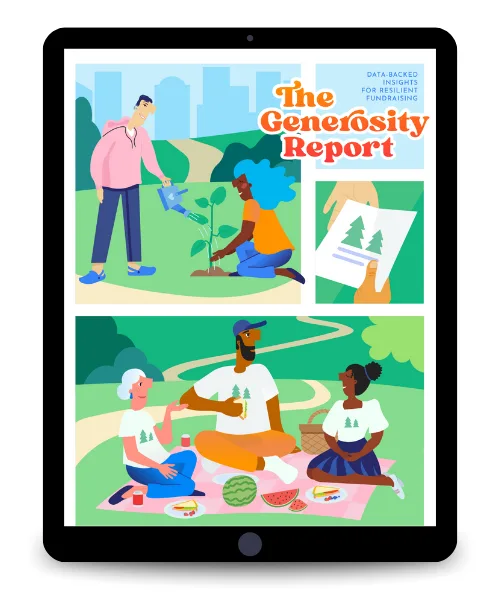
Our annual Generosity Report had one clear takeaway: Long-term donor support is the result of a supporter’s relationship with a nonprofit and their affinity to its cause rather than their inherent capacity to give.
Our research reiterated how generosity shows up in a wide range of ways (volunteering, event attendance, pledgemaking, peer-to-peer participation, membership, recurring gifts). So a one-size-fits-all approach to managing your network isn’t going to cut it.
Your volunteers have a different relationship with you than your membership base. People who raise money for you during peer-to-peer campaigns are different from people who set up recurring gifts. Different forms of generosity influence each other, too.
You’ll want to make sure you are communicating and stewarding your supporters in ways that are unique to the way that they support you. And the right contact management platform (and a relationship-first approach) will help you do that.
Fuel Your Mission: Engage Everyday Donors
Learn actionable strategies to effectively connect with and cultivate the generosity of your everyday supporters—download The Generosity Report now!
5 Tips and Tricks to Put Relationships at the Forefront
With that in mind, your platform should be designed to make relationship-building simple. And you should focus your contact management strategy on putting relationships at the forefront. Here are some tips.
1. Focus on Generosity in All Forms
We’ll say it once and we’ll say it again: don’t limit your view of a supporter to their last financial donation. A relationship-focused approach tracks and celebrates all forms of generosity!
2. Segment Supporters Based on Behavior, Not Just Dollar Amount
We talked about segmentation above, but you’ll want to make sure to segment beyond just donations. Sure, you’ll want to have “first-time donors” or “major gifts,” but you should also group people based on how they engage—volunteering, event attendees, email openers, etc. Behavior segmentation allows you to create an even more tailored message and drive even better engagement.
3. Prioritize the “Thank You” and Follow-Up
Nothing damages a budding relationship faster than transactional silence. Your automated systems should make every thank-you feel personal and prompt. Immediately follow up on any interaction (a donation, a volunteer shift, a survey completion) with a warm, personalized acknowledgment. You could also use automation tools in a CRM to trigger a personalized welcome email series for a new donor, not just a receipt.
Quick, personal gratitude makes the supporter feel seen and appreciated, which is the most critical first step toward building a lasting relationship.
4. Track Soft Data and Personal Notes
The best relationships are personal, and that requires tracking details that go beyond standard fields to track.
We also mentioned this above, but you should use the notes field or activity tracker in your CRM to log things like a supporter’s preferred communication method, their spouse’s name, or a personal anecdote they shared about why your mission matters to them.
When you call them and reference a detail they shared months ago, the communication instantly becomes a genuine conversation, not just a fundraising call.
5. Create Automated Touchpoints to Prevent Relationship Drift
Supporters often fall away not because they stop caring, but because they simply stop hearing from you.
Set up automated workflows that send personalized emails to supporters who haven’t engaged in 6 or 12 months. This could be a simple “We miss you!” email or an invitation to an exclusive mission update webinar.
These touchpoints keep your mission top-of-mind without requiring intensive staff time, effectively warming up the relationship before you make a direct ask.
Neon CRM: Your Ideal Contact Management Platform
We’ve gotten into a lot about nonprofit contact management—so where do we go from here?
As you think about all of the best practices of contact management for nonprofits, key features in CRM platforms, and putting relationships first, I want to close by sharing how all of these things shape our approach here at Neon One.
The Nonprofit Relationship Management Platform
We don’t just call our solution a CRM; it’s a Nonprofit Relationship Management platform.
This isn’t just a buzzword. It reflects the vital understanding that to succeed, you need to recognize generosity in all forms. You need to value the volunteer’s time just as much as a major donor’s check.
Key Contact Management Features
Neon CRM provides the specific tools to turn that relationship-first philosophy into action. Our features put these best practices into action and give you the power to see, serve, and celebrate every person in your community:
- 360° Supporter View: Get a 360° view of every single gift, interaction, and relationship.
- Smart Automation: Use smart automation tools to handle the repetitive, manual tasks—like sending welcome series or event reminders.
- Integrated Tools: Manage your fundraising, events, and volunteers all in one spot, tracking shifts, selling tickets, and communicating instantly from a single source of truth.
- Personalized Communication: Skip the inbox clutter and connect quickly and personally with branded emails and texts sent directly from the platform. Our built-in workflows also ensure timely, relevant outreach.
- Customization Power: Create unlimited custom forms (for donations, surveys, and RSVPs) that are branded and mobile-friendly, taking personalization to the next level by capturing the exact information that you need.
The long story short is that you don’t have to feel overwhelmed by your data. When you switch your mindset from managing contacts to nurturing relationships, your software should make it simple. Ready to see how easy it is to put relationships at the forefront of your mission?
See Neon CRM in Action
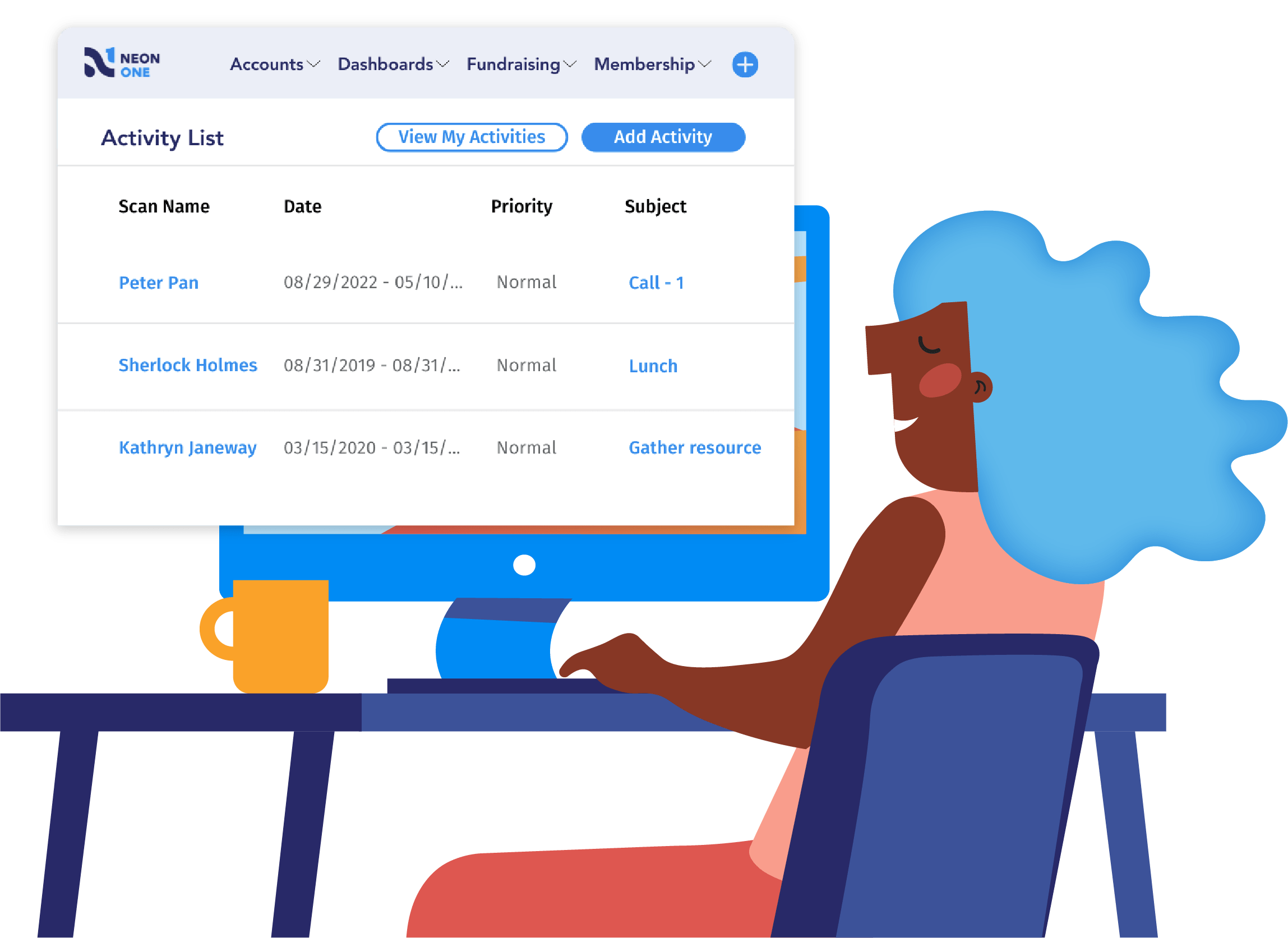
Take this self-guided tour and see how top nonprofits build community, raise more, and save time with a single platform that manages it all!