

— KEY TAKEAWAYS
Starting a nonprofit is, legally, pretty straightforward; building one that succeeds takes hard work, strategic thinking, and strong relationships.
- Before you file anything, ask whether a new nonprofit is the right move. Close to 1.5 million 501(c)(3)s already exist, and fiscal sponsorship or joining an existing board may serve your cause better.
- You can’t start a nonprofit by yourself. Most states require at least three board members to incorporate, and the IRS expects a board made up mostly of people without family or business ties.
- The legal incorporation sequence runs in this order—registered agent, articles of incorporation, EIN, bylaws, and a conflict of interest policy, then Form 1023-EZ or Form 1023 for 501(c)(3) status.
- The legal sequence runs in order—registered agent, articles of incorporation, EIN, bylaws and a conflict of interest policy, then Form 1023-EZ or Form 1023 for 501(c)(3) status.
- Your earliest money comes from you, your network, a fiscal sponsor, or earned income, since most foundations won’t consider you for at least a year.
How many nonprofits do you think there are in the US? Half a million? A million? The answer is actually somewhere close to 1.5 million 501(c)(3) organizations. That’s (get ready for some expert analysis here) a lot!
Every single one of those nonprofits started as just an idea. Or, more accurately, it started as a need. Some problem in a local community or a state or even the country at large that made someone stand up and say, “we’ve gotta fix this.”
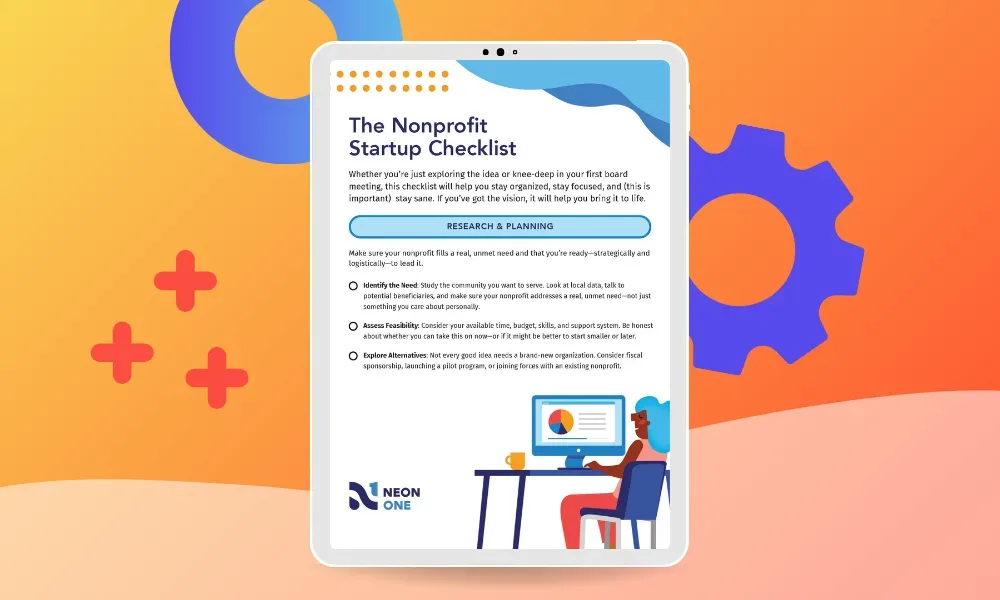
If you’re wondering how to start a nonprofit, that’s probably the stage you’re in right now. You see a problem, you have a solution, and you’re wondering how to make it happen. This guide (and free nonprofit startup checklist!) are here to help you get over that initial hump as you move from inspiration to action.
We’re going to cover important nonprofit operations that run the gamut from how to assess whether your idea fills a real gap, how to incorporate and apply for 501(c)(3) status, how to build your board, and what tech and tools you’ll need, plus about two dozen other things.
On that note, let’s wrap up this intro and dive right in!
Table of Contents:
- Starting a Nonprofit FAQs
- TL;DR, or How to Start a Nonprofit in 7 Easy Steps
- Is Starting a Nonprofit Right for You?
- Building Your Nonprofit’s Identity
- Creating a Nonprofit Board That Leads—and Lasts
- Securing Initial Funding for Your Org
- Legally Incorporating Your Nonprofit: Step-by-Step
- You’ve Officially Launched Your Nonprofit. Now What?
- You’re Ready to Start. Use This Checklist to Stay on Track.
Starting a Nonprofit FAQs
Got questions? You’re in good company. Here are some of the most common things people wonder about starting a nonprofit.
A nonprofit is an organization created to serve a community or advance a mission, not to make profits for owners or shareholders. Any money left over after expenses is reinvested into the organization’s work.
Tax-exempt status is granted to nonprofits that meet IRS requirements for structure, purpose, and compliance. The most common path is 501(c)(3), which covers public charities. You’ll need to show that your work serves a qualifying purpose and commit to financial transparency and governance standards going forward.
To get 501(c)(3) tax-exempt status, your organization must be set up and operated for charitable, religious, scientific, literary, or educational purposes. You can’t benefit private individuals, can’t endorse political candidates, and must limit lobbying. Once approved, you’ll need to file a Form 990 annually to stay in good standing.
After you apply, the IRS will send a determination letter if you’re approved. You can also track the status of your application on the IRS website.
Not quite. You’ll need a board of directors—usually at least three people—to meet legal requirements and act as your governing body. Even if you’re the founder, you can’t go it alone on paper.
It depends. Incorporating at the state level can be quick, but applying for federal tax-exempt status takes longer. If you qualify for the streamlined 1023-EZ form, you might get approved in a few weeks. If you file the full 1023, it could take several months or more.
Sort of. You don’t need a huge budget to start a nonprofit, but you will need some funds to cover required fees like incorporation, 501(c)(3) filing, and basic startup costs. Many founders start small with support from their personal network, a fiscal sponsor, or their own savings.
Yes. Nonprofit staff, including founders, can (and should!) be paid a fair salary for their work. The key is that compensation has to be reasonable, and any surplus revenue goes back into the mission, not into anyone’s pocket.
Definitely. If you’re not ready to incorporate, consider volunteering, donating, or fundraising for an existing organization. You might also explore launching a local chapter of a national nonprofit or offering your skills as a consultant or board member.
STEP BY STEP
TL;DR, or How to Start a Nonprofit in 7 Easy Steps
- Define Your Mission & Recruit a Board of Directors Before you can file any kind of paperwork, you’ll need a clear mission and a board of directors, which is typically a minimum of three unrelated individuals (as in, not members of the same family). Your board is your legal governing body. Even if you’re the founder, you can’t run a nonprofit solo on paper.
- File Articles of Incorporation This is your nonprofit’s birth certificate. Filing articles of incorporation with your state creates your legal entity and allows you to reserve your name, limit liability, and set the stage for tax exemption. Requirements vary by state, but you’ll generally need to list your organization’s name, purpose, registered agent, and incorporators.
- Get an Employer Identification Number (EIN) Even if you don’t plan to hire anyone immediately, your nonprofit needs an EIN from the IRS. It’s free, and you can apply online in minutes. This number is required to open a bank account, file taxes, and apply for 501(c)(3) status.
- Create Bylaws & Conflict of Interest Policy Bylaws spell out how your board operates, how decisions are made, how officers are elected, and how conflicts are handled. You’ll also need a conflict of interest policy that requires board members to disclose and recuse themselves from any personal or financial conflicts. These documents should be formally adopted at your first board meeting and will need to be submitted with your IRS application.
- Apply for 501(c)(3) Tax-Exempt Status Once your nonprofit is incorporated, has an EIN, and has adopted bylaws, you can apply for federal tax exemption. You’ll either file Form 1023-EZ (if your organization is small and meets certain criteria) or Form 1023 (a longer, more detailed application). You’ll pay a fee and wait several weeks to several months for IRS review. Once approved, you’ll receive a determination letter confirming your status.
- Register for State Tax Exemption & Charitable Solicitation Federal tax exemption doesn’t automatically cover you at the state level. Depending on your state, you may need to file additional forms to qualify for charitable solicitation (even if you’re only raising funds online) as well as sales tax or state income tax exemptions.
- Set Up Your Record-Keeping Systems Compliance doesn’t stop once you’re approved. From day one, you’ll want to keep clean, organized records of your finances, board meetings, governing documents, and any state or federal filings.
Pro tip: When filing your articles of incorporation, be sure to include the specific language the IRS requires for 501(c)(3) status—your state might not tell you, but missing it can delay your tax-exempt application.
Is Starting a Nonprofit Right for You?
Before you file paperwork, before you dream up a logo, before you even buy the domain—stop. Ask yourself one essential question: Is starting a new nonprofit the right move?
Take a step back for a moment and explore the following questions around need, feasibility, and fit.
After all, there are more than 1.5 million nonprofits in the United States. There’s a chance that starting a new one isn’t the best way for you to make a difference.
Question #1: What’s the Need?
Your cause might be deeply personal, but your nonprofit’s success depends on identifying a measurable, unmet need in the community you aim to serve.
Start by gathering hard data. Are there underserved populations, geographic gaps in service, or recurring public issues that show up in local reports? Next, take a qualitative approach. Talk to people in the community you hope to help and ask them what they actually want or need.
Finally, see if anyone else is currently addressing this problem, whether that group is nonprofit, government, or for-profit, and determine how their approach compares to your own. Maybe it’s worse, but it could be better, too.
Question #2: Is This Feasible?
Once you’ve determined that there is, in fact, an existing need that isn’t being served, you need to make the case for why your organization is the one to address it. Examine the three following factors:
- Cost: The cost of incorporation varies by state, but you’ll likely spend several hundred dollars on paperwork alone. Add to that any software, hardware, web hosting, legal consultation, or marketing you might need to get off the ground.
- People: After all, you’re not going to be able to do this alone. Literally. Most states require at least three board members to file for incorporation. You don’t want to pick just anyone, either. It’s usually smart to choose folks whose skills and connections make up for gaps in your own.
- Bandwidth: As for you, running a new nonprofit is like being Ginger Rogers: You’re not just doing the dance, but you’re doing it backwards and in heels. You have the passion, yes, but do you actually have the bandwidth to do this?
You’ve already determined that your idea is good. Feasibility is about whether it’s actually possible right now for you to turn that idea into something real.
Question #3: Are There Better Alternatives?
Even if you answer questions one or two in the affirmative, it’s always good to look at all the choices available to you. Sometimes, you’ll find one that’s just a better fit than starting your own 501(c)(3):
Here are some of the best ones:
- Donate to or volunteer with existing nonprofits.
- Fundraise independently for a cause you believe in.
- Start a local chapter or affiliate of a national organization.
- Partner with a fiscal sponsor to pilot your project.
- Join an existing board or staff team.
- If you have a unique skill set, offer free consulting to local groups.
Starting a nonprofit is one way to make a difference, but it’s not the only way. Going through this process will help you find the path that best serves your cause.

Looking for Better, Safer Ways to Use AI?
The AI Xchange, by Neon One, is a resource hub that helps you use AI efficiently and safely—so you save time without risking donor trust.
Building Your Nonprofit’s Identity
Before you apply for tax-exempt status or launch a fundraising campaign, take the time to define your organization’s identity. It will help you take that crucial step from a nonprofit on paper to a nonprofit in your community.
Mission & Vision Statements
Your mission statement is your organization’s true north. It’s the one constant that explains why you exist, what you do, and who you serve. The best mission statements are short, digestible, and practical enough to guide decision-making.
If you’re stuck, start with this formula: We [do what] for [whom] in order to [achieve what].
If your mission is your “what,” your vision is your “why.” A good vision statement paints a picture of what the world would look like if your nonprofit achieved its goals. Think one or two sentences max and avoid abstraction. “A future where every child reads at grade level by third grade” is better than “A more equitable tomorrow.”
Core Values
Your values shape how you work, not just what you work on. These guiding principles should reflect the ethics and behaviors you want your organization to embody.
You don’t need a dozen. Start with three to five. Choose words that matter to you and define what they mean in practice. “Equity” means different things to different people. If it’s one of your values, spell it out.
Name & Visual Brand Elements
Picking a name for your nonprofit is an early, critical fork in the road. Pick a decent one and you’re fine. Pick a bad one and it could send you wildly off course. You want something that’s easy to remember, clearly tied to your mission, and (this is very important) not already taken.
Do a thorough check through your state’s Secretary of State business registry and do a Google sweep. Look for a name for which you can snag any associated .org domains and social handles.
Next, think about your visual identity. You don’t need to hire an agency, but you do need consistency. Start simple:
- A logo that works both in color and in black and white.
- A color palette with 2–3 core shades.
- A readable font pairing.
You can build these using tools like Canva and … oh, just use Canva. What matters most is coherence across your website, emails, signage, and printed materials. That’s how you build your nonprofit’s brand.
Business Plan
You may not be in this for the money (if you are, oh no), but you need a nonprofit business plan all the same. It will help you think through how your organization will function and show potential funders, board members, and partners that you’re building something that can last.
Here’s what to include:
- Executive Summary: A few quick paragraphs that summarize who you are, what you do, and why it matters.
- Programs and Services: Describe the need you’re addressing, the people you serve, and the value you provide.
Market Analysis: Who else is in your space? What are your strengths, weaknesses, opportunities, and threats? - Marketing Plan: Who are you trying to reach? How will you engage them?
- Operational Plan: Map out location plans, equipment needs, and staff and volunteer roles (even if it’s just you for now).
- Impact Plan: Describe your goals, the resources you’ll need, and the ways you’ll track and report success.
- Fundraising Strategy & Financial Plan: Talk about where your funding will come from (grants, individual donors, events, etc.) as well as your initial budget.
Don’t let this list intimidate you. You don’t have to have every little detail figured out on day one. But sketching out your plan will give you (and your board) clarity, confidence, and a roadmap to build on.

How to Create a Winning Nonprofit Business Plan (+ Free Template)
Creating a Nonprofit’s Board That Leads—and Lasts
A nonprofit is more than just a group of people coming together to support a common cause; it’s a legal entity with real responsibilities. That’s why every nonprofit organization has to have a board of directors: to make sure those responsibilities are upheld.
Going one layer deeper, beneath the fiduciary realities, your nonprofit’s board is your governing body, your inner circle, and your reality check. These are the people who will support your vision, ask the hard questions, and help ensure that your organization is built to last.
A great board doesn’t have to be filled with high-profile names. It needs people who care about your cause, bring a mix of skills, and are willing to roll up their sleeves to get things done.
What the Board Does
By law, the board governs your nonprofit. That means overseeing finances, approving major decisions, and ensuring your organization is operating in line with its mission.
But a strong board does more than vote on bylaws and budgets. They contribute their time, expertise, and often their own money. They help raise funds, build partnerships, offer legal or financial insight, and bring community credibility to your work.
QUICK ANSWER
Can I start a nonprofit by myself?
You can’t start a nonprofit by yourself, at least not on paper: most states require a minimum of three board members to file for incorporation, and the IRS expects your board to consist mostly of people who don’t have existing family or business ties. You can be the founder and still need a governing body.
Your board is your legal governing body, not a formality. By law it governs the nonprofit, which means overseeing finances, approving major decisions, and making sure the organization operates in line with its mission. A strong board does more than vote on bylaws and budgets. Board members contribute their time, expertise, and often their own money, and they help raise funds, build partnerships, and bring community credibility to your work.
Key distinction: The three-person minimum isn’t a box you fill with relatives and close friends. Because the IRS expects a board made up mostly of people without existing family or business ties, your founding board has to be a genuine group of outsiders. Choose folks whose skills and connections make up for gaps in your own, and above all, people who will actually show up.
Who Should Be on the Board?
Most states require a minimum of three board members to incorporate as a nonprofit, and the IRS expects your board to consist mostly of people who don’t have existing family or business ties.
As you build your founding board, look for a mix of talents and perspectives: someone with fundraising experience, another with finance or legal experience, and hopefully a person who’s connected to the community you’re serving.
And most importantly, people who will show up. That starts with showing up to meetings, but it also means helping build momentum behind the scenes. If you’re not sure where to find the right folks, start with people you know and ask for referrals.
Setting Expectations From Day One
Once someone says “yes,” don’t just hand them a meeting schedule and hope for the best. Set them up to succeed by setting clear expectations.
Every board member should know what’s expected of them—how long their term lasts, how many meetings they’re expected to attend, whether they’re expected to donate or fundraise, and what kind of time commitment they’re signing up for.
A simple board agreement can go a long way in aligning expectations and avoiding confusion later.
Orientation Matters
Treat a new board member like any other person who’s new to your organization.
Give them an orientation that includes your mission and vision, your bylaws, your budget, and your big-picture goals. Introduce them to staff (if you have any), pair them with a more experienced board member to show them the ropes, and make space for questions.
It doesn’t have to be fancy. A one-on-one meeting, a board buddy system, and a short welcome session with some snacks can do the trick. What matters most is that they feel informed and included.

How to Create a Nonprofit Board of Directors (+ Free Checklist)
Securing Initial Funding for Your Org
Every nonprofit, no matter the cause or the urgency, needs money to get started. Incorporation fees, IRS filings, marketing materials, a basic website—none of it happens for free.
You don’t need a giant pile of money to launch your org—if you do, rock on—but you do need a realistic plan to cover your early expenses.
Nailing this stage of the launch has knock-on benefits beyond paying some fees and bills: It builds critical credibility with potential funders and supporters by showing that your organization can sustain itself.
Understanding Startup Costs
Before you start asking for support, take time to map out your expected costs. What exactly will you need to pay for in your first three to six months?
Typical early expenses include:
- Incorporation fees for your state (often $50–$150)
- IRS application fees for tax-exempt status (ranging from $275 to $600+)
- Charitable solicitation registration in states where you plan to fundraise
- Software tools like donor databases, email platforms, and payment processors
- Marketing and branding materials, including a website, logo, and social media setup
- Basic operational costs, like a bank account, workspace, and even office supplies.
You don’t need every penny accounted for on day one (that’s a basic refrain we’ll keep hitting throughout this piece). You just need to be honest about what it takes to operate responsibly.
QUICK ANSWER
How much does it cost to start a nonprofit?
How much it costs to start a nonprofit comes down mostly to two required fees: state incorporation, which often runs $50 to $150, and the IRS application for 501(c)(3) tax-exempt status, which costs $275 for the streamlined Form 1023-EZ or $600 and up for the full Form 1023. Expect to spend several hundred dollars on paperwork alone.
Those two fees are the floor for what you’ll pay; you should budget for more. Map out what you’ll need to pay for across your first three to six months: charitable solicitation registration in every state where you plan to fundraise, software tools like donor databases, email platforms, and payment processors, marketing and branding materials including a website and logo, and basic operational costs like a bank account, workspace, and office supplies.
Which IRS form you qualify for matters here too, since Form 1023-EZ is limited to organizations with gross receipts under $50,000 and assets under $250,000.
Key distinction: Most new nonprofits don’t cover these costs with grant money. Foundations typically require a proven track record and won’t consider applications until you’ve been operating for at least a year, so your startup funds will almost certainly come from your own pocket, your personal network, a fiscal sponsor, or earned income.
Where Early Funds Come From
Most new nonprofits don’t start with money from grants. That’s because foundations typically require a proven track record, and most won’t consider applications until you’ve been operating for at least a year.
These early funds are, almost certainly, going to need to come from people who believe in you and your cause. Here are four of the most common sources for nonprofit startup funds:
- You: Many founders begin by investing a small amount of their own money. This is often unavoidable given the many difficulties of raising funds when you’re a brand-new organization. If you choose this option, it’s a good idea to pair it with the next one.
- Your Personal Network: Family, friends, and professional connections are often your earliest champions. When asking for their support, don’t take them for granted: explain exactly what the money will be used for, keep detailed records, and say thank you—early and often.
- Fiscal Sponsorship: This is an established nonprofit that agrees to accept donations and/or process grants on your behalf while you’re getting up and running. Most fiscal sponsors charge an administrative fee, but you gain credibility in return.
- Earned Income: Many organizations begin generating revenue by charging small fees for services, selling branded merchandise, or hosting workshops and events. Just be sure to track this income carefully. It can affect your tax filings, even during the pre-exempt phase.
Lastly, some founders explore personal loans, microloans, or support from community development financial institutions (CDFIs) to cover short-term startup costs. But if you find yourself in the “taking out loans” phase of starting your nonprofit, it might be time to return to the three questions at the beginning of this article, particularly the one about “feasibility.”

Legally Incorporating Your Nonprofit
Once you’ve laid the groundwork for your nonprofit’s mission and structure, it’s time to make it official. But, unlike marriage, which is pretty light on the paperwork, incorporating a nonprofit is a multi-step legal process at both the state and federal levels.
It’s annoying, sure, but these are the boxes you need to check—all of which are genuinely important—to become a registered 501(c)(3). Here’s what you need to know to get this all done as quickly and efficiently as possible, with no do-overs in sight.
STEP BY STEP
How do you legally incorporate a nonprofit?
- Appoint a registered agent. Every state requires your organization to name a registered agent, the person or business responsible for receiving legal documents on the nonprofit’s behalf. It can be a staff member, a board member, or a commercial registered agent service. What matters is that they have a physical address in the state and are consistently available during business hours. If you plan to operate in multiple states, you’ll need a registered agent in each.
- File your articles of incorporation. Filing with your state’s Secretary of State office is how you become an official nonprofit corporation. Requirements vary, but most states ask for your organization’s legal name, the name and address of your registered agent, a physical address for your organization, a statement of purpose that aligns with IRS charitable guidelines for 501(c)(3) orgs, and the signature of the incorporator.
- Get an Employer Identification Number (EIN). Your EIN is your organization’s federal ID number, and the IRS requires one to open a bank account, file taxes, or apply for 501(c)(3) status, even if you have no employees. You can apply for free using Form SS-4, online, by mail, or by fax. You’ll need your nonprofit’s legal name, physical address, and the name and Social Security number of the person applying on behalf of the organization.
- Adopt bylaws and hold your first board meeting. Your bylaws are the internal rules that govern your nonprofit, covering how decisions get made, how board members are elected and removed, how long terms last, and how meetings are run. Once your board is assembled, hold your first official meeting to adopt the bylaws, elect officers, and approve a conflict of interest policy. Both documents are required as part of your IRS application, so don’t skip or rush this step.
- Apply for 501(c)(3) status. Incorporating and getting tax-exempt status are two separate steps, and this second one is the longest part of starting a nonprofit. You’ll file either Form 1023-EZ, the streamlined version for organizations with gross receipts under $50,000 and assets under $250,000, or the standard Form 1023. Form 1023-EZ has a $275 fee and can be approved in a few weeks or months; Form 1023 costs $600+ and takes longer, sometimes up to a year. If approved, you’ll receive a determination letter confirming your status.
- Apply for state tax exemptions. Federal tax exemption doesn’t automatically make you exempt from state income, sales, or use taxes. Some states accept your IRS determination letter as sufficient, while others require a separate application through the state’s Department of Revenue. Check the rules in any state where you’ll operate, fundraise, or do business.
- Register to fundraise. If you plan to ask the public for donations, whether through events, mailings, online campaigns, or even a “donate” button on your website, you’ll likely need to register for charitable solicitation in your home state and any other state where you solicit. 40 states have registration requirements, 41 if you count Washington, D.C. Some ask for financial reports, most require annual renewal, and raffles or games of chance may need additional licenses.
Pro tip: You can navigate all of this on your own, but mistakes cost time and money. If your budget allows, have a consultant, attorney, or CPA with nonprofit expertise review your incorporation documents or IRS application once before you file. It’s also worth looking for organizations in your area that offer free or low-cost support to nonprofits.
You’ve Officially Launched Your Nonprofit. Now What?
If all you want to know is the strict step-by-step legal process needed to found your nonprofit, you can stop reading here. By following the advice we’ve laid out in this article so far, you’ll be able to incorporate your org, register as a 501(c)(3), and file the paperwork to fundraise. You’re good to go!
But there’s so much more to starting a nonprofit than the pre-launch, planning, and legal paperwork. If you want some more insights into all those early-stage decisions that nonprofit founders face after they’ve incorporated, read on.
Build Your Organization
Now that your nonprofit is officially up and running, it’s time to turn your attention to how the work will get done. That means hiring your first team members, choosing the right tools to manage operations, and figuring out where you’ll physically (or virtually) work.
Here are some insights into all three of those:
- Hiring Your First Team Members: Begin by identifying which roles are essential to your first year of programming and fundraising beyond what you, as the founder, can handle. Do you need someone to manage donor relationships, oversee a member base, or run events or marketing campaigns? Think through issues like role type—part-time, full-time, contractor, salaried, hourly—what benefits you can offer, registrations required in your state (unemployment insurance, payroll tax), and, finally, performance expectations and metrics. For all new hires, having a clear title, documented responsibilities, and a basic employee handbook can make a big difference.
- Setting Up Your (Physical or Virtual) Office: If you need physical space, start with what’s low-cost or free. Ask a partner organization if they can share office space or look into coworking facilities with nonprofit discounts. Many local community centers or libraries offer rooms you can use for meetings or events. If you’re operating remotely, be sure to document your systems for communication, file sharing, and collaboration. Tools like Slack and Google Workspace (which includes Docs, Sheets, and Meet) can help create a sense of structure and consistency, even if your team never shares a physical room.
- Choosing the Right Software Tools: The most common tech tools that early nonprofits need are ones that can handle donations, contact management, accounting, websites, and email. Event registration is also important for some orgs. You can stitch many of these functions together using free or low-cost tools like Google Workspace, Mailchimp, QuickBooks, Wix, etc., but there will still be a lot of headaches to manage, specifically when syncing data between these systems. More robust donor management software will cost more, but if it’s the right system, one that you can grow with, it might be the right move.
All three of those decisions are tricky, especially because there’s no one-size-fits-all solution. Your nonprofit is unique; your mission and your programs and your funding situation are all unique as well. While some best practices apply across the board (employee handbooks, syncing data, encouraging collaboration), most of the specifics will vary from org to org.
One piece of advice that we can offer with certainty is that getting your brand and fundraising capabilities on their feet quickly and confidently is a great first step towards building sustainable revenue that your mission needs to thrive.
Maintain Compliance
Staying compliant with federal and state regulations is an ongoing part of running a nonprofit. It’s not glamorous work, but it’s essential. After all, maintaining your legal status ensures your organization can keep fundraising, remain tax-exempt, and continue delivering on its mission without disruption.
Here are some of the most important things your nonprofit will do to maintain compliance:
- Maintain Your Federal Tax-Exempt Status: Your 501(c)(3) status never expires, but it can be revoked if you fail to meet the IRS’s ongoing requirements. The most important piece is filing your annual return. All tax-exempt nonprofits must file some version of Form 990, which reports your financials, activities, and leadership. If your revenue is under $50,000, you’ll file the simple 990-N e-postcard; if you’re above that threshold, you’ll file Form 990-EZ or Form 990, depending on your size. Missing your filing for three consecutive years will automatically result in your nonprofit losing its tax-exempt status. Reinstatement is possible, but it’s time-consuming and expensive.
- Keep Up with State-Level Tax Exemption: Each state has its own set of rules for nonprofit tax status. Some automatically grant an exemption based on your IRS determination letter, while others require you to submit a separate application or renew your exemption every few years. You’ll also need to stay current with any required state tax filings, which often differ from your federal 990. Even if you’re not paying taxes, failing to file can lead to penalties or loss of exemption at the state level. Double-check requirements with your state’s Department of Revenue and calendar any renewals so they don’t sneak up on you.
- Renew Charitable Solicitation & Corporate Registrations: If you registered to solicit donations in your home state—or other states where you fundraise—you’ll likely need to renew that registration annually. These renewals often require basic financial reporting and updated contact information. Similarly, if you registered your nonprofit as a foreign corporation in another state (due to having staff, offices, or regular activity there), you’ll need to maintain that registration as well. Stay organized by keeping a renewal calendar with state-specific deadlines, and designate someone on your team or board to manage compliance tasks regularly.
- Keep Good Records: Good compliance means good systems. Organized records make tax filings, grant applications, and board oversight much easier. At a minimum, maintain financial records, including income, expenses, and receipts; board meeting minutes, including votes and decisions; up-to-date copies of your bylaws, conflict of interest policy, and IRS filings. If you ever get audited, apply for a large grant, or bring on new board members, you’ll be glad you didn’t have to dig through a digital junk drawer.
- Operate in Line with Your Bylaws: Your bylaws are your governing document. Following them protects your board and your organization legally. Make sure meeting frequency, officer elections, term limits, and voting procedures are followed as written. If your operations shift over time, update your bylaws to reflect those changes through a formal vote.
Finally, know when to bring in an expert. If you’re unsure about your obligations—or seriously pressed for time—it’s worth consulting a CPA or nonprofit compliance expert. A single hour of guidance might save you from months of stress and a missed deadline that puts your status at risk.
Plan for Growth
Now that your nonprofit is up and running, you can turn your attention to the challenges of building momentum, earning trust, raising funds, and delivering on your mission in a way that lasts.
You know, the easy stuff.
To help simplify things, you can take all those different initiatives and place them under a single strategic heading: Growth. If the goal is to broaden your impact, expand your programs, raise more money, and bring more supporters into your tent, here are the four main things that will help you do that:
- Marketing Your Mission: This is how you connect with the public, build relationships, and invite people into your work. In these early days, focus on a few key channels where your audience already spends time. Namely, you should be using social media to tell stories and celebrate impact; keeping your website updated with clear donation and volunteer opportunities, sending regular emails with updates, wins, and ways to get involved, and attending or hosting local events to meet people face-to-face.
- Building Community Support: When it comes to building support, prioritize relationships, not money. If you look at your first donors and volunteers as just transactions, they won’t stick around for long. Start with seed money and use your marketing efforts to expand that circle of support. The goal here is to build a base of people who care about your work and want to see it succeed. Nurture that community by keeping them updated and always (always!) saying “thank you.” Keep them engaged by inviting them to participate in meaningful ways.
- Developing Fundraising: Focus first on building a reliable base of small and mid-level donations. As you grow, diversify your revenue streams. Consider things like individual donations (one-time and recurring), memberships, ticketed events, peer-to-peer fundraisers, online campaigns (maybe even crowdfunding), corporate sponsorships, and—eventually—grants. And don’t forget your board, either. Members should be active participants in your fundraising strategy by giving personally as well as making both introductions and appeals.
- Planning for Scalability: As you grow, the systems you set up early will either support or hinder you. That’s why it’s smart to build with scale in mind. Donor management software can help you keep clean records, identify trends, and manage a growing supporter base. Organized data now makes expansion possible later.
Growth doesn’t happen overnight. It’s the result of consistent effort, smart systems, and a strong community around your cause. Start now, and your future self, five years from now, will thank you.
Your action guide to build relationships that drive growth.
In this playbook, we’ll dive into insights that can help and simple steps you can take to start putting relationships first in your day-to-day work.
You’re Ready to Start. Use This Checklist to Stay on Track.
Starting a nonprofit is, legally, pretty straightforward. But starting a nonprofit that’s actually going to be successful takes a lot of hard work, strategic thinking, and the ability to build strong relationships. There’s a whole bunch of information you’re going to have to keep straight in your head all at once. That’s not easy!
But we can make it a little easier. Download our free nonprofit startup checklist, and you’ll have a handy, streamlined guide that hits all the major points without getting you too bogged down in the details. It will help you stay focused on your mission instead of that state application deadline you can’t remember if you missed.
Click the button below to download the checklist for free. Good luck! We’re rooting for you!

Author Bio
Alex Huntsberger, Content Marketing Manager
Alex Huntsberger is Content Marketing Manager at Neon One, where he brings his expertise in nonprofit fundraising, events, and memberships to the Neon One blog. Alex has spent over a decade as a content writer, search marketer, and communications pro. He’s also an experienced theater critic and arts writer, having covered plays and musicals across Chicagoland since 2010 for the Chicago Sun-Times, Time Out Chicago, and Newcity Stage. Like every other liberal arts grad in the Chicago area, Alex once worked for Groupon. He currently lives in Mundelein, IL, with his wife and their two children.