

Do you read the Fundraising Effectiveness Project’s (FEP) quarterly reports? You can think of them as a report card for the entire nonprofit sector. Every quarter, FEP compiles data from a huge panel of organizations across multiple fundraising platforms and explores trends around the same three questions:
- How much money came in?
- How many donors gave it?
- How well are nonprofits retaining donors?
The Q1 2026 report just came out, and it’s got some interesting findings. Something to keep in mind: this report is from Q1 2026, and year-over-year changes are based on the numbers from Q1 2025. In it, we find that some trends are heading in the right direction. Others signal that it’s time for nonprofits to double down on a few key strategies.
Here are the high points, and what they actually mean for your organization.
What Happened With Total Dollars Raised?
Total giving grew 4.3% year-over-year in Q1 2026. This is good news—it means that nonprofits have more funding they can use to support the work they’re doing in their community.
But there’s a larger trend to pay attention to. That 4.3% growth was smaller than the 5.4% YOY growth we saw in Q1 2025 and a much bigger step down from 10.4% growth in Q1 2024. Growth is still happening, but it’s slowing down.
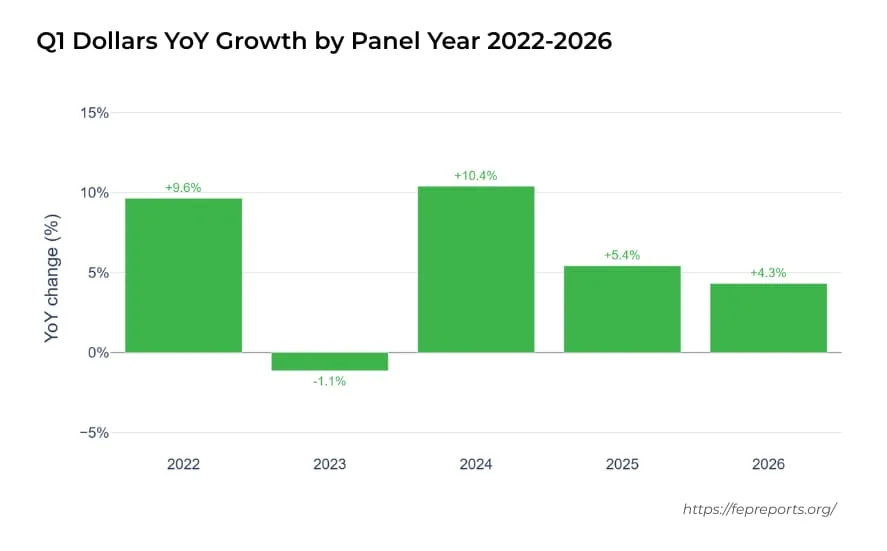
Another thing to keep in mind is that part of this quarter’s growth may be attributable to timing. Some of the exceptional fundraising results we saw in late 2025 probably came from donors accelerating their gifts ahead of anticipated tax law changes. That means that some of those December donors gave because they wanted to make a gift before recent adjustments to tax deductions took effect. That means part of last year’s momentum may be borrowed from this year.
What It Means
If you’ve had great fundraising results lately, that’s something to celebrate. Just don’t get too comfy. Some of those results, both in 2025 and during the beginning of this year, may be due to the tax law changes mentioned above.
The second half of 2026 could be a little trickier. The report says as much directly: prepare for the back half of the year now, so you don’t have to scramble later.
This isn’t to say you need to panic. That’s not the case. But you do need to take steps to engage your donors now. Don’t wait until the end-of-year fundraising season to start.

What Happened With Donors?
Donor count fell 0.8% year-over-year in Q1 2026. That’s a decline, but there’s a silver lining; that decline is a much smaller one than the 2.3% drop the sector saw in Q1 2025.
The slowdown is due to a couple of interesting trends. Existing donors are giving again—a positive thing, and one we’ll touch on in a minute—while new donor acquisition kept dropping.
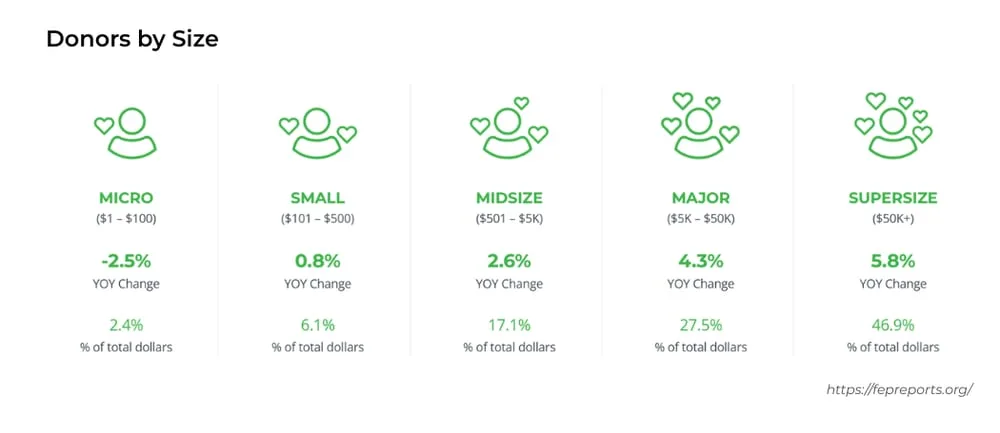
Growth also happened across giving tiers: donor counts rose across small ($101-$500 in annual giving), midsize ($501-$5,000), major ($5,000-$50,000), and supersize (>$50,000) donors this quarter. Micro donors ($1-$100) still declined.
What It Means
That slowing decline is good news, but it isn’t the same as growth. The FEP report calls this “a plateau, not yet a turnaround.” That distinction matters when you’re reading your own numbers.
If your active donor count looks flat in Q1, you’re in good company—that was a sector-wide trend. But, if you’re like most organizations, that stability is coming entirely from donors who already knew you, not from anyone new. Donor acquisition rates were low, and focusing on changing that trend is going to be key for fundraisers.

What Happened With Retention?
Retention was flat at 18.0% this quarter. That’s better than it dropping, but this is a slow continuation of a drift from 2024’s high of 18.2%.
That flatness doesn’t necessarily mean that donor bases are especially stable. Donor retention rates actually fell for small, midsize, major, and supersize donors during the beginning of the year.
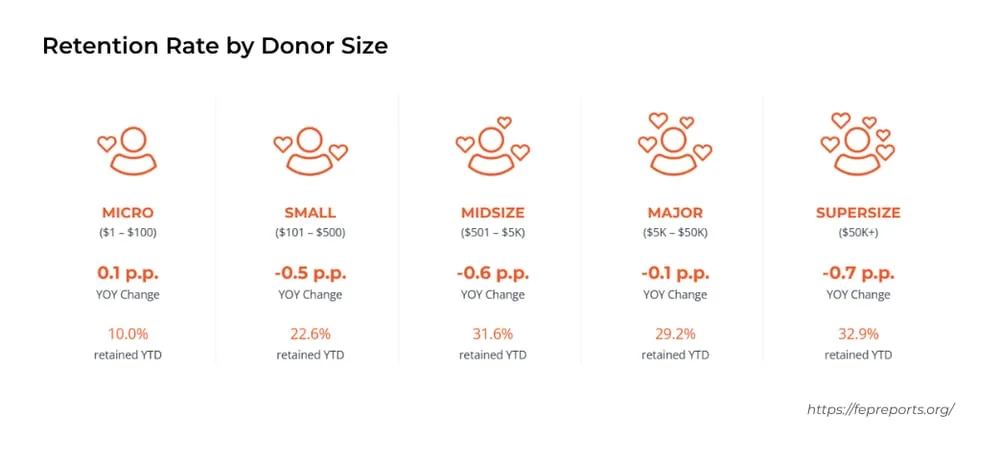
Only retention rates among micro donors actually improved by 0.1 percentage points. Since micro donors are by far the largest donor group (they make up 57% of all supporters), they skew the trends a little bit.

What It Means
The same donor tiers that drove increased revenue in Q1 are the ones who are quietly disengaging from supporting traditional nonprofits. Imagine the donor pyramid: micro donors are the base of the pyramid—they’re the largest donor group. They’re being retained, but new ones aren’t joining. At the same time, donor groups that are smaller but donate the lion’s share of charitable dollars are shrinking.
What to Do With These New Findings
Here are some ways you can apply the report’s findings to your own fundraising strategy.
1. Build your base. Donor counts for small, midsize, major, and supersize donors grew, but micro donors shrank. And, since micro donors are the largest group, that means that the “base” of the donor pyramid is shrinking (and, listen, we know that the donor pyramid is an imperfect analogy, but it’s a familiar one that works well here).
Build your base! Focus on donor acquisition, especially for small-dollar donors. If you currently rely on your website and on emails you send to existing supporters for the majority of your fundraising, you’re going to have a hard time engaging new donors. Other channels, like social media, advertising, and community events that provide the opportunity to reach new audiences are going to be key. If your marketing and fundraising teams don’t already work closely together, they need to start.
Want to learn more? These four donor acquisition tips are based on what more than 2,000 donors had to say about what motivates them to give.
2. Have a donor stewardship plan in place. The decline in donor retention that has been a recurring theme for the last few years has stopped. That’s something to be celebrated. But retention is still at 18%—fewer than one in five donors a nonprofit acquires will make another gift. Now is the time to implement a donor stewardship strategy, especially for any first-time donors you acquire.
If this is an area you want to focus on, check out this guide to nonprofit donor retention. It’s full of useful insights.
3. Grow your recurring giving programs. There’s a reason Neon One has been focusing so much on recurring donors. This group is overwhelmingly made up of “everyday donors,” have high donor retention rates, and tend to grow their giving over time. If you’re looking for a way to stop the erosion of the base of the donor pyramid, this is going to be an important tactic.
This article on recurring donors is full of research-backed insights you can use to start or expand your program.
Dig Into the Q1 2026 FEP Report!
These are just the highest-level takeaways from the most recent report. The full publication goes much deeper into the numbers and how you can use them.
If you want to learn more about how the nonprofit sector is performing and what those trends mean for your own work, check out the report at fepreports.org.