

We could go on and on about the importance of volunteers. But the truth is, if you’ve worked in (or are even familiar with) the nonprofit space, you get it.
Volunteers are an essential part of most nonprofit operations, often serving as fundraisers, advocates, and even leaders. In the nonprofit sector, volunteers account for about one-third of the workforce.
While your volunteers’ passion and value are immeasurable, their contributions are not. And while tracking volunteer hours may feel like just another task on your to-do list, it’s actually a strategic imperative that can help you gain a deeper understanding of your programs, an understanding that you can use to grow your overall impact.
In this blog, we’re going to cover the importance of tracking volunteer hours, best practices for doing so effectively, and how the right tools can help you to track volunteer hours with ease.
The Importance of Tracking Volunteer Hours
We know, we know. Tracking volunteer hours seems pretty minor in the grand scheme of things. But hear us out, because it can actually help you out in three major ways.
Proving Your Impact to Grantmakers and Donors
Volunteers are not just valuable because they’re getting important work done for your organization. Think of volunteer hours as a form of “in-kind” donation, or a non-cash gift of a service, to your organization.
Just like a regular donation, these in-kind donations can be calculated and used as compelling evidence of the support behind your organization. The latest estimate values the monetary value of one volunteer hour to be $34.79.
You can use this figure to calculate the total value of your volunteer labor and share it in places like grant applications or annual reports. Say you have 100 volunteers who each gave 10 hours of time during the year, that’s $34,790 in donated value! That number can hold a lot of power.
When it comes to grants, many of them require that an organization provide matching funds or a percentage of the total project costs. In some cases, volunteer hours may count towards that match, making it easier to qualify without having to raise more money.
Gaining a Deeper Understanding of Your Programs
Beyond financial considerations, tracking volunteer hours can also help inform your organization’s strategy and decision-making.
When you’re looking at a program, event, or even a role, volunteer hours can provide you with some important insights.
Are our after-school programs seeing consistent volunteer support? Are our current volunteer hours enough, or should we make a plan to add more volunteers and gain more volunteer hours?
Did our annual gala have adequate support last year? Do we need to plan for more volunteer support this year?
How much time has our volunteer marketing coordinator worked this year? Is that a realistic amount of time to ask another volunteer to do next year or does this merit finding funding to make a staff position?
Your programmatic, event, and staffing decisions can (and should) incorporate all sorts of data. Tracking volunteer hours gives you yet another data point to consider as you seek to understand your current body of work and plan for the future.
Celebrating Your Support System
Tracking volunteer hours can also be helpful when it comes to retaining volunteers and fostering that sense of loyalty.
Volunteers who feel celebrated and appreciated are more likely to keep coming back and you can provide more personalized recognition if you’re tracking their exact contributions.
There is a laundry list of ways that volunteer recognition can take shape, but here are a few ideas:
- Celebrate key milestones (e.g. one year of service, 100 hours of service, five years as a volunteer) by sending a note of your gratitude or a small token of your appreciation.
- Highlight your top volunteers on social media or in your newsletter
- Have your Executive Director present awards to top volunteers at your organization’s annual gala
- Create a tiered recognition program where people get a small gift or certificate as they volunteer more.
Tracking volunteer hours feeds into a strong volunteer engagement strategy and can ultimately lead to better retention.

Best Practices for Tracking Volunteer Hours
We’ve talked about the why, so let’s dive into the how. Sure, adding another thing to track can feel like a pain in the butt, but following these best practices can make it (hopefully) simple and streamlined.
Keep It Simple
You may have heard of the KISS principle (for those who haven’t, it’s an acronym for “Keep It Simple, Stupid.”) And that principle applies here.
If your process for tracking volunteer hours is too complicated for your staff and volunteers, chances are that no one is going to do it.
What works best for you will depend on your specific situation. You might create a mobile-friendly portal for volunteers to track their hours. You could create a simple form that volunteers fill out every time they work a shift.
You could even go old school and print off a sign-in sheet for your volunteer event and then upload the information into a tracking system after (though this takes a bit more admin).
Once you have a process, make sure to review it thoroughly with your volunteers and staff to make sure that everyone’s on the same page.
With a seamless experience and expectations properly set, you’ll be well on your way to consistent and accurate reporting.
Explain Your Why
Another thing that can be helpful when asking your volunteers to track their hours (or asking your staff to support) is educating them on why tracking volunteer hours is important.
Help them understand how tracking volunteer hours supports your work and why it’s so important that they stay on top of it.
You could even share stories about how volunteer data has helped you get grant funding, grow your programs or unlock other new opportunities.
Centralize & Streamline
Save yourself the headache of scattered spreadsheets and endless data entry. A centralized system that integrates volunteer data with other constituent information is going to be your best friend.
A really good relationship management platform, like Neon CRM, will even allow you to set up volunteer opportunities, create volunteer applications, assign projects, track hours, and send emails to volunteers all in one platform.
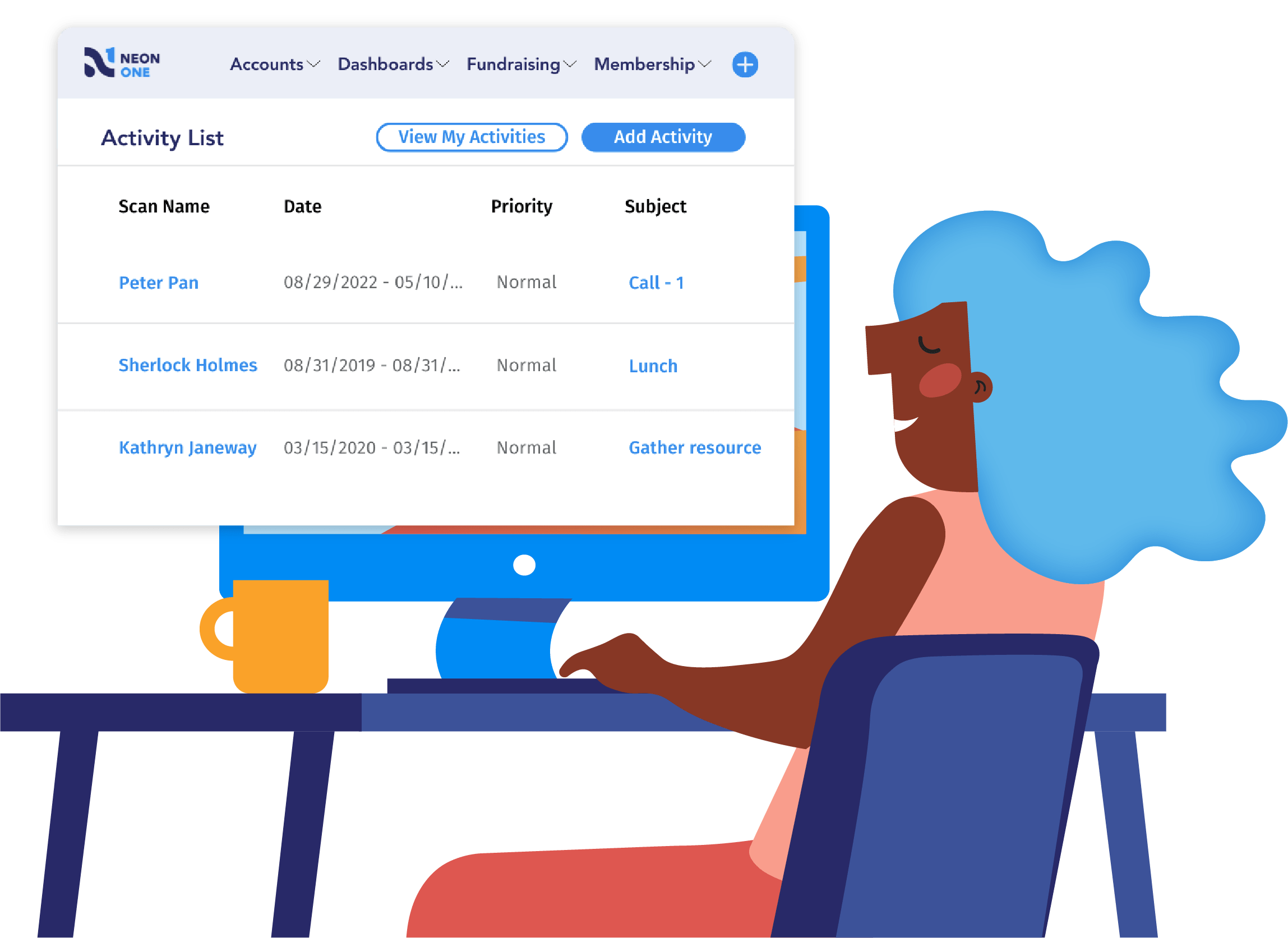
See Neon CRM in Action
Take this self-guided tour and see how top nonprofits build community, raise more, and save time with a single platform that manages it all!
Neon CRM Helps You Track Volunteers With Ease
Volunteer management is actually an area where a lot of nonprofit management systems are lacking. Some platforms, like Bloomerang, require paid-ons for volunteer management, while others don’t have volunteer tracking at all.
Neon CRM, on the other hand, not only has in-platform volunteer management capabilities, but it goes a step further and unifies volunteer and donor records. This integration allows you to easily see how someone contributes—whether it’s through time, money, or both.
Tracking Volunteer Hours
There are two ways within Neon CRM that you can track volunteer hours: timesheets entered by a system user and timesheets entered by volunteers.
System users (aka your staff) can record hours, expenses, and mileage for your volunteers or your volunteers can use a Constituent Login Portal to self-report.
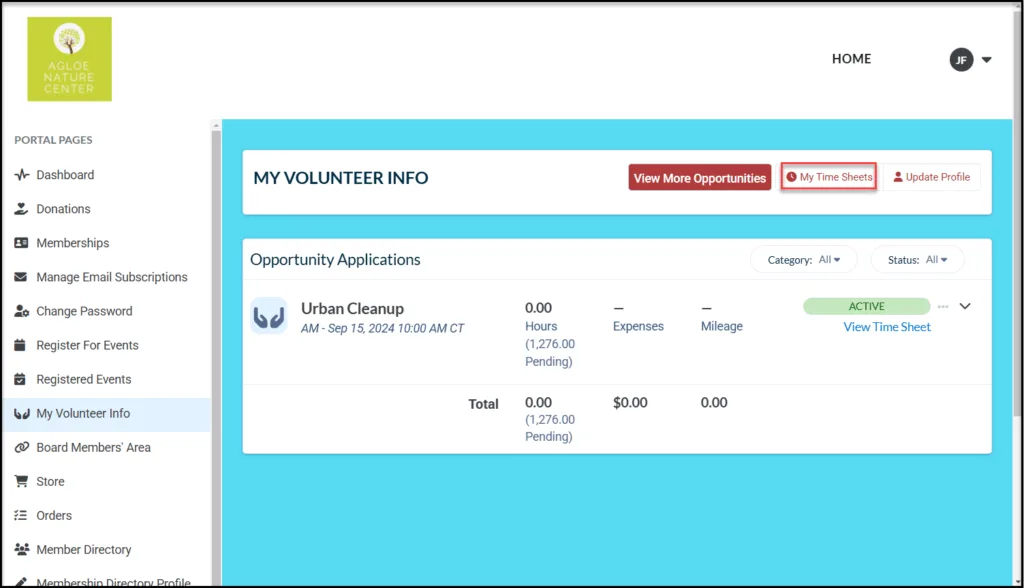
Your staff can then approve submitted timesheets, and they will be added to your volunteer data.
Manage Volunteers
Beyond tracking volunteer hours, Neon CRM also allows you to create volunteer applications, create volunteer forms, manage volunteer roles, assign volunteer shifts, and communicate with volunteers through email and text.
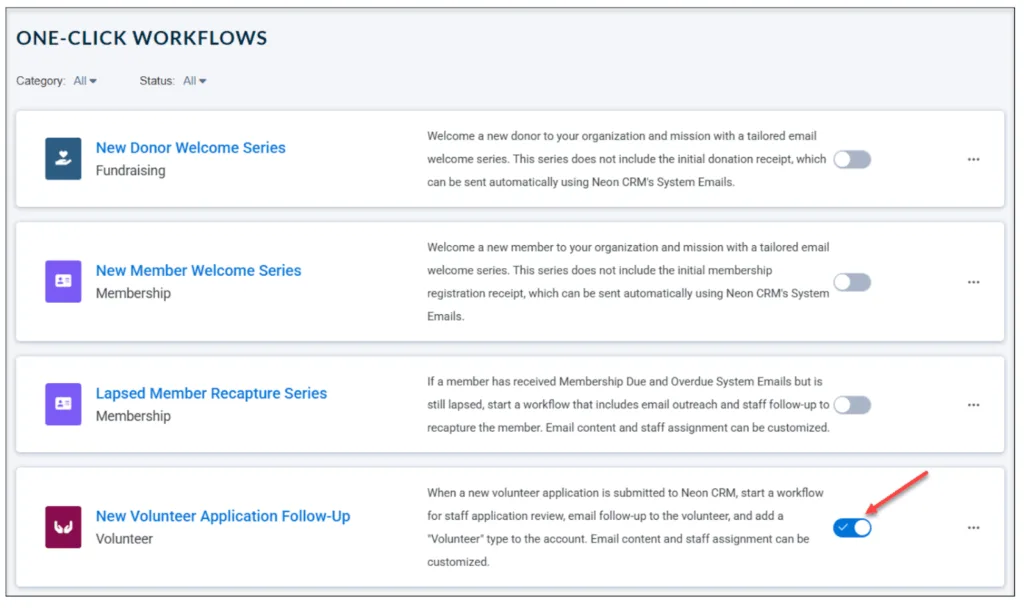
Not to mention that we also have automated workflows that help lighten your workload. You can set up one-click workflows, like our new volunteer application follow-up.
Track Your Volunteer Programs
Neon CRM also makes it easy to gather the data that you need for grant reporting, annual reports, honoring your volunteers, and beyond.
In our platform, you can use a variety of filters to target the volunteer information that you want, and the total hours/expenses/mileage will automatically update to reflect your filters. You can also pull volunteer data into our reporting tools.
Turn Volunteer Hours Into Impact
Your volunteers are important, there’s no two ways about it. And you hopefully now understand why tracking volunteer hours and volunteer management as a whole can have a big impact on your nonprofit’s success.
Tracking volunteer hours doesn’t just prove impact. It’s a vital tool to celebrate contributions and make data-driven decisions that guide your overall strategy. And, speaking of tools, having the right one will make sure that your volunteer tracking isn’t a burden.
Neon CRM is designed to manage a fulfilling volunteer experience with a suite of tools for volunteer applications, sign up, project assignments, time tracking and more. To see Neon CRM in action, sign up for one of our upcoming live group tours or reach out to schedule a private demo.