

Hi, I’m Laura. I run a whole business helping nonprofits use CRMs more effectively, and I’m not ashamed to share that sometimes I don’t feel so on top of my own CRM. No one does.
As a professional CRM wrangler, I’ve seen the many ways that CRMs get messy. Relationships can be messy. Data can be messy. So it makes total sense that the relationships humans have with their data can also feel messy.
The “Over It Cycle”
Most nonprofits are in some stage of what I call the “Over It Cycle.” They’ve got a CRM, they get the sense that it’s ‘not working,’ they look for a new feature or a new tool, make some changes—maybe even switch CRMs!—do some light change management or training, only to notice after a few months that this new CRM setup isn’t ‘working’ either. Yikes!
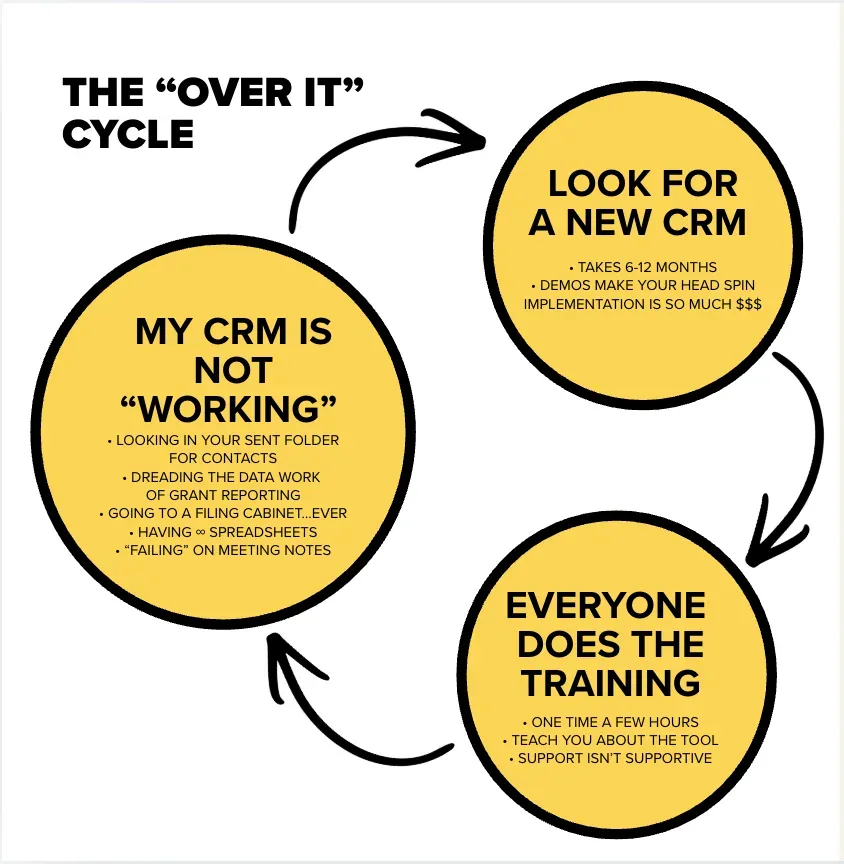
Research shows most nonprofits go through this cycle every three years—and it’s one full of frustration and, yes, wasted money.
What Causes the “Over It” Cycle?
Charles Kettering, whom I love because I am an engineer (both at heart and by education), once said, “A problem well-stated is a problem half-solved.” Most of the CRM frustration and waste stems from not really knowing what the problem is. Is it the software? Is it you? Is it both? And do you actually need to adjust to make your data work more workable?
It’s easy to end up in a hamster wheel situation where you’re chasing one data task after the next (monthly newsletters, anyone?), and so it’s easy to think that “upgrading” your tool will solve everything.
I’m not saying a new CRM isn’t the right solution for you. I’m saying you should do some targeted investigation and troubleshooting first before you drop tens of thousands of dollars on a solution to the wrong problem.
In my experience, CRM frustration comes from one or more of three buckets, and narrowing it down makes it infinitely easier to get a frustrating relationship with your CRM back on track…or make a decision that it’s time to break up. Ready for the list?
- Operations
- Data Hygiene
- Relationship Stewardship
Problem #1: Operations
In the nonprofit world, “Operations” could mean anything from fundraising to data to bookkeeping. But to better understand how operations relates to your CRM, ask some of these types of questions:
- Does my team actually know how to use this CRM, or are we reverting to Google Sheets because it seems easier?
- Do I suspect we’re spending too much time on tedious data work (aka something that technology could solve)?
- Do we all know who is responsible for what’s in our CRM? (For example: Who adds donors? Do we do anything proactive to make sure our lists are accurate? Do any other tools automatically move lists into our CRM?)
If you’re reverting to Excel, if you’re spending over five hours on data chores in a week, or if CRM ownership is anyone’s guess, it’s likely you have some work to do in this bucket.
Problem #2: Data Hygiene
Do you have a Mr. Potato Head, Mrs. Potato Head, the Potato Head family, and Mr. and Mrs. Potatohead all as separate records in your CRM?
If yes, a new tool or feature is not going to solve this problem. Even if you think a new tool will force you to fix these records, I can guarantee you that if Today You doesn’t have time to figure it out, Future You REALLY doesn’t have time to do it.
Problem #3: Relationship Stewardship
This all comes down to one question: Does your CRM help you manage relationships? Or is it just a place to put your data?
If your CRM doesn’t help you make strategic decisions, better serve your mission, or maintain relationships with your donors and community, it’s time to investigate why not. Is it because the CRM you have doesn’t actually have the features you need, or do you just need help taking advantage of them?
How to Fix the Cycle
I can almost hear you saying, “OK, Laura. I know my problem bucket. Now how many hours of work (that I don’t actually have!) is it going to take me to fix it?”
My answer: just one to start (and I’ll even offer to hold your hand while you do it!) Simple, easy-to-incorporate habits can make a huge shift in how your CRM works for you. I’ve got three of them for you right here:
Habit #1: Pick One Thing to Focus on
If you’ve determined you have an Operations problem:
The “one thing” to focus on will become super clear if you get everyone in a room together for 30 minutes and map out what happens to a person in your CRM system. What takes place from the moment they get introduced, to when they donate, to ongoing communication?
This is guaranteed to surface misunderstandings and miscommunications and allow you to, quite literally, “point to where it hurts.” That’s where you focus.
If you’ve determined you have a Data Hygiene problem:
Nail down specifically what needs cleaning up.
- What does “duplicates” mean to you?
- Is there a problem stemming from a previous migration?
- Is your contact information outdated?
In other words: what specifically don’t you trust about your data?
Pick one thing, and that’s now your focus.
If you’ve determined you have a Relationship Stewardship problem:
Before you focus on one thing, make sure your relationship problem isn’t actually stemming from the other two. If your data is 80% trustworthy and you’ve got some solid “way we do things” in place, you’re halfway there. If not, start with one of those buckets first.
But let’s say you’ve got clean-ish data and some working processes (Mazel tov!) but still feel like your CRM isn’t helping you manage your relationships. Pick one thing that you want to establish.
- Is it making sure you know when donors were last contacted?
- Is it making sure you thank donors over $500 within 2 hours?
- Is it improving your messaging by using segmentation you already have?
Habit #2: Contain Your Gripes
Whether you’re focusing on relationship stewardship, data hygiene, or operations, when you mix people and technology, there is never a shortage of challenges or inconveniences.
Keep those issues in one spot. I like to have a little Google Doc where I just dump all of the things that frustrate me about using my CRM. It’s easier to remember frustrations in the moment and much harder to recall them when they’ve been interrupted by days and weekends.
Having everything in one spot will help you narrow the focus on how to make your current CRM work for you based on what feels broken or if you really do need to switch. You’ll know exactly what to pinpoint.
Habit #3: Chat CRM Five Minutes Each Week
I’m guessing whoever works with your CRM also meets on a roughly weekly basis. Just take five minutes and talk about your CRM and how your progress is going (or not going) on your “one thing.” That’s it; that’s the habit.
Fix the Cycle—You’ll Feel Better, I Promise!
This level of focus and these small habits yield BIG changes to how your team gets the most out of their CRM and, therefore, their relationships.
Want Help? Good Egg Solutions has Got You!
You don’t have to go it alone! I love to work with people just like you both 1:1 and in cohorts.
Help! I’m So Over My CRM is a month-long cohort for any nonprofit leader who feels over their CRM. We meet weekly to do quick and easy data detective activities, craft your roadmap to fixing your real CRM problems, and share expert support and cheerleading the whole way.
By the end, you’ll determine if you can make your CRM relationship work or if it’s time to split. Either way, you’ll protect your multi-thousand CRM investment (or prevent you from making a mistake before you spend another multi-thousand!)
The next cohort starts in September.
Don’t want to wait until September? I get it. Book time with me and I’ll get you sorted out.
About the Author

Laura Leonard is the founder of Good Egg Solutions, a trusted Neon One partner that helps nonprofits make the most out of their CRM: regardless of their size, budget, or tech expertise. She is an engineer, holds an MBA in Operations from the University of Michigan, and is Lean Six Sigma Certified, which is all a fancy way of saying she can make complex processes (like CRM wrangling) much, much easier for your organization. She lives (and gives) in Austin with her family and enjoys all things food, Taylor Swift music, and extremely cute animal memes.