

Creating a monthly giving program for your nonprofit will help increase total giving and promote financial stability—but it’s about more than just the numbers.
Actually, hold up. That’s not quite true. Sure, building a recurring donor base cannot be done through numbers alone, but the numbers around the importance of monthly and recurring donors are actually pretty staggering. Instead of shoving the numbers aside, let’s put them front and center, at least for a moment.
According to Neon One’s recently published Recurring Donor Report: Data-Backed Insights for Sustainable Generosity, even as overall nonprofit donor bases shrank 5.45% between 2023 and 2025, recurring donor bases grew by 31.58%—and recurring revenue across the sector grew 36.25%. The average recurring donor stays engaged for 7.5 to 8 years and generates a lifetime value of $7,288.26, compared to just 1.5 to 2 years and $3,606.90 for non-recurring donors.
See? The numbers prove it: These are some of your most loyal, valuable supporters. If you don’t have a monthly giving program in place, you’re making it harder to build the kinds of deeper, more personal relationships with them that will keep them engaged.
In this article, we’ll lay out the basics of how monthly giving programs work, why they are important for nonprofits like yours, and how your organization can choose the right best practices to make your own monthly giving program a success.
And those are the people who can help take your nonprofit’s mission to the next level—and sustain it for years to come. Let’s get started!
As an optional bonus as you read, we also encourage you to click play on the video below to hear from recurring giving expert Erica Waasdorp.
What is a Monthly Giving Program?
Recurring givers are donors who’ve committed to donating set amounts to an organization on a regular basis. While these donors often want to give on a monthly basis, a recurring giving program should also include options for bi-monthly, quarterly, and even annual giving.
While these donors often want to give on a monthly basis, a well-designed recurring giving program should also include options for bi-monthly, quarterly, and annual giving—giving donors the flexibility that makes this type of gift sustainable for them.
The most common way for monthly donors to give is by automating a regular transaction with their debit or credit card. Any good fundraising platform should include features that support this! If the transaction isn’t automatic, donors will have to remember to make a donation every month—that’s a lot of work for them, and even more work for your staff.
That said, smaller nonprofits starting a monthly giving program should also include an option for donors who prefer to give by check. While it will mean more hassle for your staff, it will likely be worth it.
Do You Know Your Donors?
They’re more generous than you might think … and we have proof. Download The Generosity Report today!
Why is a Monthly Giving Program Important?
You may want to create a monthly giving program for a few reasons. For one, monthly donors offer a lot of financial benefits for a nonprofit. On an annual basis, recurring donors give more than three times what new donors give. The Fundraising Effectiveness Project found that repeat donor retention was 69.2% in 2024, which is significantly higher than the new donor retention rate of only 19.4%.
Neon One’s own 2026 research reinforces this picture. Between 2023 and 2025, recurring donor retention held steady at 78% to 80%—while non-recurring donor retention fell from 35.75% to 32.41%. The average recurring donor stays engaged for 7.5 to 8 years (vs. 1.5 to 2 years for non-recurring donors), and their average lifetime value in 2025 was $7,288.26—nearly double the $3,606.90 generated by non-recurring donors.
And here’s something worth understanding about who these donors are: In a survey of 718 recurring donors, 58.6% said they made their recurring gift without being directly asked. The most common trigger was simply noticing a nonprofit doing work that mattered to them (cited by 41.6% of respondents). These are passionate people who want to make an impact—you just need to make it easy for them to do it.
Beyond giving and retention, monthly donors are more likely to support you in other ways. 50% of recurring donors make additional one-time gifts on top of their monthly commitment. And recurring donors are six times more likely to leave your organization a bequest. They’re not just donors—they’re your most loyal advocates and your most likely planned-giving prospects.
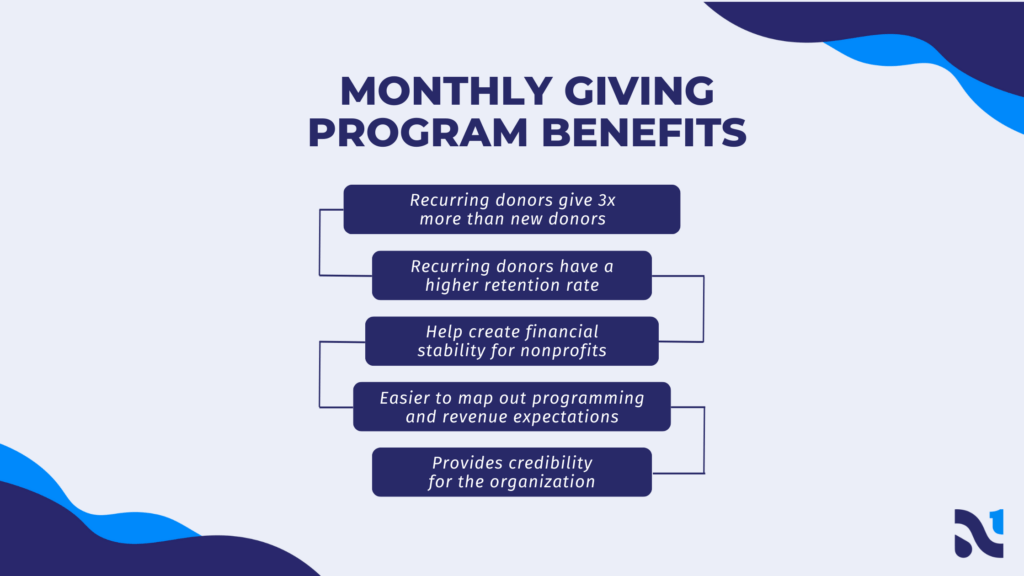
Monthly giving programs also help create financial stability for nonprofits. With a dedicated group of recurring donors, you can more easily map out programming and revenue expectations for a given fiscal year. And having a public monthly giving program provides your organization with credibility—for a new person researching your nonprofit, it shows that others in your community trust your ability to deliver on your mission.
That stability is achievable at any size. When Path of Hope Rescue, a small animal rescue nonprofit in Spokane, Washington, formalized its monthly giving program using Neon CRM, it grew from just a few recurring donors to more than 55, generating $1,500 in reliable monthly revenue that founder Caitlin Knight and her team can count on.
How to Start a Monthly Giving Program
If your nonprofit has no recurring donors, building a base of loyal monthly donors may seem like an impossible task. Don’t worry—as recurring giving expert Erica Waasdorp puts it, it’s “better too late than never” when starting a monthly giving program.
Find the Right Provider
Your online giving platform should include the ability to process monthly gifts. It’s a standard feature for most solutions, but it’s worth double-checking! If you’re using a custom solution, your payment processor can help you figure out how to support monthly donations.
Add Monthly Options to Your Donation Form
The next step is to make sure your main donation form includes the option to make monthly gifts. You may also consider setting up other frequencies (like bi-weekly or quarterly), but monthly gifts are by far the most common type of recurring donation.
If your platform allows, set up some suggested donation amounts for monthly gifts that are different from your one-time suggestions. Monthly donors tend to give smaller amounts than one-time donors—giving $100 once is very different than giving $100 every month! Tailored suggestions will help people choose what to give.
Also look for the opportunity to write impact statements that speak directly to monthly donors. Try language that helps people understand how invaluable their long-term support is to your nonprofit and your work.
Adjust Your Suggested Giving Amounts
Many monthly donors tend to give slightly smaller amounts than their one-time counterparts. If your one-time suggested gifts are $25, $50, $100, and $250, consider setting your monthly suggestions lower—something like $10, $20, $30, and $50. Then, before going live, test your form and its associated thank-you messaging to make sure it’s completely clear to the donor that they’re setting up a recurring gift.
Review Your Systems
Reaching new recurring donors takes work—be sure you retain them once you have them! Take time to update your thank-you pages, donation records, payment processors, and email systems with messaging that’s tailored to this group. Keep a close eye on your donors’ data too. Improperly marked records or a faulty email system can prevent you from properly stewarding your monthly donors—and staying on top of that data will also help you avoid losing donors due to an upcoming credit card expiration.

10 Tips for a Successful Monthly Giving Program
Turning brand-new donors into recurring monthly donors isn’t always easy. You have to make a concerted effort to acquire and retain a donor who will commit to giving monthly.
Creating a monthly giving program will help steward these donors and hold your organization accountable for maintaining relationships with them.
Make your monthly giving program a success by implementing these eight tried-and-true best practices.
1. Build Community
An important aspect of monthly giving programs is forming a community. Through branding, stewardship, and outreach, you can create a monthly giving program with a strong sense of community.
Your monthly donors are an important part of your organization’s community, and you should treat them as such. In your emails to monthly donors, it is vital to show your gratitude and include personal touches that make them feel included, welcome, and appreciated. We have created a series of free Monthly Giving Program Email Templates that will help your team leverage expert advice to create emails that encourage monthly donors to keep on giving.
Research from Neon One’s 2026 Recurring Donor Report reinforces why community-building pays dividends beyond monthly revenue: Recurring donors are 23% more likely to volunteer, 25% more likely to participate in advocacy, and 14% more likely to give items compared to non-recurring donors. The people in your monthly giving program are your most engaged supporters—treat them accordingly.
2. Give Your Monthly Giving Program a Compelling Name
Every cool club or affinity group has a name. Your program should follow suit. A title for your recurring givers is an easy way to create common ground with your recurring donor base. Although the program’s name itself isn’t going to be the driving force behind donations, it’s a nice personal touch that matters more than you might expect.
We know this from an analysis of around 13,000 personal notes left by donors when they set up recurring gifts. Many donors used language that referenced key identity markers—their age, background, religion, sexual identity, and even socioeconomic status.
The decision to make a monthly gift is deeply tied to a person’s sense of self. A named group is one of the most direct ways to honor that connection. They’re not just a monthly donor—they’re an “Animal Hero”, a “Conservation Champion”, or a member of “The Uproar.”
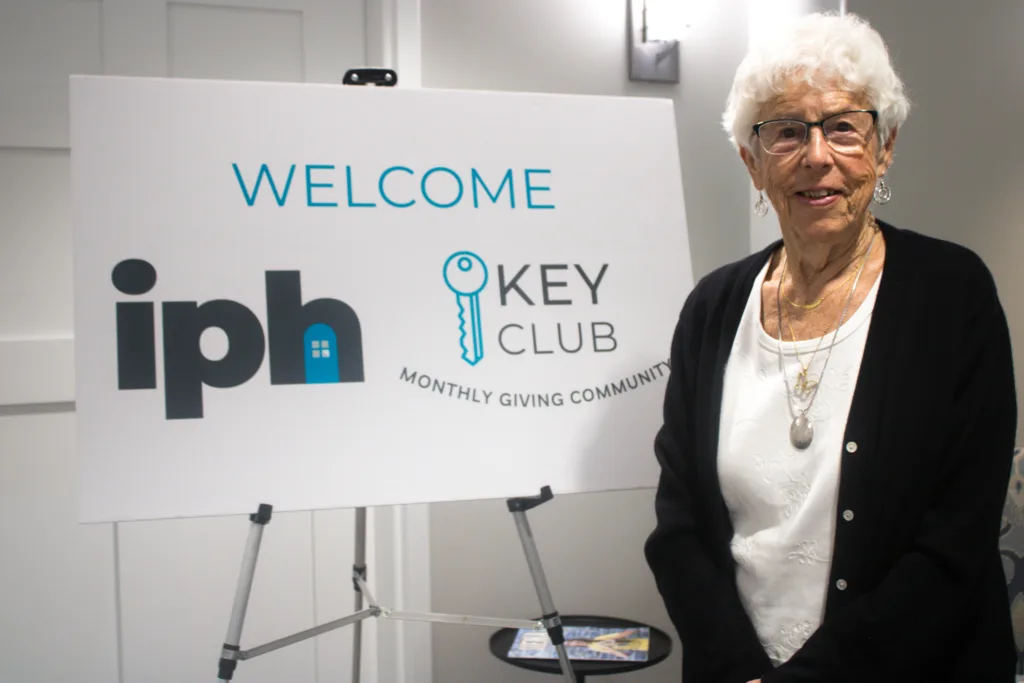
IPH, a human services nonprofit, built its entire monthly giving program around this idea. They named their program “The Key Club”—a nod to their tagline “Opening doors every day”—and credit the branding work as foundational to everything that followed.
As Meghan Meyerson, IPH’s Director of Donor Experience, put it: “Figuring out the branding and the messaging that we wanted to share with folks was, pun intended, the key to us figuring out this whole recurring giving program.”
Since launching The Key Club in 2019, IPH has grown its recurring giving revenue by more than 150%, and recurring gifts now account for 20% of its entire Annual Fund.
Best Practices for Choosing a Name
Align with your audience. Your program’s name should make sense in light of your organization’s mission, but it should also make sense to your audience. A catchy monthly giving program name is worthless if your audience doesn’t understand it. If your audience is mainly of an older generation, a name that includes Gen Z slang would only confuse them. Understand your donors first, then name the program.
Shoot for memorability. A monthly giving program name that your donors find catchy, resonate with, and can remember is what you’re after. If your supporters can think, “I’m a part of the Penguin Partnership, which means I give monthly to support the well-being and preservation of penguins,” you have a memorable and relevant program name.
Get feedback. Before your monthly giving program name is set in stone and advertised to the public, ask around. Get feedback from people of all ages and people from inside and outside of your industry. They may be able to warn you about potential negative associations with the name—or even legal and ethical concerns.
Make a big deal about it. Once your team has brainstormed, voted, and tested a name, shout it from the rooftops. Create a plan for your program’s rollout that sears the program’s name into supporters’ minds. Print nametags. Send recurring donors a mug emblazoned with their group identifier. Whatever you do, put your monthly giving program name front and center.
A Formula to Get You Started
There’s no strict formula for a great monthly giving program name, but a good starting point is: [Your Mission] + [Inviting Adjective, Noun, or Call to Action]. Here are some words that work well:
- Group/community words: Friends, Partners, Champions, Heroes, Allies, Advocates, Guardians, Pioneers, Ambassadors, Trailblazers, Defenders, Visionaries
- Structure words: Club, Guild, Crew, Society, Council, Force, Fellowship, Circle
- Phrase templates: The _____ Society | Friends of _____ | The _____ Alliance | _____ Builders | Circle of _____ | Cornerstone _____ | Founding _____
4 Monthly Giving Program Name Examples
The Uproar (Equal Rights Advocates). ERA is an organization that fights for gender justice in workplaces and schools across the United States. The Uproar encourages supporters to “fuel gender justice every month.” On the program’s dedicated landing page, ERA also specifies what donors have to look forward to after joining: a thank-you gift, invitations to virtual events, and organization updates.
Heroes of Hope (Sofia’s Hope). Sofia’s Hope funds research, raises awareness, and supports families affected by childhood cancer. Heroes of Hope is aptly named after the organization and directly ties into its mission. Sofia’s Hope wisely outlines what various donation amounts can do so that supporters can understand the impact of each giving level.
The Bread & Butter Club (Food & Friends). Food & Friends provides meals, groceries, and nutrition counseling to neighbors in the Washington, DC, area who are living with life-challenging illnesses. The Bread & Butter Club emphasizes joining the club to help your neighbors—and shows what monthly amounts like $25/month (fresh produce for five neighbors) actually accomplish.
The Editor’s Guild (The Lucy Project). The Lucy Project advocates for children who struggle with reading. The Editor’s Guild’s monthly donors help provide reading lessons for children and professional development for educators. They make it simple and easy for donors to choose a monthly donation amount with a convenient form right at the top of the page.
3. Create a Donor Stewardship Plan
Build a special donor communications plan for stewarding your monthly givers, including welcomes, thank-you messages, prompt receipts, and donor-exclusive updates on the happenings at your organization. This plan doesn’t need to be complex right away—you can always expand it later. Start with the basics, then slowly add more.

4. Encourage Growth
Donors who are currently giving to your organization on a monthly basis will be your best advocates. They strongly believe in your mission and trust you to put their money to good use. Having current donors spread the word is a really solid way to build a donor base—but you want to make it as easy as possible for them.
Write calls to action that they can share on social media or send via email to friends and family. You can even create a template they can use to run a peer-to-peer fundraiser. All they have to do is click send.
5. Run Multiple Targeted Campaigns
One way to market your monthly giving program is by branding it into multiple giving campaigns.
If you are an arts nonprofit, for example, you might have several different classes and programs that need support.
By marketing different programs to different segments of donors—sending some an email about your pottery class for adults while another segment receives messages about your filmmaking for kids program—you get donors excited about aspects of your mission that speak directly to them.
You can also target donors based on their giving frequency and their likelihood of becoming a monthly donor.
Create a campaign specifically for your existing monthly donors, thanking them for their consistent giving, highlighting their impact, and asking them why they choose to be a part of your monthly giving program. This information can be extremely valuable in shaping your messaging to target potential monthly donors.
For prospective monthly donors, let your data lay the foundation for your campaign. Consider those who used to be recurring donors and those who currently donate on an almost monthly basis.
Do you have donors who give a large amount a few times per year? Or donors whose giving history suggests they would be great candidates for monthly donations? Or volunteers who are particularly passionate about and active with your organization?
These segments deserve their own targeted campaigns with messaging that’s meant just for them.
IPH put this into practice when they wanted to recruit new members to The Key Club. Rather than sending one appeal to their entire list, they segmented their donor base into three groups—people who had given $25, $50, and $100 the previous year—and sent tailored messages to each. That single segmented campaign brought in seven new Key Club members.
6. Use Up-to-Date Data
Implementing a donor portal can help alleviate donor losses due to credit card expiration. If your donors can update expiring payment methods themselves—and receive email reminders to do so—you can ensure you don’t lose donors due to clerical errors. A nonprofit CRM can help your data management efforts through automation.
If your CRM includes built-in fundraising tools and payment processing, like Neon One’s CRM does, you may be able to automatically update some of your donors’ expiring payment methods. Neon Pay, for example, can automatically update a recurring donor’s card under most circumstances.
NAMI Greater Mississippi Valley relies on this for its monthly giving program. “Neon CRM notifies us when a donor’s credit card information is outdated and automatically sends reminders,” said Executive Director Mark Mathews. “This type of automation significantly streamlines operations.”

7. Designate a Point of Contact
Your program needs a single point of contact for donors. If any issues arise, having a person in the organization that donors can reach directly helps ensure you are keeping them happy. Just make sure they know how to get in touch with you!
8. Make Donation Frequency Clear
When it comes to creating your donation forms, there are practices that you can implement to encourage monthly donations. One of the best ones is to make the “monthly” option on your form the default option. According to a study from NextAfter, this increased recurring donor conversion by 366%!
However, it is vital that you make it extremely clear on your donation forms whether a user is giving one time or monthly. Clarity and effective communication build trust. If your supporters are “tricked” into giving monthly, they will lose trust in your organization.
To get around this, try setting the default frequency to monthly on one of your forms and linking to it every time you ask for recurring gifts or share public updates about your monthly giving program. Your standard donation form can still default to one-time gifts. You get the best of both worlds.

9. Emphasize the Program’s Impact
One way to encourage your supporters to join your monthly giving program is to highlight the tangible outcomes of monthly donations (this is an important tactic for all fundraising campaigns, by the way). Use a combination of storytelling and impact statistics to illustrate how helpful the consistency of monthly donations is for your organization. Talk to your current monthly giving program participants and include testimonials from them in your marketing materials.
Don’t be afraid to be honest with your donors—the monthly giving program not only makes the work you do possible, but it also provides financial security and keeps the lights on, which further ensures that your mission is possible!
Understanding what motivates your recurring donors also helps you speak to them more effectively. In Neon One’s 2026 Recurring Donor Report, recurring donors said the most common trigger for their gift was simply noticing a nonprofit doing work that mattered to them (cited by 41.6% of respondents). The second most common trigger was a social media appeal.
This tells us something important: When you consistently show your community the impact you’re making—online, in email, everywhere—you don’t just convert potential donors, you inspire them to stay.
10. Get Pointers from Your Peers
Hopefully, you’ve built relationships with other nonprofits, but if you haven’t yet, this is the perfect time to do so! Which organizations have a monthly giving program that you admire? Take a close look at what they’re doing and examine what makes their monthly giving program successful.
Once you’ve determined which elements of their monthly giving program you’d like to see in your organization, reach out to them.
Has their monthly giving program always been thriving? If not, what challenges did they face, and how did they overcome them? What lessons can you extract from their experiences? Which strategies can you incorporate into your own monthly giving program?
There you have it—all the tools and tips you need to build an effective monthly giving program. If you want to dive deeper into monthly giving, check out our webinar with monthly giving expert Erica Waasdorp.

How to Grow Your Monthly Giving Program
If you have a small number of monthly donors or would like to generate more recurring revenue, here are some tactics you can try.
Promote Your Monthly Giving Program on Social Media
Acquiring recurring donors takes time—it’s not an “if we build it, they will come” situation! In addition to sharing details about your recurring giving program on your website and through email, make sure you include it in your social media posts, too. Focus on sharing compelling stories that will make people excited about supporting your cause, tell them what that support will achieve, and make it easy for them to set up an ongoing gift.
Add a “Give Monthly” Call to Action to Direct Mail Appeals
Since many direct mail donors have historically given by check, nonprofits commonly focus on asking for one-time gifts through this channel. But by explicitly asking your donors to give monthly, you may have a more successful campaign than if you had just asked for single gifts. Try including a QR code people can use to navigate to your online donation form to set up their gift—this is a great use case for a monthly giving-specific form. You may also want to include contact information for someone at your office who can help donors who would prefer to set up their gift over the phone.
Invite One-Time Donors to Set Up Monthly Gifts
This tactic will be most effective if you’ve already told one-time donors what their previous gift achieved. Once they know they’ve made a difference with their one-time donation, they’ll be more likely to set up an ongoing gift to achieve similar outcomes.
Occasionally, Ask Your Monthly Donors for Upgrades
12% of monthly donors will upgrade their gift when asked—it’s worth trying. Here are a few things to keep in mind.
First, new recurring donors should not be approached for upgrades for a while—give them at least six months before asking for increased support. Second, appeals for additional support will be most effective if donors already understand how their existing gift makes a difference. Share their impact, thank them for their existing gift, and explain why you’re asking for more. Then ask for the upgrade.
Alternatively, you can occasionally ask monthly donors to give an additional one-time gift, buy a membership, attend an event, or support you in other ways.
Include a Monthly Giving Call to Action in Your Email Signature
This is a small touch that can help keep your program in the minds of your constituents, even when you’re not actively asking for support. When you do ask for a monthly gift, it won’t be a new concept!
Enhance Your Monthly Giving Program Emails
How to Steward and Maintain Your Monthly Giving Program
Monthly donors deserve special attention. The average recurring donor stays engaged for 7.5 to 8 years—but that doesn’t happen by accident. The effort you invest in stewardship determines whether someone who makes one monthly gift becomes a decade-long partner.
Create a Special Email Segment
When you create an email segment exclusively for monthly donors, you can easily send them updates about how their generosity is having a real-life impact. Keeping them up to date on how their support is making a difference is an important part of stewardship.
Send Tailored Versions of Standard Communications
Once you’ve set up an email segment for monthly donors, you can send them more personal versions of other emails, too. When you send newsletters, general updates, event invitations, and other important messages to your broader donor base, try sending a dedicated version specifically to your monthly supporters. You don’t need to write each of those communications from scratch—simply copying the version you’ll send to other donors and tweaking the copy a little can make a big impression.
Plan Future Appeals Thoughtfully
Should you exclude your monthly donors from receiving additional appeals that are part of separate fundraising campaigns?
No! But you do need to be thoughtful about how (and how frequently) you ask for more support. Research shows that half of recurring donors made extra donations on top of their monthly commitment.
It’s absolutely okay to send periodic appeals for extra support—but when you do, acknowledge their existing monthly gift first, thank them for their generosity, and then explain why you’re asking for more.
Be strategic about timing: asking someone to increase their gift size two weeks after their first gift won’t go over well.
Schedule a Monthly Donor Retention Day
Set aside time once a month to check in on your monthly giving program. Review any payments that didn’t go through, identify donors who could benefit from some follow-up, and check which supporters’ payment methods are due to expire soon.
Proactive outreach to your monthly donors—whether that’s a call to ask about updating their card or simply to say how much you appreciate them—is the best way to keep retention levels high.
Talk to Canceling or Lapsed Monthly Donors
Your monthly donor retention day will sometimes surface supporters who are not renewing their gifts. When someone asks to cancel, consider asking if they are willing to pause or lower their contribution instead—the donor may not realize this is an option. If your monthly donor still wants to cancel, that’s okay.
Thank them for their ongoing support, and reiterate how much their generosity has meant to your community.
Send Annual Tax Receipts
Sending tax receipts summarizing a monthly donor’s annual contributions may seem like a small detail, but it’s a valuable way to show them you care about their support. Make sure they receive a tax receipt in January. It’s also a valuable stewardship opportunity—consider using this moment to nurture legacy-giving conversations.
Get Creative with Donor Appreciation
Regular updates and tailored communications are important, but if you really want to build a loyal, passionate group of monthly donors, look for ways to surprise and delight them:
- Send a handwritten card on the anniversary of their first gift
- Mail cards or notes on donors’ birthdays or other holidays
- Run a donor appreciation event for monthly supporters
- Offer early registration or discount codes for events, discounts on memberships or merchandise, or exclusive swag
- Call your monthly donors just to say “thank you” and learn a little about them
These little touches will make your monthly donors feel valued, remind them of their passion for your cause, and reinforce the relationship between them and your organization.
Now’s the Perfect Time to Build Your Monthly Giving Program
A successful monthly giving program is built in layers. You start with the right technology and donation form setup. You give your program a name that donors can personally identify with. You use data to reach the right people with the right message. And then you invest consistently in the relationships that make monthly donors stay engaged—not for months, but for years.
The data is clear: even as overall nonprofit donor bases are shrinking, recurring donor communities are growing. Recurring revenue grew 36.25% across the sector from 2023 to 2025. The people who will support your work with a sustaining gift are some of the most passionate, committed, resilient people you will encounter. They’re ready to support you. Now you just need to let them do it.
IF you’d like to learn more about the behavior and motivations of recurring donors, sign up to receive the 2026 Recurring Donor Report!
Neon One Can Help Boost Monthly Giving
When creating a monthly giving program, you want to get donors excited about all the ways their support can impact your mission. By giving your program a catchy name, tying dollars given to direct impact, and using up-to-date data, you can create a community of dedicated supporters and evangelists that will help your organization grow.
Before you launch your program, make sure your nonprofit CRM software has the capacity to handle it. Neon One is a complete nonprofit relationship management platform that lets you combine CRM, fundraising, donors, events, volunteers, memberships, and more into a single integrated system. With unlimited contacts, unlimited donation pages, powerful analytics tools, email marketing and segmentation features, and workflow automation, running your monthly giving program in Neon One is a snap.
Monthly giving programs benefit nonprofits in a few important ways. Recurring donors give more than three times what new donors give annually, and they’re far easier to retain—Neon One’s 2026 research found recurring donor retention held steady between 78% and 80% while non-recurring donor retention fell to 32.41%. The average recurring donor stays engaged for 7.5 to 8 years and generates a lifetime value nearly double that of a non-recurring donor. With a dedicated base of monthly donors, you can more easily map out programming and revenue expectations for the year—and having a public monthly giving program signals to new donors that others in your community already trust you to deliver on your mission.
Start by confirming your online giving platform can process recurring gifts, then enable monthly options on your donation form with suggested amounts tailored to recurring donors (typically lower than one-time suggestions). Give your program a name, customize your automated receipts, and build a basic stewardship plan before you launch.
The best names are short, memorable, and tied to your mission—think Heroes of Hope, The Uproar, or The Bread & Butter Club. Avoid names that are too long or too generic. Use community-signaling words like Champions, Guardians, Circle, or Alliance, and always get feedback from people inside and outside your organization before finalizing.
Keeping your donor data clean and current is the most important thing you can do to protect your monthly giving program. Implement a donor portal so supporters can update expiring payment methods themselves, and set up email reminders before expiration—outdated payment information is one of the most common reasons recurring gifts lapse. Beyond payment data, set aside time once a month for a dedicated program check-in: review payments that didn’t go through, identify donors who could benefit from follow-up, and flag cards due to expire soon. That kind of proactive attention is what keeps retention rates high over the long run.
The key is consistent, personal stewardship. Create a dedicated email segment for monthly donors, send them tailored versions of your standard communications, and schedule a monthly check-in to review lapsed payments and expiring cards. Personal touches—handwritten anniversary notes, birthday cards, and the occasional phone call—go a long way toward keeping these donors engaged for years.
Yes—but thoughtfully. Research shows that half of recurring donors make additional one-time gifts on top of their monthly commitment. Always acknowledge their existing monthly gift first, explain why you’re asking for more, and be strategic about timing. Avoid asking for upgrades within the first six months of a donor’s recurring gift.
Your best prospects already exist in your database. Start with lapsed recurring donors—they’ve already demonstrated that instinct—then look at donors who give on an almost-monthly basis, since they’re already behaving like recurring donors without the official commitment. Donors who give a large amount a few times per year are strong candidates too, since monthly giving offers a more manageable way to sustain that level of support. For each of these segments, the approach is the same: show them the impact their past support has already made, then invite them to make that impact ongoing.
According to Neon One’s 2026 Recurring Donor Report, a strong recurring donor retention rate is between 78% and 80%—which is where the sector held steady from 2023 to 2025. Non-recurring donor retention, by comparison, fell to 32.41% in 2025. If your retention rate is below 70%, prioritize stewardship improvements like proactive payment method updates and personalized outreach.
According to Neon One’s 2026 research, the average initial recurring donation is $84.38, with a median initial gift of $30.00. Monthly donors tend to give smaller amounts than one-time donors, which is why it’s important to set lower suggested amounts on your recurring donation form.