

— KEY TAKEAWAYS
A donor stewardship plan is a nonprofit’s strategic blueprint for engaging and retaining supporters after their initial gift. Rather than treating donor relations as an afterthought, an effective plan outlines a specific, repeatable system for thanking contributors, demonstrating the real-world impact of their generosity, and guiding them toward deeper involvement.
- By strategically segmenting audiences—such as major givers, recurring donors, and peer-to-peer fundraisers—organizations can deliver personalized communications at a consistent cadence.
- This ongoing relationship-building is vital for sustainable fundraising, as single-year donors generally account for only 10.9% of dollars raised, whereas long-term supporters dramatically increase their giving over time. Neon One, 2025 Generosity Report.
- Implementing a clear stewardship matrix, assigning team ownership to specific tasks, and utilizing a nonprofit CRM to automate outreach ensures no supporter falls through the cracks.
- Automation and careful segmentation transform one-time contributors into lifelong advocates for your mission.
For many small or early-stage nonprofits, the idea of building a formal donor stewardship plan sounds… overwhelming. You’re already doing 20 different jobs: writing grants, sending thank-you emails, planning events, maybe even managing social media or cleaning up after a fundraiser. With limited staff, time, and tools, it’s easy to fall into a “just keep moving” mindset.
But that doesn’t really work. If you’re only ever focused on the short-term, you’re going to “keep moving” right until the moment you keel over.
Donor retention is the financial bedrock of a sustainable nonprofit. Neon One’s Generosity Report found that, while single-year donors make up 46.1% of an organization’s base, they account for just 10.9% of total revenue. You can’t afford to constantly chase new donors—you need to keep the ones you’ve already inspired.
Here’s the good news! You don’t need expensive tools or a big staff to build a stewardship plan that works. All you need are the right best practices and the tools to put them into action. To help you with both of those, we created this free donor stewardship planner, complete with sample communication plans for nine common donor segments.
Download your free donor stewardship plan template now and follow along as we walk you through how to build your plan.

What Is a Donor Stewardship Plan?
QUICK ANSWER
A donor stewardship plan is a nonprofit organization’s strategic blueprint for building and maintaining meaningful relationships with supporters after their initial donation. It systematically outlines exactly what happens next in the donor journey, detailing how your team will say thank you, demonstrate the tangible impact of the gift, keep supporters engaged, and invite them to deepen their involvement.
By establishing personalized follow-up workflows, a strong stewardship plan ensures that every supporter—from one-time event attendees and monthly givers to major donors and peer-to-peer fundraisers—feels consistently acknowledged and valued. Rather than relying on ad-hoc or reactive communications, this proactive framework provides a clear, repeatable system that guides communications.
Ultimately, a well-executed donor stewardship plan shifts the focus from simply acquiring new financial contributions to systematically nurturing existing relationships, turning passive contributors into active, long-term advocates for your mission.
Key distinction: While donor cultivation focuses on relationship-building before a gift is made to inspire a contribution, stewardship begins the exact moment a gift is received to ensure long-term retention.
A donor stewardship plan is your nonprofit’s blueprint for building and maintaining relationships with supporters after they give. In short, it outlines everything that happens next, like how you say “thank you,” keep your donors engaged, show them the impact of their gift, and invite them to get even more deeply involved.
The plan should help you build personalized follow-up strategies tailored to each donor type, from monthly supporters and major donors to first-time or peer-to-peer contributors. A strong donor stewardship plan ensures your supporters feel acknowledged and valued, no matter how or when they gave.
If you’re still not entirely sold on the importance of proactive donor stewardship—or at least not sold on why it should be your top priority—here are a couple of key reasons why it’s so crucial.
- It’s far more cost-effective: Acquiring a new donor costs more than keeping an existing one. And most donors give far less than their total giving capacity in their initial gift. When resources are tight, the smartest investment is often the one you’ve already secured.
- Donor retention drives long-term revenue stability: Repeat donors are more likely to stay engaged with your mission and increase their support over time. In fact, five-year donors studied in The Generosity Report gave 1,519.72% more than one-year donors, proving that consistent follow-up turns one-time gifts into major investments.
- Knowing your donors can set you apart: Supporters often give because they’ve met your staff, heard your story firsthand, or experienced your work up close. They have a relationship with you! A stewardship plan helps deepen those relationships in a way that feels authentic, even as your organization grows.
- You don’t need a big team to do it well: Many leaders from small orgs assume that good donor stewardship requires a huge team. It doesn’t. Utilizing automated CRM workflows reduces administrative hours, letting small teams scale their engagement points and deliver meaningful communications that scale alongside their donor base.
A clear stewardship plan helps you build trust with your supporters, improve retention, and make your fundraising campaigns way, way (way!) more effective. If you want a base of loyal, dedicated supporters who support your organization year after year, donor stewardship is the way
When we researched everyday donors—the 96.9% of people who give less than $5,000 annually—and all the different ways they showed their generosity, we found that people who stayed engaged for a long time increased their giving dramatically over that span.
To check out the full study and get some more awesome insights that will help you take your donor stewardship plan from good to great, download your copy of the Generosity Report today!
Fuel Your Mission: Engage Everyday Donors
Learn actionable strategies to effectively connect with and cultivate the generosity of your everyday supporters—download The Generosity Report now!
How to Build a Donor Stewardship Plan That Works
Creating an effective donor stewardship plan requires more than sending out thank-you notes (although that’s a wonderful place to start). It will include three main pillars: building trust with your donors, creating connections with them, and making them feel like they’re making a real difference.
At its best, stewardship involves building relationships with a strategy that’s firmly rooted in human psychology. Remember: Behind every donation is a person who wants to be seen, appreciated, and inspired.
A good donor stewardship plan recognizes those needs and incorporates them in a repeatable system your team can actually follow.
Here’s how to build one!
1. Segment Your Donors
Start by grouping your donors based on giving level, frequency, motivation, or channel. This allows you to tailor your messaging and timing in a way that will resonate most.
For instance, you should explicitly segment peer-to-peer participants alongside recurring and major donors. Peer-to-peer participants give 888.81% more after five years of engagement, requiring a highly specific stewardship track.
This is why donor segmentation is so foundational. Without it, it’s hard to make anyone feel like more than a name on a list.
Example: A local community center might have separate stewardship flows for new event attendees, grant funders, recurring donors, and peer-to-peer fundraisers. Each group gets different updates, in different formats, with a tone and timeline that fits their interests.
2. Set a Consistent Cadence
A single “thank you” is just the beginning (literally). Good donor stewardship requires ongoing communication that’s delivered at the right time, keeps donors engaged, and builds long-term loyalty.
If updates and messages from your nonprofit are reactive or irregular, you’re sending the wrong message. A donor gives, hears nothing from you for months, and then suddenly gets another ask. That silence in the middle feels like indifference, and it’s easy for them to either tune you out or feel like an ATM when they only ever get appeals for money.
To be very, extremely, 100% clear: This does not mean you should email your donors constantly. It means you should establish a regular rhythm: a thank-you within a few days, a quarterly update, an annual summary, a mid-year check-in.
When scheduling your ongoing communications, aim for Wednesdays or Fridays, which yield the highest email click-through rates (3.58% and 3.68%, respectively) for nonprofits. When donors hear from you regularly, they’re more likely to remember why they gave and why they should do it again.
Example: A regional food bank welcomes donors with a thank-you email, follows up a month later with a story from a family they served, and sends an invitation to an annual impact webinar six months down the road.
3. Translate Goals into Specific Tasks
Having a goal to “stay in touch” is a nice idea, but it’s not a plan. To make stewardship effective, you need to turn your good intentions into specific, repeatable actions.
While you’re creating your donor stewardship plan, define specific tasks like “Send handwritten note within one week,” “Include impact story in next email,” or “Call major donors each quarter.” The more clearly you outline the “what” and the “when,” the more likely it is to actually get done.
Without clear next steps, even the most motivated teams will get stuck. Everyone agrees donor relationships are important, sure, but no one knows exactly what to do next. The result is hesitation, overlap, or radio silence.
Example: A mental health nonprofit builds a stewardship checklist that includes monthly social media spotlights for peer-to-peer fundraisers, biannual progress emails to recurring donors, and personalized birthday messages to longtime supporters.
4. Assign Clear Ownership
We’ve all been a part of some project or committee where no one person was ultimately responsible for getting something done, so you just stood around and watched as it slowly fell through the cracks.
This can become a big problem when stewardship is “everyone’s job.” Tasks get pushed aside for more urgent needs, and meaningful follow-up gets lost in the daily shuffle.
While you’re building your plan, assign stewardship responsibilities at the individual level. That creates accountability and ensures nothing gets overlooked. If you have the right donor management system, it will help make sure that your stewardship tasks and responsibilities stay front of mind.
As your nonprofit grows and adopts more technology, you may be able to use automated workflows to simplify this process!
Example: A two-person development team decides that one staff member handles all new donor welcome emails and social shoutouts, while the other owns mid-year check-ins and major donor touchpoints. Everything is logged in a shared spreadsheet, so nothing gets lost.
5. Choose the Right Channels
Donor communication isn’t a one-channel-fits-all job. Some people respond best to email, while others appreciate a phone call. A TikTok video might speak to younger supporters, while a printed letter might feel more personal to longtime givers.
To maximize engagement, incorporate multi-modal content into your digital outreach. Integrating micro-explainer videos or impact images within stewardship emails can dramatically increase a donor’s emotional connection. Furthermore, do not overlook the structural details of your emails: emails containing preview text raise 53.85% more funds than those without.
Using multiple formats doesn’t have to be complicated—it just has to be thoughtful. Use the right tools for the right audience and moment. That variety keeps things fresh and helps your messages land more effectively.
Example: A performing arts organization thanks new donors with a video from a cast member, calls major donors personally, and highlights volunteer fundraisers in an Instagram story series. Each format reflects the specific donor segment and serves the message being shared.
6. Track, Analyze, & Refine
The final part of a strong stewardship plan is measurement. You can’t improve what you don’t track.
Look at both outcomes (like donor retention rates, repeat giving, or email engagement) and execution (were the thank-you notes actually sent?). Review your plan regularly, tweak what isn’t working, and build upon what is.
Many small nonprofits (and midsized nonprofits, for that matter) have no system for checking whether their stewardship is effective or even happening. That lack of feedback makes it hard to grow, adjust, or replicate what’s working. It becomes a guessing game and, eventually, a lower priority.
As you track these metrics, use them to refine and improve your stewardship plan. If your impact update email to new donors is getting low open rates, try sending at a different time of day. If it’s being opened but nobody’s clicking through to where they can learn more about what they’ve helped achieve, try using a video to tell the story instead of text.
The more data points you track and analyze, the better your stewardship strategy will be!
Example: A human services nonprofit notices that recurring donors are most responsive to short, personal updates. They adjust their plan to focus more energy on that format and begin to see higher retention and increased gifts.
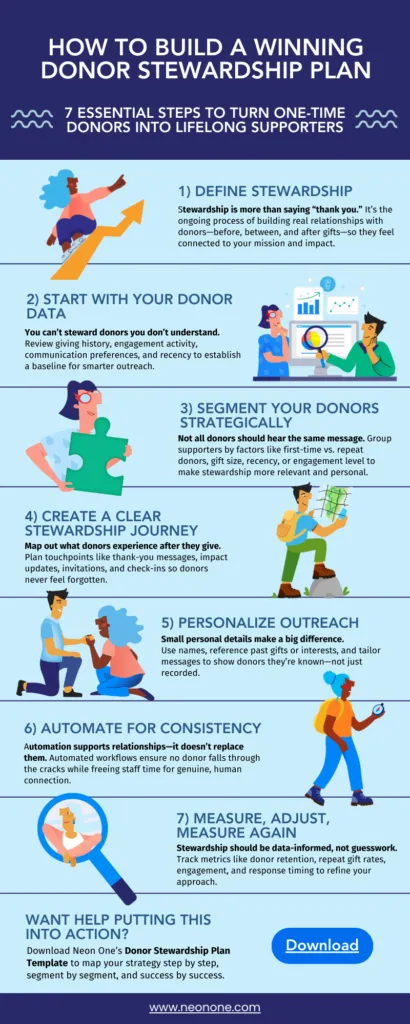
Inside the Donor Stewardship Planner: A Real-World Template You Can Actually Use
There’s a big difference between knowing what to do and creating a system that ensures you actually do it. That’s where many stewardship efforts fall apart. To bridge that gap, we built the Donor Stewardship Planner, a ready-made template designed to help small and growing nonprofits put their stewardship strategy into action.
It applies the principles we’ve covered—segmentation, timing, ownership, and thoughtful communication—and turns them into a practical plan your team can start using today.
Segment-Specific Planning That Meets Donors Where They Are
This planner isn’t going to give you a one-size-fits-all strategy. It’s based on the reality that different types of donors need different kinds of stewardship.
Each tab in the spreadsheet corresponds to a specific donor segment, including new donors, recurring donors, major givers, mid-level supporters, corporate partners, grant funders, lapsed donors, and even peer-to-peer contributors.
Rather than reinventing the wheel every time a gift comes in, you’ll have a clear outline for how to engage each group of supporters in a way that feels intentional. New donors are welcomed with a phone call and a short onboarding sequence. Recurring supporters get quarterly updates and anniversary notes. Major donors are invited to site visits or scheduled for one-on-one impact calls.
This structure turns vague goals like “follow up more” into specific, repeatable actions that build long-term relationships.
Tasks That Are Clear, Trackable, and Actionable
Saying “send a thank-you” is easy. Knowing who will send it, when it needs to be sent, and how to confirm it actually happened is where things usually break down.
Each tab in the planner includes a full set of stewardship tasks tailored to the donor segment. Every item comes with a short description, a suggested due date, and a clear owner. A status column helps you track what’s done, what’s next, and what needs a nudge.
With this structure in place, you won’t be left wondering if someone followed up with that new donor from last month or whether your director made the promised call to a major gift prospect. Instead, this planner gives you a central “single source of truth” where you can track it all.
Built to Fit the Way Small Teams Work
The planner is a spreadsheet, not software. That makes it lightweight, adaptable, and easy to share across your team without any special tools, training, or extra cost.
You can quickly duplicate tabs for campaigns or appeals, filter tasks by type or due date, and customize donor categories to match your donor database. Whether you’re a solo fundraiser or part of a scrappy team, it works the way you already work.
You can also use it to assign responsibilities, manage deadlines, and bring consistency to your follow-up process without adding extra systems to the mix.
A Living Document That Scales With You
You don’t need to use every feature of the planner on day one. In fact, many organizations begin with just one segment, like new givers or recurring donors, and expand from there.
Over time, you can refine your timelines, add more detailed metrics, or even use the tool to onboard new staff and volunteers. The more you use it, the more it will become part of your team’s culture.
Nonprofit Success Starts With Strong Relationships
When your stewardship plan is organized, predictable, and built for collaboration, everything else gets easier: Donor relationships deepen, communications become more thoughtful, and your team gains confidence and clarity in how to follow through.
You can adapt this planner quickly, share it with your team, and get started right away—no training required. Download it now!
3 Donor Stewardship Plan Examples (by Segment)
To show you how this template works, we’ve included three stewardship plans built using the planner. There’s one for major donors, one for new donors, and one for recurring supporters.
Each plan is broken down into manageable tasks with clear descriptions, due dates, priorities, and ownership. They’re designed to help you stay consistent, organized, and donor-centered, no matter the size of your team.
Example #1: New Donors

A donor’s first gift is the beginning of a potential long-term relationship. The way you respond in the following days and weeks will have a huge influence on whether or not someone becomes a repeat supporter! A clear onboarding plan helps new supporters feel seen, appreciated, and excited about staying involved.
What This Plan Includes:
- Welcome Email: Immediately after the donation, donors receive a warm and informative thank-you email. If you really want to take this to the next level, try a series of welcome emails that include impact stories and some material that gets new supporters more familiar with your work and why it’s important.
- Thank-You Note: A handwritten thank-you note makes a powerful impression on new supporters.
- Phone Thank-You: Within three days, a quick thank-you call from a member of your team puts a human voice to the relationship.
- New Donor Survey: Two weeks in, donors receive a short questionnaire asking about their interests, communication preferences, and reasons for giving.
- First Impact Email: Around two to three weeks after their gift, send a short story that shows how their donation is already making a difference. This reinforces their decision to give and builds trust.
- Social Media Follow-Up: Invite the donor to follow your organization on social media. It’s a low-barrier way to stay connected and makes it easier for them to engage with future campaigns.
- Second Ask: Within 45 days, plan a thoughtful and personalized second ask. Ideally, this will be tied to their interests or the impact of their first gift. Use what you’ve learned so far to make it meaningful.
This section of the template acts like an onboarding checklist. You can see exactly where each donor is in their first 30 days and avoid dropping any of these high-impact touchpoints.
Example #2: Recurring Donors

Recurring donors are investors in your mission’s future. And, while their gifts may be smaller individually, the lifetime value and consistency they bring are enormous. A good donor stewardship plan is a really important part of keeping them involved for a long time.
What This Plan Includes:
- Welcome Confirmation: As soon as a recurring gift is set up, send a dedicated thank-you email confirming the details and expressing appreciation for their ongoing support.
- Monthly Update Email: Every month, send a short update with a story, photo, or stat that shows their recurring gift in action. Keep it fresh and mission-focused.
- Birthday/E-Card Program: Celebrate your donors! Schedule a birthday or giving anniversary e-card to make them feel remembered and valued.
- Payment Check Reminder: Monitor for any failed or missed payments and reach out with a friendly, helpful heads up if they need to update a payment method. Provide clear instructions and support.
- Quarterly Appreciation Note: Once per quarter, send a handwritten card or personalized digital message to thank them for their continued generosity.
- Behind-the-Scenes Webinar: Invite recurring donors to a special virtual event that offers a behind-the-scenes look at your programs. It builds connection and transparency.
- Annual Upgrade Ask: Around the one-year mark, ask if they’d consider increasing their monthly gift. Reference their impact so far and invite them to go even further.
Recurring stewardship tasks can easily slip through the cracks without automation. The planner organizes them by cadence and priority, and assigns owners for each step, so you can treat recurring donors with the consistency and recognition they deserve.
Example #3: Major Donors

Major donors are your mission’s power partners. Their contributions can help you launch major programs, seed new initiatives, or anchor capital campaigns. Because of that, their stewardship plans need to be deeply personal and relationship-oriented.
What This Plan Includes:
- Initial Meeting: After identifying a major giving prospect, schedule a face-to-face or virtual meeting. Use this time to learn about their interests, their philanthropic goals, and share how their values align with your work.
- Personalized Proposal: Based on what you’ve learned in your initial meeting, prepare a tailored proposal that outlines giving opportunities, expected outcomes, and how their support will make a transformational difference.
- Impact Report Presentation: Once they make a gift, schedule time to go over their impact report. Walk through the results, stories, and outcomes their support enabled.
- Thank You Letter: Send a personalized thank-you letter that reflects the donor’s unique contribution. Reference specific elements of their gift and the change it’s helping to create.
- Quarterly Update Call: Every few months, reach out for a quick call to share updates, answer questions, and keep the relationship active and informed.
- Site Visit Invitation: Invite your major donor to visit your facility or program site. Seeing the work firsthand can deepen their connection and open the door to future gifts.
In the planner, you’ll track each task with due dates, status updates, and assigned ownership. You can see what’s done, what’s coming up, and who’s responsible, making it easy to stay on top of high-value relationships.

Want to Automate Stewardship Actions? Neon CRM Makes It Easy
Once you’ve started building and using a donor stewardship plan, you’re almost certainly going to grow your donor base. That’s when things start to get more complex: You’ll have more donors, more segments, and more touchpoints to track. It’s a great sign … and it’s also when your team might outgrow manual systems.
That’s where Neon One comes in. What you’ve mapped out in the Donor Stewardship Planner can easily be replicated—and automated—inside Neon CRM using three powerful features:
- Activities: Think of these like task records for every donor. You can assign follow-ups, log calls, track thank-you notes, and even attach notes or files in a single interface. Each donor has a timeline of interactions that your whole team can see and manage.
- Activity Templates: Have common stewardship steps, like “Send new donor welcome packet” or “Call after second gift?” Create templates that make assigning these tasks fast and consistent across the board.
- One-Click Workflows: Automate thank-you emails, assign tasks when a donor gives over a certain amount, and trigger impact updates every quarter. You define the trigger, and the system takes care of the rest.
This kind of automation ensures your stewardship plan stays active, timely, and trackable even as your donor base grows (and grows and grows). And as you effectively steward your donors, you’re more likely to see better outcomes with donor retention, aka you’re raising more money and having a sustainable base of long-term supporters!
Take a self-guided tour or schedule a personalized 1:1 demo to see how Neon CRM can bring your stewardship plan to life.
Real-World Proof: How NAMI Greater Mississippi Valley Automates Stewardship
For small teams, automating stewardship actions isn’t just a nice-to-have; it’s an operational necessity. NAMI Greater Mississippi Valley, a team of just four people serving eight counties across two states, uses Neon CRM to put their donor stewardship plan on autopilot.
When a supporter makes a donation on their website, the data flows directly into Neon CRM, triggering automated acknowledgment emails. They also rely on automated workflows for event reminders, quick follow-ups, and even alerts for outdated credit card information.
“[Neon CRM’s] workflows are really handy to automate all kinds of communications, like quick follow-ups and even last-minute reminders,” says Mark Mathews, Executive Director at NAMI Greater Mississippi Valley.
“Neon CRM notifies us when a donor’s credit card information is outdated and automatically sends reminders. This type of automation significantly streamlines operations.”
By automating these vital stewardship touchpoints, this small team has removed hours of manual administrative work. Today, they operate 50% more efficiently, giving them more time to focus on building genuine relationships and advancing their core mission of mental health advocacy.
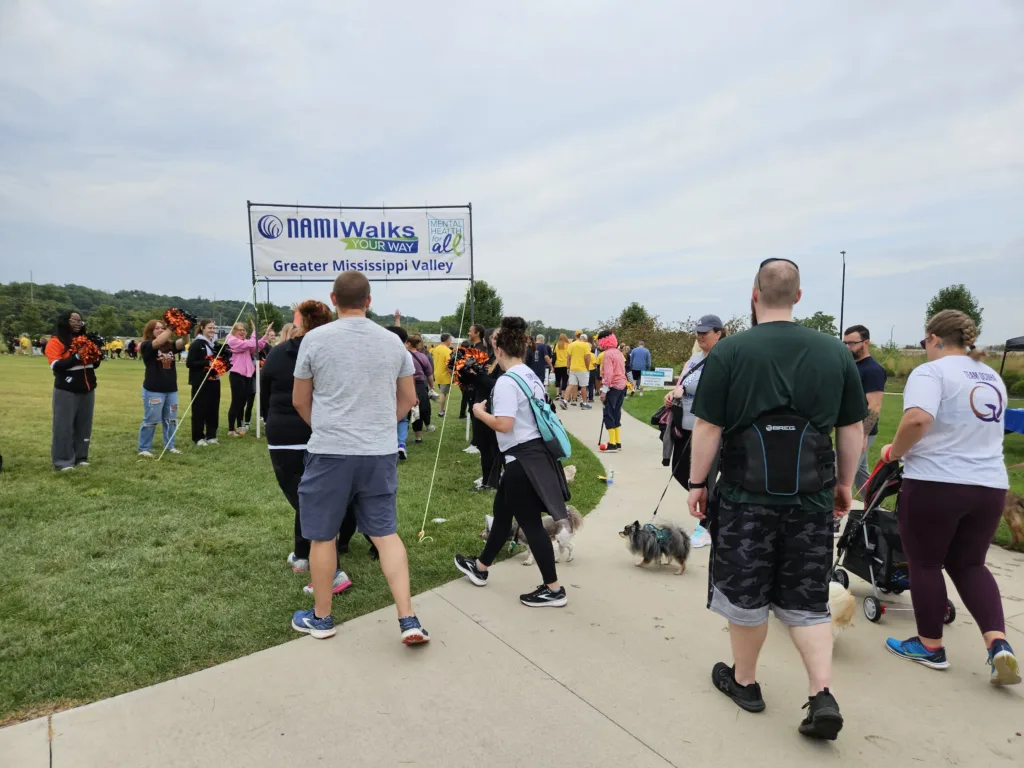
NAMI Greater Mississippi Valley: How a Small Team Achieves a Big Mission with Neon CRM
Start Small. Built Trust. Raise More.
You don’t need a giant team or complex systems to run a great donor stewardship program. What you need is a real, actionable plan that helps you follow through on the relationships you’re building.
The Donor Stewardship Planner is a simple tool that helps you do exactly that. It gives you structure. It builds consistency. And, most importantly, it makes it easier to show up for your donors in meaningful ways.
Download your free donor stewardship plan template now and take the first step toward stronger donor relationships and more sustainable fundraising.
Common Donor Stewardship FAQs
Donor cultivation and donor stewardship represent two separate, critical phases of the relationship-building lifecycle within nonprofit fundraising operations. Donor cultivation refers to the strategic process that occurs entirely before an individual makes a financial contribution.
During the cultivation phase, fundraisers focus on identifying prospects, understanding their philanthropic motivations, and building initial affinity for the organization’s mission to inspire their first gift.
Conversely, donor stewardship begins the exact moment a donation is processed. Stewardship encompasses everything that happens next, including sending immediate acknowledgments, providing transparent impact updates, and continuously engaging the supporter to build long-term trust.
Data from Neon One highlights why this transition matters: while first-time gifts are usually under $200 regardless of a donor’s capacity, strategic stewardship helps convert single-year contributors into multi-year supporters. Nonprofits that fail to steward donors effectively risk losing them entirely, as single-year givers account for less than 11% of total fundraising revenue.
Determining your outreach frequency requires strategic donor segmentation based on engagement metrics and contribution types to prevent communication fatigue while maximizing lifecycle value.
For major donors, your stewardship plan should mandate a personal touchpoint at least once per quarter completely separate from a financial appeal. This sequence can include individual phone calls, custom impact updates, or face-to-face program site visits to honor their deep investment. Everyday one-time or lower-level contributors, on the other hand, do not require intensive individual outreach but do thrive on high-quality digital stewardship.
According to Neon One research, a monthly email update combined with an annual impact summary is highly effective for broader segments. To optimize email delivery channels, your organization should distribute these regular communications on Wednesdays or Fridays, which yield the highest industry click-through rates. Additionally, ensure your digital outreach always utilizes optimized preview text, as emails with preview text generate 53.85% more revenue.
To measure the success of your operational fundraising campaigns, your development team must move away from transactional guesswork and track four foundational, data-informed key performance indicators (KPIs).
The preeminent marker is the Donor Retention Rate, which measures the specific percentage of contributors who give year over year. Tracking this is vital because data reveals that donors who give for five consecutive years account for 45% of total revenue.
The second KPI is Average Gift Size, which monitors whether your stewardship flows are successfully upgrading everyday contributors to higher giving brackets over time. The third metric is Time to First Thank-You, measuring the days elapsed between transaction processing and personalized acknowledgment.
Finally, track Donor Lifetime Value; recurring givers possess a lifetime value of $7,288.26 compared to just $3,606.90 for single-gift supporters, proving that consistency underpins long-term institutional financial health.
Donor stewardship can be heavily automated to maximize staff efficiency without sacrificing the human element crucial for relationship building. Nonprofits frequently face an efficiency plateau, where teams spend excessive administrative hours manually processing receipts and typing basic emails instead of engaging in face-to-face donor cultivation.
By deploying a dedicated nonprofit CRM, organizations can use one-click workflows to instantly trigger personalized tax receipts, schedule task reminders for personal phone calls, and automate welcome series emails. This structural automation ensures no contributor falls through the cracks during intense fundraising campaigns like GivingTuesday or year-end drives.
Crucially, while backend workflows handle administrative mechanics, the messaging content should remain deeply personal. Using dynamic personalization tokens to insert preferred names, past contribution histories, or specific program interests preserves authentic connection.
Automated systems enable small fundraising teams to deliver consistent, highly targeted outreach points that seamlessly scale alongside their expanding donor base.