
Have you heard of the Pareto principle? You may have encountered it in your donor prospect research. It says 80% of your donations will come from 20% of your donor base.
This “law of the vital few” isn’t absolute, but to most nonprofit leaders, it rings true. A few vital donors make up a significant portion of your organization’s revenue, which can be risky. Losing one of those key supporters can be a big financial blow.
There are two avenues you can take to build a more sustainable donor base. The first is to intentionally cultivate a large group of smaller donors. The second option—growing your base of major donors—can also help mitigate some risk.
That’s what we’ll focus on today.
With donor prospect research, you can use data to discover individuals who are potential major donors and learn how to get them to support your cause.
Fuel Your Mission: Engage Everyday Donors
Learn actionable strategies to effectively connect with and cultivate the generosity of your everyday supporters—download The Generosity Report now!
What Is Donor Prospect Research?
Donor prospect research is the process of identifying potential high-value donors to approach for ongoing relationships or large one-time gifts. This is a more comprehensive approach to the more general research that you’d do for a mass marketing campaign.
Donor prospect research is critical because it helps you identify individuals in your community who are most likely to give large gifts. That ensures that your major gifts officer, development team, or whoever is responsible for building those relationships can use their time and energy wisely.
It’s estimated that one-third of all charitable contributions come from the top 1% of earners. But, because such a small percentage of people represents such a significant portion of charitable donations, there’s a lot of competition to engage these donors and inspire them to give.
That competition requires that donor prospect research go beyond wealth screening. It must also help you connect with those high-value donors in a meaningful way!

How Donor Prospect Research Differs From Wealth Screening
People often talk about wealth screening like it’s the only part of donor prospecting. But, really, it’s really just a small segment of the overall process.
Yes, wealth screening is absolutely a key part of donor prospecting. But it’s important to understand the differences between wealth screening and a more thorough donor prospecting process.
| Wealth Screening | Donor Prospecting |
|---|---|
| Wealth screening uses available data to help you uncover people’s net worth. That data may include reported income, real estate holdings, business dealings, and registered assets like cars, boats, and airplanes. If you use wealth screening tools, you can use information about a potential donor’s net worth and decide if they have the potential to make a major gift. | Donor prospecting includes information from the wealth screening, but it includes additional data that’s not necessarily financial. It helps organizations map donor relationships, find common passions and interests, and create ongoing connections with potential supporters. If you’re practicing donor prospecting, you’ll get a feel for your potential donor’s net worth and their interests, philanthropic history, motivations, and potential to support your cause. |
Donor prospecting will include wealth screening and other elements that will help you identify potential donors who may be interested in supporting your cause.
Key Components of Donor Prospect Research
When you begin the process of donor prospect research, wealth assessments are a good place to start. After that part is done, you’ll need to focus some time and effort on understanding your donor’s connections, interests, and any other factors that will help you determine whether they’d be likely to donate to your organization.
Donor prospecting should include a review of the following:
Wealth Screening
Wealth screening will give you insight into your existing donors’, supporters’, and constituents’ net worth. You’ll establish their capacity to give major gifts, which will help you decide how to go about building a relationship with them.
Could you ask people to self-report this information? Sure… but that’s going to be an awkward conversation.
Working with data aggregation companies like Windfall Data is a much better way to get insight into overall donor assets without asking them directly.
Charitable History
A person’s giving history—including donations they’ve made to other organizations—can help you understand how likely they are to contribute to your nonprofit.
Some organizations manually search their donors’ names online and on social media for donations that mention their names. Data vendors may also compile this research on your behalf. Neon One, for example, considers someone’s giving history as part of their Generosity Indicator score.

Understanding your donors’ giving history can help you determine if they’d be interested in supporting your work. Say you identify a donor with a long philanthropic history in your hometown but who donates almost exclusively to health-focused charities. They may not be a good potential donor for your animal shelter! But, if they’ve historically given exclusively to animal shelters, they may be a good candidate for additional research.
Business Affiliations
A potential donor’s business affiliations are typically very public and easy to research. This is particularly important for two reasons. One is because you may be able to find matching gift opportunities where a business matches donations made by its customers and employees. The second is that this information can be useful as you brainstorm ways to engage your potential donor.
It’s estimated that matching gifts programs generate $2-3 billion annually (not to mention the additional $4 – $7 billion in matching gift funds go unclaimed), making them an incredibly effective way to raise valuable money for your organization. If you identify a high-net-worth individual who works for a local company, for example, you may be able to foster a relationship with them that could result in a matched gift.
Alternatively, you may also discover that your potential donor may not be a good candidate for a major gift conversation at all. But that person could introduce you to someone at their company who would be willing to discuss becoming a corporate sponsor.
Relationships
Knowing how your donors connect to you and to each other can grow your reach. One donor can open the door to another!
A high-value prospect may not yet be a supporter, but they may know someone who is. They may even be connected to other major donors in your donor database, which could be an opportunity to meet the donor you’re researching.
Major gifts rarely result from a one-time interaction or appeal. They’re usually the result of long-term donor stewardship activities and personal relationships! Understanding your donors’ networks can help you identify opportunities to get to know them or work together to raise money for your cause.
Interests
People will donate to a nonprofit if they believe in the cause. Understanding someone’s interests can give you great insight into the causes they care about.
An avid mountain climber, for example, may also be interested in supporting a conservation-focused nonprofit. Someone with pets may be likely to support causes for animals. Interests that align with your mission are among the best indicators of a strong donor prospect.
When you consider someone’s interests, you can make an educated guess about whether or not they’ll be open to making a major gift in the future. People with major gift capacity, a history of giving to organizations like yours, and interests that align with your mission will usually be the people who are most interested in supporting your cause.
When you identify those people, you can begin taking steps to get to know them, introduce them to your organization, and build a relationship with them. You may even be able to work with them to identify potential corporate sponsorships or others in their network who may be interested in giving to your cause.
One thing you may have noticed about all those components is that they all depend on one thing: information. You need to know your prospect’s assets, interests, relationships, business dealings, and giving history. For that, you’ll need the right tools and resources.
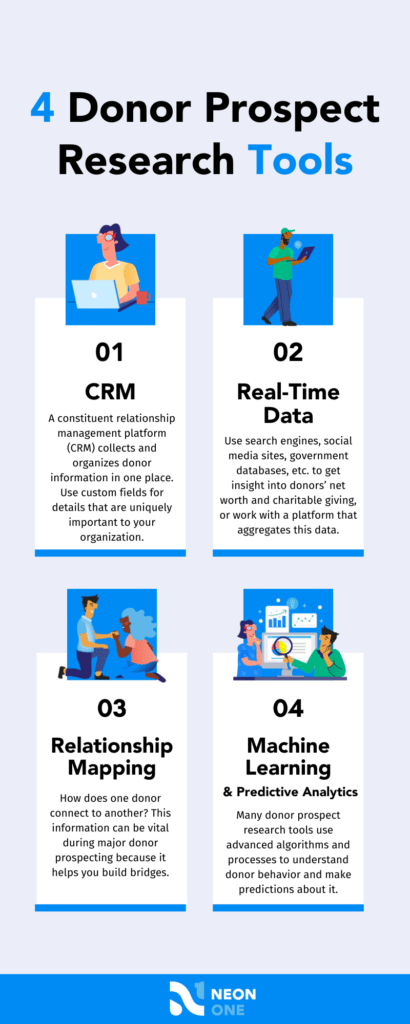
4 Donor Prospect Research Tools
All the information you need for donor prospecting is out there. But finding and compiling the information you need is almost impossible for one potential donor—never mind all of them—unless you have supporting systems in place.
That’s why you need a few tools to support your strategy. Here are some resources you’ll want to use for your donor prospect research.
Constituent Relationship Management (CRM)
The first thing you’ll need to support your donor prospecting is a constituent relationship management platform (CRM). A CRM makes it possible for you to collect and organize all your donors’ information in a single place. A CRM should let you track all basic donor details (like name and address), plus things like:
- Family relationships
- Business connections
- Donation history
- Average donation amount
- Seasonal addresses
- Nonprofit involvement
- Board participation
- Education
- Employment information
- Hobbies and interests
- Volunteer activity
- Net worth
Aside from these fields, it’s also good to use a CRM to track custom fields for details that are uniquely important to your organization. For example, if you were an animal shelter, you may want to track pet details like names and types to customize the communications you send to your supporters.
The Buyer’s Guide to Choosing a Nonprofit CRM
Need help finding the right CRM? This in-depth guide will help you identify key features to look for, common concerns to address, questions to ask your staff and potential vendors, plus a whole lot more!
Real-Time Data
Unless you want to burden them with extensive and invasive interviews, you can only get so much data from your donors themselves. We’re big fans of using donor surveys to understand supporters, but asking questions about net worth and other important data points can feel intrusive.
Instead, you could search for your donors on search engines, social media sites, government databases, and hundreds of other places to get insight into their net worth and charitable giving. You could also work with a platform that aggregates this data for you.
Some data analytics platforms have developed algorithms for mining all these sites for information on donors and compiling it into accurate estimates of net worth, giving history, and more. All of the information that’s collected is publicly available and voluntarily given, so a highly rated and reputable data aggregator makes it possible for you to get that data in an ethical way.

Donor Relationship Mapping
How does one donor connect to another? That information can be a vital part of building relationships with potential donors.
While you may not have a direct personal connection to a high-value donor you’ve identified in your database, one of your other donors might. Perhaps they work together, serve on the same nonprofit board, or have children in the same school activities.
Can you ask that person to introduce you to your potential donor? By mapping the relationship from one donor to another, you’ve built a roadmap to a personal connection with that prospect.
This is also ideal for seeking out corporate giving prospects. You may notice many of your one-time donors are coming from the same major company. That’s a prospect for corporate matching that could have amazing potential!
Machine Learning & Predictive Analytics
“Machine learning” and “predictive analytics” may sound intimidating (and expensive), but this type of technology has come a long way in a short period of time.
Many donor prospect research tools use advanced algorithms and processes to understand donor behavior, then make predictions based on it. This is especially true in something called “future prospecting,” which considers things like someone’s future earning capacity in addition to their current net worth.
This is often also called “propensity modeling,” in which an organization builds predictive models based on past donor behavior. Say a donor with an estimated net worth of $50,000 gives $25 to your organization, for example. This individual is not a high-value donor prospect now, but propensity modeling tells you they might be in ten years.
This tells you that donors like this one went on to significantly increase their net worth and make average contributions of over $10,000 annually after one decade of consistent giving. The ability to predict future behavior tells you to cultivate this relationship early and often.
Neon One’s Generosity Indicator is a great example of how this kind of technology can support your donor prospecting. Here’s where you can learn more about this innovative feature and how it works!
Use Neon One in Your Donor Prospect Research
Your CRM is the foundation of successful donor prospect research. With the right platform, you can gather all the information you need to find donors whose passions match your own.
You have to think beyond someone’s wealth—you also need to focus on understanding their relationships, interests, and connections—to truly create an effective donor prospecting strategy. That information will help you build relationships now that will bear fruit in the future.
Neon One’s Neon CRM is an intuitive, customizable database management tool that supports donor prospect research. Want to get a feel for how it works? Check out this self-guided tour of the system!