
We all know that personal connection is everything. Whether you’re interacting with volunteers, donors, community partners (or really anyone in your community), or the people in your network, the relationships that you build with them are essential to accomplishing your mission.
But when your nonprofit is growing, it can feel impossible to send the right message to the right person. Generic appeals might feel easier, but they don’t work well. Plus, they lack the personal touch that will help you retain your supporters.
Luckily, you don’t need to reinvent the wheel. You just need a few simple steps and considerations to refine your donor communication strategy.
In this blog, we’re going to look at donor communication as a journey—a clear journey where every single person knows what to expect next. The goal is to outline four specific communication strategies tailored to where your donors are right now (plus a gentle reminder that your non-donors should be getting some love too!)
Why You Need to Segment Your Donor Communications
“Donor segmentation” is just a fancy phrase for grouping your donors based on their relationship and engagement with your organization (if you want to dive into all the nitty-gritty, check out our Complete Guide to Donor Segmentation). And it’s a powerful tactic for nonprofits.
Segmentation allows you to tailor your communication and engagement efforts with different groups of donors, making sure that your donor management outreach feels personalized and that they feel valued. For example, a person who just gave you $25 for the first time should not get the same email as someone who’s been giving $25/month for five years. Donor segmentation makes it possible for you to talk to each person separately.
Segmentation can have big impacts. Research shows that well-personalized emails can increase revenue by up to 5.7 times.
It’s important to note that the goal of segmentation isn’t just sending different emails. Your segmentation and communication should focus on what makes each segment unique. What are they invested in? What have they done lately? By thinking about their unique motivations, you can tailor your message to create a deeper, more personalized connection.

The Donor Communications Journey: Your Four-Step Map
When you’re segmenting your donor communications, a key factor to consider is donor journey stages. Your ultimate goal for any donor management plan should be to move donors through the journey and into becoming major donors.
The ideas can serve as a launch pad for even more targeted campaigns, and hopefully, your donor cultivation will soon be cooking!
A quick pro tip before we dive in: Don’t feel like you need to dive into all of this all at once. Choose what makes sense for your team’s capacity and priorities and start there!
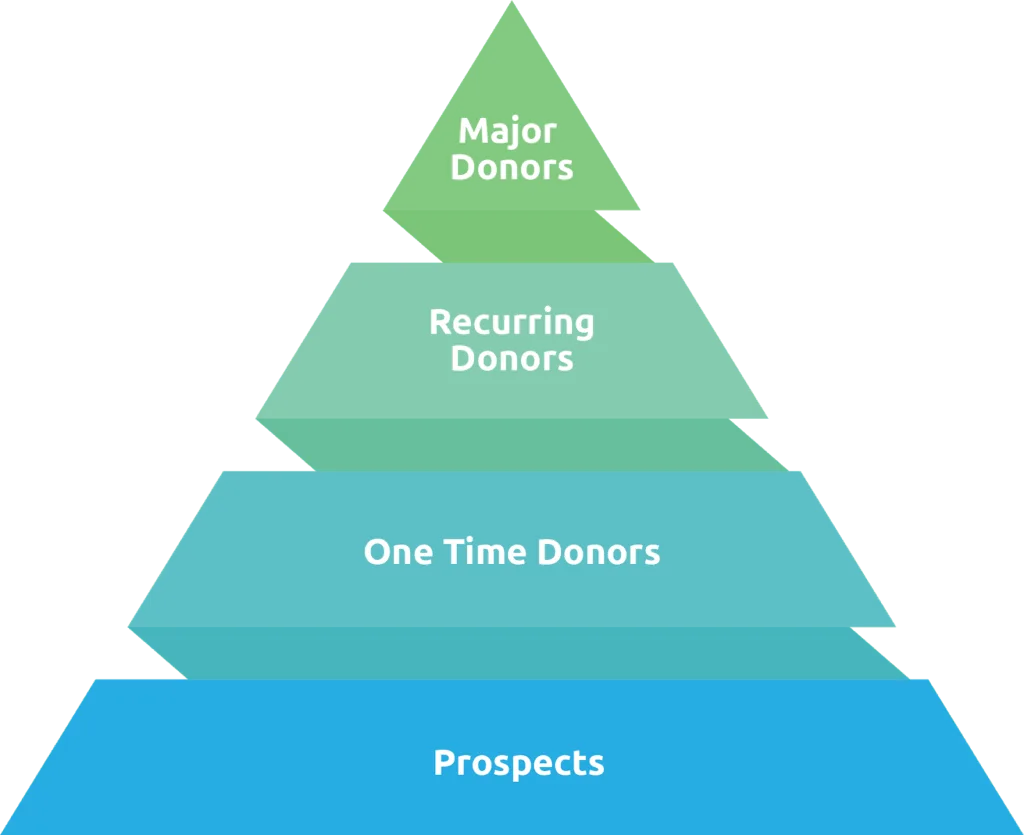
Stage 1: Prospects
Who they are: People who have engaged with you in some capacity (e.g., newsletter sign-ups, event attendees, petition signers), but they haven’t made a financial gift. They’re interested in your work but need to be engaged further before they donate.
Your communication goal: You want to start by establishing trust with this audience and showing the impact that your organization makes. This first stage is the time to start building the foundation of your relationship based on shared values, not just jumping straight to a donation ask.
Try this: Instead of immediately asking for money, try to move them into action first. Here’s one example:
- Invite prospects to a volunteer event
- If they attend, immediately follow up with a “gratitude email” that quantifies their impact (e.g., “Thanks to you, we served 100 meals today”).
- Wait a week, then send your appeals.
Stage 2: One-Time Donors
Who they are: People who have made a single financial donation. This is a critical point, as many people will make a one-time donation and then drop off and never give again.
Your communication goal: Prevent donor drop off, secure a second gift, and nurture them into recurring givers to your cause!
Try this: Immediate, deeply personalized appreciation messaging will help your first-time donor feel valued and like a crucial member of your crew. For example:
- Send a timely thank-you email (or mailer) personalized with their name and the exact impact of their donation.
- Create a short welcome series that introduces your organization’s mission and accomplishments. Build the relationship and make them feel part of something special.
- Make your next ask personal. You could even try to make the next ask a phone call. A personal touch is often more effective than another email.
Stage 3: Recurring Donors
Who they are: Your monthly givers are the backbone of stable revenue and predictable cash flow for your organization. They’ve signaled that they’re invested for the long term and may make good candidates for eventual major gifts outreach.
Your communication goal: Nurture the relationship and help them see their consistent impact. You want to continue to make them feel valued and central to your organization.
Try this: Because their giving is already scheduled, your communication should focus on sharing the impact that their support is making. For example:
- When they sign up, send a personalized mailer explaining what their cumulative donation will accomplish over three, six, and 12 months.
- Keep them informed through a general impact newsletter and timely donation receipts.
- Filter your recurring donors out of standard appeal emails to make sure you’re not asking them to give more (instead, send them more personalized appeals—many will choose to give in addition to their regular gift, but that will largely depend on how you ask them for more support).
- If your program doesn’t automatically renew expiring gifts, start stewarding for renewal at least three months before a gift set to expire. Remind donors of all that they’ve achieved with their support and the work that still needs to be done.
Stage 4: Major Donors
Who they are: Your highest-level givers, usually driven by a deep, personal connection to your mission.
Your communication goal: Express your gratitude, lead with the mission, and reinforce their role as crucial community leaders.
Try this: The rules change for major donors. You should focus less on mass communication and more on focused, high-touch strategies. For example:
- All major donor communications should be taken care of in person or on the phone. Online communications are too impersonal for this level of investment.
- Bring in your board members or leadership to make these asks and thank-you calls.
- Promote their attachment to your mission by inviting them to tour your facility or to a specialized, behind-the-scenes event where they can meet your team and beneficiaries.
But Don’t Forget Your Other Supporters Too
Your donors are obviously generous, but generosity also shows up in a lot of other ways. Your nonprofit community is bigger than your bank account! Don’t let your communication plan forget the people who support you without writing a check.
Volunteers, board members, advocates, event registrants, and beyond also play a crucial role in your organization’s success, and their contributions (though not financial) should still be valued, celebrated, and communicated with clearly.
When communicating with your other supporters, they need specific information on shifts, advocacy toolkits, or policy updates, not necessarily a fundraising appeal. Segmenting their communications ensures they feel respected for their unique contribution, keeping them engaged and ready to help when you need them. Plus personalized communications are a critical piece of strong donor retention efforts.
Plus, people are willing to support you in numerous overlapping ways! So who’s to say today’s volunteer might not become tomorrow’s donor!
Do You Know Your Donors?
They’re more generous than you might think … and we have proof. Download The Generosity Report today!
Make Personal Donor Communications Possible As You Grow
As I noted at the top, making personal connections—with donors, volunteers, and your entire community—is essential to an effective donor management strategy. But as a nonprofit grows, it can be harder to make and sustain those personal connections.
You need a simple way to track all the unique things about a prospect, a one-time donor, or a volunteer so that you know which message to send next.
Neon One is the nonprofit relationship management platform that empowers you and your organization to make and maintain personal connections that drive growth. Our powerful donor management tools take the stress out of segmentation so you can focus on building relationships.
Ready to see how easy it is to keep personalized communication at the forefront of your work? Tour Neon CRM today and check it out!
See Neon One’s CRM in Action
Take this self-guided tour and see how top nonprofits build community, raise more, and save time with a single platform that manages it all!