

If fundraising is such a critical part of running a nonprofit, then why does it feel so impossible to find time to plan it? Probably because overseeing a small nonprofit org—particularly the smaller local ones that are so critical to the fabric of our communities—is a full-contact sport. It barely leaves you with any time to check your email, let alone build an actual fundraising plan.
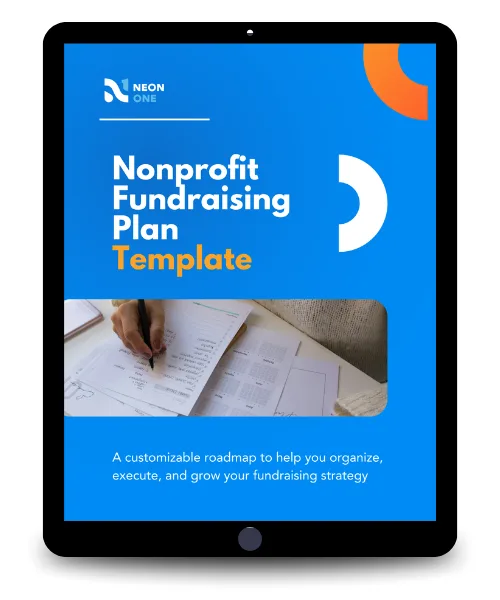
That’s where we come in. Neon One’s free nonprofit fundraising plan template was built for small, scrappy nonprofits like yours to use as their organizing tool. It walks you through the essentials (goals, activities, budgets, segmentation, etc.) so you don’t have to invent a format from scratch.
To download the template, just click the button below. It’s a spreadsheet, and it comes in both Google Sheets and Excel (aka .xlsx) varieties. And, if you’re not in a rush to get started, you can keep scrolling for a simple, five-step process for building a basic fundraising plan that will help you raise more funds without completely burning yourself out.
Let’s get started!
Start Building a Better Fundraising Plan
Whether you’re managing one appeal or a full annual strategy, this free fundraising plan template will help you stay focused, aligned, and on track to meet your goals.
1. Look Back and Learn
Begin by reviewing last year’s fundraising. What campaigns or events worked, and what didn’t? What did you spend (in time and in dollars) versus what you raised?
Small nonprofits often run on some terrible, beautiful combination of faith, caffeine, stubbornness, faith again, and an ever-dwindling list of personal favors called in.
And, while that’s great, you’re gonna need a bit more than moxie to write a successful fundraising plan. You’re going to need data. As much of it as you can get.
After all, you only want to be pursuing fundraising strategies that actually work for your org and your community. And data on your past fundraising efforts is how you’ll get there.
So start by gathering all the information that you can! List each major fundraising activity from last year (e.g. mailing campaign, gala, grants applied), and write down the money raised and the costs—like printing, ads, event catering, etc.—associated with each one.
Once you have those two figures in place, you can calculate your ROI, which stands for “return on investment.” For each activity, determine ‘How much money you spent for every dollar we raised?”
If an event or a campaign barely breaks even, it may be time to let it go—or at least massively retool it before you try again next year.
On the other hand, if an activity earned far more than it cost, plan to repeat or expand it. If something flopped despite tweaks, consider dropping it. Repeat until you have a full picture of last year’s successes and, um, “learning experiences”
In the Template
Use the “Reflection” tab to record these insights. Jot notes about what brought in the most revenue, what donors responded to, and any surprises.
If your nonprofit is brand-new, you can skip this step (but be sure to keep track of this year so next year’s plan can get a head start).

See Neon One in Action!
Check out these 12 self-guided tours and learn how Neon One’s tools empower nonprofits to connect with their communities, move their supporters to action, and simplify their operations.
2. Set Clear Fundraising Goals
Now that you’ve got a good handle on where you’ve been, it’s time to set a destination for where you’re going. In other words, it’s time for everyone’s favorite part of any project planning process: goal-setting.
Don’t just set a target dollar figure and call it a day. You should also be thinking about how many donors you have, how many you’re retaining, and how much you’re raising from them.
At a minimum, your fundraising goal should include:
- Total dollars to raise: This is your annual fundraising goal (often tied to your budget). If your budget says you need $50,000, then that’s your target – plus a bit extra for reserves. Figure out how much money you need to run all your programs, add at least 5-10% for savings, and that sum becomes your goal.
- Donor renewal target: How many of last year’s donors do you want to keep giving? (In practical terms, what retention rate are you aiming for?) The latest data from the Fundraising Effectiveness Project (FEP) pegs average new donor retention at a hair above 18%. That means that not even one in five new donors sticks around year to year. Achieve a number well above that, and you’re in business.
- New donor goal: You should plan to bring in new supporters, too. After all, even if you’re retaining 50% of your recent donors, you still need new ones coming through the doors to grow your overall base. A simple way to set this goal is with a statement like “add 50 new donors.” If you ended last year with 200 donors, maybe aim to grow to 250.
- Dollars raised per donor: Determining how much money you’re raising per donor not only helps you assess the strengths of your fundraising efforts, it also helps you better segment and target future appeals. If your average gift is $50, setting suggested gift amounts at that number while asking your returning donors for a more generous $75 donation is smart, strategic fundraising at its best!
As you define your goals, you should make sure you also have metrics in place, like average gift size, donor retention rate, and new donors acquired.
These metrics are how you’ll measure success against your goals, and sometimes they can be a little complicated to calculate. Having them all recorded in one place is helpful.
In the Template
Write these goals in the “Goals” tab of the template. Seeing numbers on paper (even rough ones) is not only motivating, but recording them is a necessary part of holding people accountable.
The same holds true for the “Metrics” tab.If anyone doesn’t understand what they should be measuring for a specific campaign or how exactly that metric should be calculated, this is the place they can go to find out.
Just remember, though, especially with your goals, that your plan might need to evolve. You can (and should) revisit and adjust these numbers as you gather more information.
For more on setting fundraising goals, check out the article below.

3. Pick Your Strategies and Activities
With your goals in place, it’s time to figure out how you’ll reach them. Your strategy is going to be the overall plan guiding your efforts, while your activities will be the individual actions you take in support of that plan.
Start by focusing on the methods you and your team are already good at. If you love writing letters, plan one big mail campaign or email appeal. If you have a great community network, plan a peer-to-peer campaign or local event.
It’s a cliche, but quality is going to be way more important than quantity. Which is to say: One or two high-impact activities are going to be more effective than ten mediocre ones.
Stuck on what kinds of fundraising activities you can pursue? You’re in luck, our fundraising strategy mega-list has everything you could possibly want!
Next, decide when each activity will happen. For example, maybe you do a big drive in late fall, host your gala event in spring, and apply for grants in the winter. For each of those campaigns, build out a detailed timeline of what needs to happen when.
As you develop your fundraising chops, you’ll also be gathering more and more data that you can use to refine your strategy and try new things. Even something as simple as the time of day when you send a fundraising email can, in the long run, make a real difference.
In the Template
Use the “Activities” tab to record each strategy and activity and assign a rough timeline (e.g. quarter or month). For each activity, note who’s responsible, what the estimated costs will be, and how it ties to a goal. This way, nothing slips through the cracks and everyone knows what’s coming up.

4. Budget Your Plan
No fundraising plan can get off the ground without a budget. Until you have that, it’s more just a bundle of cool ideas than it is an actual “plan.”
Now, this is not a blog post on accounting, so we’re not going to dive too deep into the ins and outs of financial management.
But we will show you how to throw together a basic budget as a part of your fundraising plan.
A fundraising plan needs a clear budget to succeed. The key to creating a solid budget is breaking down your financial goals and the costs associated with achieving them.
Here are the essential components you’ll need, all of which are included in the fundraising plan template:
- Fundraising Activities: List each of your planned fundraising activities, such as your Annual Fund, Major Gifts, or Special Events.
- Revenue Goals: For each activity, specify the, which is the total amount you aim to raise.
- Expenses: For each activity, estimate and list how much it will cost to execute. This includes all direct costs, like advertising, venue fees, or materials.
- Net Revenue: This is what’s left after you subtract the expenses from the revenue goal for each activity. It shows the true financial impact of your efforts.
- Notes: This section is for any important context about a fundraising activity, such as key assumptions, the names of grantors, or specific details about a campaign.
One other factor that’s important to include in your plan is timing. Keep track of when you expect money to come in (e.g., grants received mid-year) and when you anticipate expenses will be due (e.g., printing costs upfront). This helps you manage your finances throughout the year.
Finally, set a recurring review point to check your financial status. The budget’s clear, activity-based structure makes it easy to track your progress and make informed decisions on the fly.
In the Template
The “Budget” tab follows the format we laid out above. There’s also a column to track your Return on Investment (ROI) for each activity, and another column for notes.
We always recommend leaving notes in documents like this one because, when it comes to money, over-explaining is always better than under-explaining.

5. Segment Your Donor Base
Fundraising is most effective when you communicate the right message to the right person at the right time. So, how do you do that? Through the ancient (okay, fairly recent) practice of segmentation!
This is where you split your audience into different groups based on specific characteristics and behaviors. For example, a segment could be described as “people who have given 3 or more times” or “people who have not given in over 18 months.”
By identifying these segments and creating tailored strategies for each—tweaking your appeal language, choosing email over a phone call, or simply asking for a more appropriate gift amount—you can significantly increase the impact of your fundraising activities.
Some of the most common donor segments that your plan will (or will eventually) include are:
- Sustaining Donors: Individuals who have given multiple times (e.g., 3 or more times).
- Major Donors: People who have demonstrated significant financial commitment, often defined by a high giving threshold (e.g., over $1,000 in the past year).
- Lapsed Donors: Previous supporters who have not given a gift in an extended period (e.g., over 18 months).
- Recurring Donors: People have set up a regular, scheduled gift (usually it’s monthly, but not always).
- Volunteers: Individuals who have contributed their time and effort to your organization.
- Board Members: The organization’s governing body, often key stakeholders and major gift prospects.
- Grantors: Foundations or organizations that provide grant funding.
If you’d like to know more about the ins and outs of segmentation, boy oh boy, have we got the article for you. It’s called Donor Segmentation: The Complete Nonprofit Guide.
In the Template
In the “Segmentation” tab, you’ll identify the different groups of people you want to reach, such as Major Donors or Lapsed Donors, alongside the specific criteria for each segment, like their giving history or engagement level.
Finally, you can specify the targeted fundraising activities and communication channels you will use to connect with them. That’s it!

Get This Template & Put Your Plan Into Action
The last piece of advice we can offer you here is one you’ve almost certainly heard before, but that you can definitely stand to hear one more time: Don’t let perfect be the enemy of good.
If everything isn’t going to plan—and it never goes entirely to plan—focus on what is working instead of what isn’t, adjust your strategy accordingly, and just focus on getting it done. A completed fundraiser that only hit 70% of its goal is infinitely better than a perfect fundraiser that only ever existed on paper.
That’s one of the big reasons we put together this nonprofit fundraising plan template: Because going from “it’s on paper” to “it’s actually happening” is the hardest part of any fundraiser.
With this spreadsheet in hand, you’ll have a step-by-step guide to get you from big picture revenue targets to mid-level strategies to small-bore tactics like email versus texts.
If you’re like most nonprofit leaders, you wear a ton of hats, and you have approximately negative 2 hours of time in your daily schedule to focus on strategic planning. Let us help you out. Download the template–it comes in both Google Sheet and Excel—use the examples included as inspiration, and just start writing.
And if you’re looking for a more robust donor management system to help you with fundraising, make sure to check out Neon One!
Good luck!