
— KEY TAKEAWAYS
Your CRM is more than a dry record of donors and gifts. Every constituent record is a story arc (first gift, rising action like volunteer shifts or event RSVPs, and a climax like an upgraded or recurring gift), and nonprofits that stop reading at page five struggle to grow their giving.
- Data should back up stories, not replace them. A story about one person (“Maria’s story is one of 500”) moves donors more than a big statistic, since large numbers trigger “psychic numbing” and dull empathy.
- Expand donor profiles with surveys and custom fields (interests, employer, family), and unify gifts, emails, texts, events, volunteer hours, memberships, and purchases in one CRM record so you see the whole relationship, not just a transaction.
- Use that unified data to build living donor segments (volunteers, gala regulars, lapsed donors) and pair them with automated workflows that trigger personalized messages at key moments, keeping outreach personal as your list scales.
- Common mistake: relying on a CRM that only tracks gift history, or duct-taping five disconnected tools together; that fragmentation hides the real relationship your nonprofit has with each donor and makes it harder to connect with them.
What does your nonprofit use your CRM for? Storing donor records, sure. Sending emails, great. Hosting donation forms and your payment processor, awesome. But if you’re not using it to help shape the stories you’re telling to your donors—not to mention the appeals that those stories build up to—then you’re not using it to its full potential.
And that’s a shame! Because every constituent record in your database is basically a plot outline. It’s got a beginning: the first gift, the first event. It’s got rising action: the volunteer shift, the membership renewal, the text they actually replied to. And it’s got the climax: a second gift, a big upgrade, signing up to become a P2P fundraiser.
But too many nonprofits never look past the first gift, even though that’s like never reading a book after only five pages. And that’s why they struggle to turn one-time donors into recurring ones—even though those relationships are where the real value lies.
Why Recurring Donors Outvalue One-Time Donors
Neon One’s 2026 Recurring Donor Report tracked three years of transaction data across 4,107 nonprofits. Recurring donors average $7,288.26 in lifetime value. One-time donors: $3,606.90. Recurring donors retain at 79.11%, against 32.41% for one-time givers.
With numbers like that, you don’t even need to “do the math” (thank god). They speak for themselves. Loudly.
The secret to nonprofit CRM data is this: The more of it you have, and the more you dive into it, the better you will understand your donors. You can analyze which events they attend, which emails they open, which appeals they respond to. Add that all together, and you get a great portrait of what they’re most interested in about your work.
You can then use that knowledge to craft a targeted message that resonates with a specific segment of your donors. You make them feel seen, feel connected to your mission, and feel inspired to stay involved.
In other words, you’ve got them well on the way to moving from one-time or sporadic donor to a committed recurring loyalist.
To check out the full Recurring Donor report, just hit the button below. To continue learning about CRM data and storytelling, read on!
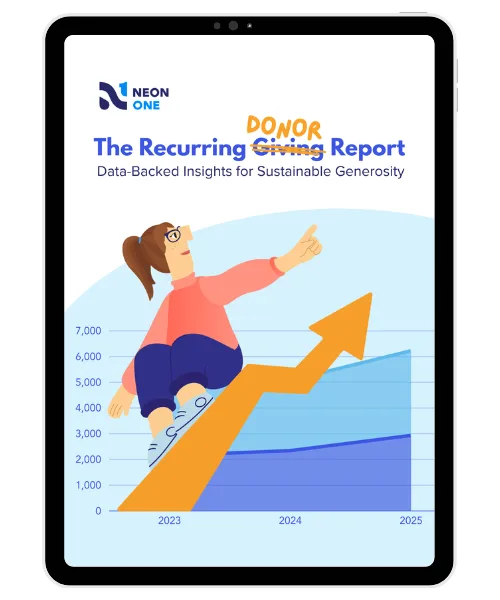
Get the 2026 Recurring Donor Report
Data-backed findings from over 4,000 nonprofits and 2,000 nonprofit donors show why recurring givers are the future of nonprofit fundraising.
Watch Out: Data Alone Won’t Move Anybody
Let’s make one thing clear that we are not telling you to do: Under no circumstances should you take “use data” to mean “throw a bunch of statistics at your donors and watch as the gifts roll in.”
In fact, the psychology of giving (and of people in general) states that you want to do the exact opposite.
“500 families served this year” is a genuinely impressive number, and it lands with the emotional force of a parking receipt. And what’s crazier than that is that upping the number to 5,000 families served or even 50,000 would have no real effect.
Psychologists call this psychic numbing: a mental reaction where people feel less empathy or care the bigger a number gets, as it makes the individual human feel small. That’s just how our brains work. Ask yourself: when was the last time that a big impressive statistic moved you to action? (See?)
Research into nonprofit storytelling backs this up hard. You remember stories way more effectively than you remember standalone statistics. Plus, appeals built around a real narrative raise roughly twice as much as the ones built purely on data.
You don’t need to ditch your numbers entirely. But what you do need to do is lead with a person, then let your CRM do the heavy lifting behind them. “Maria’s story is one of 500 we could tell this year” does something “500 families” never will.
That’s nonprofit storytelling at its technocratic finest. The story comes first, and then the data backs it up.
Use Surveys and Custom Fields to Expand Your Donor Profile
People support your nonprofit when your message reflects who they are—a parent, a lifelong resident, part of a professional community—not just what your organization does.
This is called identity-based giving, and you can see the effect in Neon One’s Nonprofit Email Report: Professional associations, whose audiences share an unusually strong identity, post the highest open rates and lowest unsubscribe rates of any nonprofit sector.
If your CRM can only tell you when someone gave and how much, you’re working off half a person. Honestly, maybe as little as a third.
It starts with what kind of data you collect. After someone makes a first gift, utilize the Benjamin Franklin Effect—which states that people like you more after they’ve already done you a favor—and send them a quick donor survey to learn more about them!
Take that data and add it to their profile using custom fields. Interests, marital status, children, alma mater, place of employment, whether they thought Twin Peaks: The Return was a masterpiece or a letdown—all of these data points can help you create stories that will resonate with them.
But even all the custom fields in the world won’t help you if your system is limited to donations.
The More Tools in Your CRM, the More Data You Can Analyze
If your CRM can only tell you when someone gave and how much, you’re working off half a person. Honestly, maybe a third. Just a pair of legs that ends abruptly in the mid-thigh.
The rest of that person’s story lives somewhere else. Your volunteer spreadsheet. Your events tool. Your development director’s handwritten notes. None of them talk to each other, so the who and the why behind the giving—the actual identity—falls through the cracks.
Take a donor who volunteers at your food pantry monthly, shops your thrift store, and shows up to your gala every June. That’s not a transaction. That’s a relationship. But if your system only tracks them by what they’ve given, you’ll never see it.
You could also manually import, update, and cross-reference data across five different tools, forever, every single time you want the full picture. That works. It’s just not an effective plan.
A single, unified constituent profile fixes it. In Neon CRM, you keep gifts, emails, texts, event attendance, volunteer hours, memberships, and store purchases on one record—so you see the whole relationship, not just the transaction.
That’s the difference between writing to “Maria the volunteer-slash-donor-slash-regular-at-the-gala” and writing to “a $50 gift from March.”Nobody wants to open an appeal and feel like “donor #1138.” Give them a record that remembers how they actually show up for you, and they’ll feel like it too.
Turn Data into Donor Segments that Reflect Real People
A complete profile is only as good as what you do with it. You know Maria volunteers monthly, shops the thrift store, and shows up every June for the gala. So what does she get from you, and when?
This is where segmentation stops being a database chore and starts being a relationship strategy—because the identities and behaviors your unified profile just surfaced are exactly what should decide who gets which message. Not everyone gets the same appeal blasted at the same time.
In Neon CRM, that means pulling from the same fields that built the unified profile—giving history, volunteer hours, event attendance, membership status, store activity—to build segments that move as people move.
Maria doesn’t get stuck as “donor” forever. She picks up a second volunteer shift or lets a membership lapse, and she slides into a new segment automatically.
From there, every segment gets its own path. Volunteers get a welcome series that leads with stories from the field. Gala regulars get a sequence that opens with photos from last year before it ever asks for anything. Lapsed donors get reintroduced to the mission before they get an ask at all.
You’re speaking to people’s actual experiences, not just their last transaction—and they’ll reward you for it.
Pair CRM Data With Automation to Personalize at Scale
The more segments and journeys you create, however, the more work you create for yourself to schedule those messages, load in the right copy and imagery, and just generally keep all of these metaphorical plates spinning.
This is where automation enters the story, because it’s what lets you keep the personal touch as your donor list grows.
Let’s use Neon CRM’s automated workflows as an example. They trigger the right message at the right moment based on what’s actually in your donor’s profile: a milestone gift, a lapsed membership, a first event RSVP. You can group and message donors by that engagement, not just gift size, and your thank-you to a monthly volunteer stops sounding like your thank-you to a first-time online donor.
Set the trigger once, and Neon CRM handles it from there. A donor hits their third consecutive month of giving, and the system automatically sends them a message about long-term impact instead of a generic thank-you. A member lets their renewal lapse, and Neon CRM flags it before you’d ever catch it scanning a spreadsheet by hand.
Even better, you can pick from a menu of “one click” workflows that are available out of the box for common types of donor journeys, or you can build an unlimited number of fully bespoke journeys that fit exactly what your supporters need.
None of this replaces the stories you’re telling. It just makes sure the right story reaches the right person without you tracking dozens of individual segmented timelines on your own.
To Find the Right Stories, Find the Right CRM
Running a basic CRM that only stores gift history? Duct-taping together five different tools for email, events, and volunteers? You can’t find your best donor stories if your data lives in five different places. Or rather, you can, but you’ll wear yourself out in, like, six months tops.
If you want to start using CRM data to improve your nonprofit’s storytelling, start by getting your constituent data into one system that tracks the whole relationship: gifts, emails, texts, events, volunteer hours, memberships, and purchases, all on one profile.
In other words, find yourself a true all-in-one platform like Neon CRM that combines (deep breath) fundraising, donor management, email, text, payments, reporting, automation, events, volunteers, memberships, P2P and–believe it or not—even more than that in one unified system with one simple login.
Want to see it in action? Take a quick, self-guided tour and check it out for yourself!
Author Bio
Alex Huntsberger, Content Marketing Manager
Alex Huntsberger is Content Marketing Manager at Neon One, where he brings his expertise in nonprofit fundraising, events, and memberships to the Neon One blog. Alex has spent over a decade as a content writer, search marketer, and communications pro. He’s also an experienced theater critic and arts writer, having covered plays and musicals across Chicagoland since 2010 for the Chicago Sun-Times, Time Out Chicago, and Newcity Stage. Like every other liberal arts grad in the Chicago area, Alex once worked for Groupon. He currently lives in Mundelein, IL, with his wife and their two children.