

If you want to grow your nonprofit without losing sight of your mission, it’s going to take a clear strategic roadmap, reliable (and diverse) revenue, and operational systems that can grow right alongside you. This guide outlines ten practical strategies nonprofits use to grow sustainably, including clarifying goals, strengthening donor relationships, diversifying revenue, improving digital engagement, and building systems that scale. It emphasizes aligning growth with mission, measuring progress with the right KPIs, and using technology to reduce manual work, centralize data, and maintain personal relationships as your organization expands.
Growing a nonprofit takes more than passion and a good mission—it takes strategy, sustainable funding, and systems that can handle expansion without falling apart. Most nonprofit organizations (like, 97% of them in the US) never crack $5 million in revenue.
And that’s not a bad thing! There are a lot of nonprofits that prefer to stay small. But there are also many orgs that want to grow bigger, and yet they keep stalling out, anyway. More often than not, it’s because the org is still running the same way it was when it was one-tenth the size.
This guide walks through ten proven strategies that help nonprofits scale successfully, from building a strong foundation early and diversifying your revenue streams to employing technology that grows with you.
You’ll learn how to strengthen donor relationships, expand your digital presence, and create the operational systems that turn growth from a pipe dream into an everyday reality.
1. Build a Strong Foundation for Sustainable Nonprofit Growth
Growing a nonprofit comes down to three things: strategic planning, financial sustainability, and building strong relationships with your donors, volunteers, and partners. (We said it was three things; we didn’t say those three things were easy.)
Before you start working on a plan to expand your nonprofit, take some time to figure out if your organization is actually ready to grow—because scaling too fast without the right foundation can end up hurting your organization more than helping it.
Think of it like building a house. You can’t add a second story if the first floor isn’t solid. Or, rather, you can try that, but you’re not allowed to act surprised when the whole thing comes crashing down around you.
Align Growth Plans with Your Mission
Every decision you make on growth should (should!) connect back to your core mission. When organizations chase funding opportunities or partnerships that don’t quite fit, they risk something called mission drift. That’s when you slowly start doing work that doesn’t really serve your original vision, and before you know it, your nonprofit has lost focus on why you exist.
So, ask yourself: Will this expansion help us serve our beneficiaries better, or are we just growing because growth sounds good?
Assess Your Organization’s Current Capacity
Before scaling up, take an honest look at what you’ve got. Can your current team handle 50% more clients? Do you have the processes in place to manage increased donations? Would your technology actually support double the amount of data you’re tracking right now?
Figuring out these gaps now—before you’re overwhelmed—will help you to better address them. Growth that happens faster than your staff can handle leads to burnout, mistakes, and a decline in the quality of services you provide to your community. All of which you want to avoid at all costs.
Define Your Nonprofit’s Unique Value Proposition
What makes your organization different from the other nonprofits serving similar communities? No, seriously, that’s not a rhetorical question. Before you start to grow your nonprofit, you should be able to answer it.
Maybe you have a proven track record with a specific group of people, or perhaps your approach combines services in a way no one else does. Whatever it may be, your unique value proposition is the reason why someone picks your work over another organization’s.
This clarity becomes really important as you grow. It helps you stand out in fundraising conversations and makes partnership discussions a whole lot easier.
2. Set Clear Goals and Success Metrics for Your Nonprofit Organization
Growth without measurable goals isn’t all that different from just “staying busy.” Effective strategic planning means defining exactly what success looks like at each stage, then tracking whether you’re actually getting there and where you might be falling short.
Establish SMART Growth Objectives
SMART goals—Specific, Measurable, Achievable, Relevant, and Time-bound—transform vague wishes into actual targets. Instead of “increase our donor base,” try “acquire 200 new monthly donors contributing at least $25 each by December 31st.”
The specificity of SMART goal planning forces you to think through the details early. How will you reach those donors? What resources will it require? SMART goals help you ask (and answer!) questions when it’s still easy to adjust your approach, not when it’s too late.
Identify Key Performance Indicators
Key performance indicators, or KPIs, are like the vital signs of your nonprofit’s health. They tell you at a glance whether your growth strategies are working or whether you’re heading in the wrong direction.
Here are some KPIs that are going to matter for growth:
- Donor retention rate: How many supporters keep giving year after year?
- Program participation growth: How many more people are youserving compared to last year?
- Fundraising efficiency: How much does it cost to raise each dollar?
- Average gift size: Are donors increasing their giving over time?
- Recurring donors: How many donors are giving at set, regular intervals?
If you’re already measuring KPIs, great. But are you measuring the right ones? What mattered 5 or 10 years ago might not matter as much today. To learn what KPIs you should be tracking for 2026, join us for our tech circle webinar, 3 Nonprofit KPIs You Should Measure This Year.

Create Your Growth Timeline
Breaking growth into short-term, mid-term, and long-term phases helps you keep realistic expectations. Maybe your six-month goal is starting a monthly giving program, your one-year goal is hiring a development director, and your three-year goal is opening a second location.
Pacing matters more than you might think, here. Organizations that try to do everything at once often end up not accomplishing much at all. Or, if you want a more optimistic view, they do a fantastic job of accomplishing nothing. Either way, it’s not great.
3. Strengthen Donor Relationships to Fuel Growth
Here’s something that too many nonprofits still get backwards: Sustainable growth doesn’t come from chasing new donors, it comes from deepening the existing relationships that you already have.
Acquiring a new donor typically costs seven times more than keeping an existing one, yet so many organizations spend most of their energy on acquisition instead of stewardship and retention.
The nonprofits that grow successfully are the ones that flip this around. They invest heavily in the donors they already have, recognizing that engaged supporters give more, give more often, and bring their friends along for the ride.
What does that look like in practice?
- Personalized communication: Tailor your messages based on each donor’s history and interests, not the same email blast to everyone.
- Regular stewardship: Show impact through updates and thank-you messages that arrive when donors don’t expect them.
- Engagement opportunities: Invite donors to events, volunteer days, and behind-the-scenes experiences that deepen their connection.
This kind of engaged stewardship will work wonders, but, if you don’t have the right technology in place, it might also bury your staff under an avalanche of tasks, messages, follow-ups, and touchpoints.
That’s why you want to have the right technology—aka a platform that lets you centralize your supporter data and functions, automate common donor journeys, and unearth the kinds of insights and learnings that will help you build more personal relationships with everyone in your community.
In other words, you want a platform like Neon One that’s designed to manage—and strengthen–all of your nonprofit’s relationships. To learn more, we encourage you to take a quick tour through the platform to see how it can help you!

See Neon One in Action!
Check out these 12 self-guided tours and learn how Neon One’s tools empower nonprofits to connect with their communities, move their supporters to action, and simplify their operations.
4. Expand Your Nonprofit’s Digital Presence
Your online presence is often the first impression potential donors, volunteers, and partners get of your organization. Digital channels have become the primary way to reach broader audiences and grow your supporter base. And, compared to traditional channels, they let you do so without breaking the bank.
Optimize Your Website for Donor Engagement
Your website should do three things well, or it doesn’t work: make giving easy, tell compelling stories, and function perfectly on mobile devices. If someone has to click more than twice to donate, you’re losing supporters right there.
Beyond the donation button, your site clearly explains your impact, showcases stories from the people you serve, and offers multiple ways for visitors to get involved. Think of it as your 24/7 staff member—it works that hard for you.
Neon Websites is our nonprofit website builder that’s designed to fit the needs of organizations like yours. We make it easy to build and manage a great-looking website that helps raise your digital profile while syncing data seamlessly with your Neon CRM database.
To see Neon Websites in action, take a tour!
Build Your Social Media Community
Pick platforms where your audience actually spends time instead of trying to be everywhere at once. A strong presence on two platforms beats a weak presence on five any day of the week.
Focus on authentic storytelling and consistent engagement rather than chasing follower counts. A smaller, engaged community that comments, shares, and takes action is worth far more than thousands of people who scroll past without stopping.
Launch Targeted Email Campaigns
Email remains one of the highest-ROI channels for nonprofits. The key is segmentation—sending the right message to the right people at the right time instead of blasting everyone with the same content.
Start by segmenting your email list by giving history, volunteer involvement, event attendance, and expressed interests. Then write messages that speak directly to each group’s relationship with your organization, not generic appeals that could come from any nonprofit.
The deeper you get into segmentation, the better you’ll get at identifying different groups of supporters and tailoring your messages to speak directly to their interests.
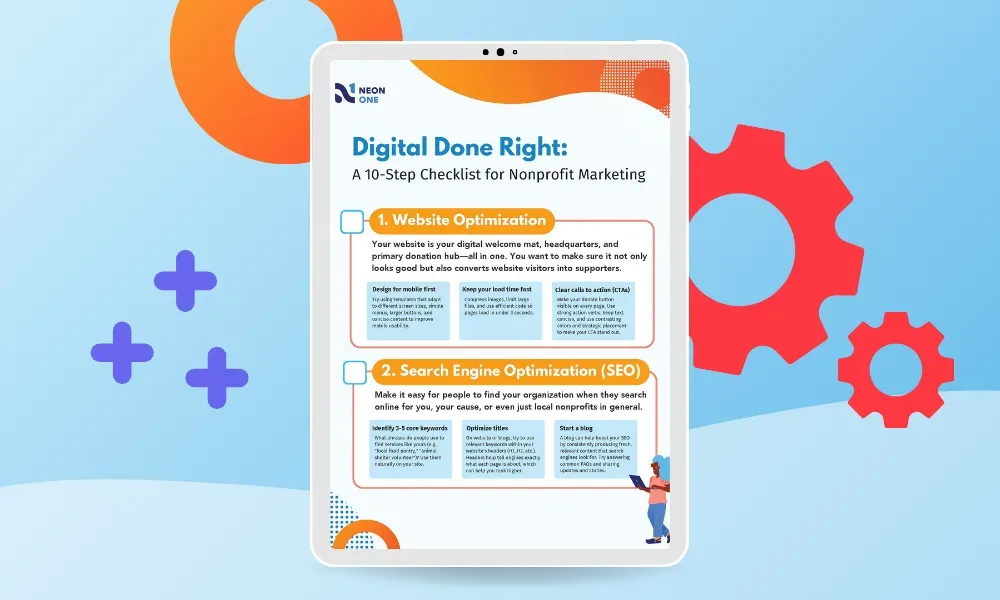
For some more strategies you can pursue to expand your digital presence, download our Digital Marketing Checklist!
5. Develop a Diversified Fundraising Strategy
Relying on a single funding source creates real risk. When that source dries up—or even if it just fluctuates wildly from one year to the next—your entire operation becomes vulnerable overnight.
By diversifying your fundraising strategy, you protect against that. The broader your base of funding sources, the less likely that changes to any one source will torpedo your work.
Create Multiple Revenue Streams
The most resilient nonprofits tap into several different funding sources. You don’t need all of these, but having three to five different streams provides stability as you grow.
Here are some of the most common ones:
- Individual donations, both one-time and recurring
- Foundation and government grants
- Corporate partnerships and sponsorships
- Membership programs
- Special events
- Earned income activities
Build a Recurring Donation Program
Monthly giving provides the predictable revenue that makes growth planning actually possible. When you know $10,000 is coming in every month from recurring donors, you can make hiring and program decisions with real confidence instead of crossed fingers.
Monthly donors often give more annually through small monthly gifts than they would in a single year-end donation. A $25 monthly donor contributes $300 per year—more than many people would write in one check.
Cultivate Major Donors
Major donors—people capable of giving significant gifts—can accelerate your growth dramatically. The catch? Major giving is about relationship-building, not transactions or quick asks.
Start by identifying donors who have both the capacity and the inclination to give more. Then invest time in understanding their interests, showing them real impact, and inviting them into a deeper partnership with your mission.
Here’s a quick tip: The best place to find major donors might just be inside your existing database.
6. Use Tech That Can Grow With You
Manual processes that work fine when you’re small become bottlenecks as you grow. The time to build systems is before you desperately need them, not after you’re drowning in spreadsheets and missed follow-ups.
Automate Repetitive Administrative Tasks
Look at the tasks consuming hours each week that don’t actually require human judgment—sending donation receipts, processing event registrations, scheduling follow-up emails. These are perfect candidates for automation.
Automation frees your staff to focus on work that actually requires a human touch: building relationships, solving complex problems, and creating a strategy that moves your organization forward.
Neon One not only lets you build your own automations, but it also comes with a set of pre-built workflows for common interactions and donor journeys. We call them “One-Click Workflows” because, in order to set up, all it takes is a single click!
Standardize Your Operations
Create consistent processes for common activities like onboarding new donors, acknowledging gifts, recruiting volunteers, and reporting impact. When everyone follows the same process, quality stays consistent, and training new team members becomes much, much easier.
Document these processes in simple formats. Even basic checklists can make a huge difference in how smoothly things run when someone’s out sick or a new person joins the team.
Document Organizational Best Practices
Capture what works before it walks out the door. When key staff members leave, they take years of learning with them unless you’ve written down how things work and why certain decisions were made.
This documentation prevents major disruptions during transitions and helps new team members get up to speed faster instead of reinventing wheels you’ve already perfected.
7. Form Strategic Partnerships That Amplify Impact
The right partnerships extend your reach without requiring you to duplicate services or stretch your resources too thin. Collaboration lets you serve more people, access new funding, and tap into expertise you don’t have in-house.
Consider partnerships with:
- Complementary organizations: Nonprofits serving the same community with different services can refer clients and coordinate care.
- Corporate partners: Businesses provide sponsorships, employee volunteer programs, and cause marketing campaigns.
- Government agencies: Collaborations on community initiatives open doors to public funding.
- Educational institutions: Universities offer research support, student volunteers, and subject matter expertise.
8. Expand Programs Based on Community Needs
Program growth responds to genuine community needs, not just organizational ambition or the desire to look bigger. Expanding for the sake of growing rarely serves anyone well—not you, not your staff, and definitely not the people you’re trying to help.
Conduct Community Needs Assessments
Before launching new programs, gather input directly from the community you serve. Use surveys, focus groups, and interviews with stakeholders to understand what gaps exist and whether your organization is actually positioned to fill them.
This research prevents you from pouring resources into programs that nobody actually needs or wants. It also builds community buy-in from the start.
Pilot New Program Initiatives
Test programs on a small scale before committing fully. A pilot lets you learn, adjust, and prove impact without betting everything on an untested idea.
Set clear success criteria before you start (another opportunity for SMART goals!), then evaluate honestly when the pilot ends. Not every pilot will s\ucceed—that’s okay and actually valuable information. Better to learn that early than after you’ve invested years and serious money.
Scale Successful Programs
When a pilot proves successful, it’s time to consider expanding. Evaluate whether you have sustainable funding, whether you can maintain quality at a larger scale, and whether you have the staff capacity to grow without burning everyone out.
Scaling too quickly can diminish impact if quality suffers. Measured, strategic expansion serves your beneficiaries better than explosive growth that looks impressive but doesn’t deliver results.
Again, this is an area where you’ll want to take a long, hard look at the technology you’re using. Are your existing systems helping you grow or are they holding you back? Speaking of which, look at what the next section is about!
9. Leverage Technology to Grow a Small Nonprofit Efficiently
The right technology helps small teams accomplish more and manage growth without adding staff proportionally. The wrong technology—or too many disconnected tools—creates more work than it eliminates and leaves everyone frustrated.
Integrated platforms consolidate the functions that matter:
- Donor Management: Centralize supporter information and track every interaction in one place
- Fundraising: Streamline online giving, peer-to-peer fundraisers, and campaign management
- Communication: Coordinate email marketing, social media, and website updates
- Event & Volunteer Management: Power your community outreach through event registration and volunteer signups.
- Reporting: Generate insights that inform smarter decisions
Platforms like Neon One bring all of these functions (and all of that data) together in one system, eliminating the data silos and double-entry that come from juggling multiple tools. When your donor database talks to your email platform and your event system, you save hours of manual work every week and reduce errors that frustrate donors.
One of the unique advantages that Neon One offers is a revenue-based pricing setup that doesn’t penalize you for adding new records. You can add as many potential donors (i.e., event registrants, volunteers, and newsletter subscribers) as your heart desires without fretting about increased costs. You can just focus on the relationships, not the records.
10. Track, Measure, and Optimize Your Growth Strategy
Growth requires ongoing evaluation and adjustment, not a set-it-and-forget-it approach. What works this year might not work next year, and what works in one community might flop in another.
Build a rhythm of continuous improvement.
Start by reviewing your KPIs monthly (and quarterly, and annually) against your goals, then gather feedback regularly from staff, donors, and program participants. Use this mix of quantitative and qualitative data to identify what’s working well and what’s not hitting the mark.
Before moving on, make sure you celebrate wins publicly to keep momentum going. Once the party is over, you can go back to adjust your strategy based on actual data and insights, not just gut feelings or what you hope is true.
Then the virtuous cycle spins on. You’ll continue to review your KPIs against your goals, gather feedback from your stakeholders, identify what’s working well, and do it all over again.
Grow Your Nonprofit By Putting Relationships First
Sustainable growth requires both a smart strategy and the right tools to execute it. Many growing nonprofits struggle because they’re managing expansion with systems designed for much smaller organizations—or worse, with no real systems at all, just a patchwork of spreadsheets and workarounds.
Neon One’s integrated nonprofit relationship management platform combines donor management, fundraising, events, communications, volunteers, and memberships in one unified system. This eliminates data silos, reduces administrative work, and lets your team focus on building relationships and creating impact instead of wrestling with technology.
As you grow, your technology grows with you instead of holding you back. Ready to see how Neon One can help your organization grow? Book a custom demo today.
FAQs About Growing Your Nonprofit
Growth timelines vary based on your starting point and the strategies you implement, but most nonprofits see measurable progress within six months to a year of consistent effort. Focus on leading indicators like engagement rates and donor retention early on, while revenue growth and program expansion typically take longer to show up in the numbers.
You can start growing your small nonprofit with a minimal budget by focusing on relationship-building, optimizing what you already have, and using free or low-cost digital tools. As you generate additional revenue, reinvest a portion—typically 15-20%—into technology, marketing, and capacity-building that accelerates growth down the line.
Use donor management technology to track relationship details and automate routine communications, which frees your time for meaningful personal interactions with key supporters. Segment your donor base so you can provide appropriate levels of personalized attention based on engagement and giving history instead of treating everyone the same.
Consider investing in relationship management software when you’re tracking donors across multiple spreadsheets, missing follow-up opportunities, or spending excessive time on manual tasks. The right system becomes really valuable as you grow beyond managing relationships through personal memory alone—typically around 100-200 active donors.