
If you were to look at a large sample of nonprofits and try to figure out why some of them failed while others succeeded, you’d find that the board of directors was a major factor. Organizations with great, engaged boards tend to thrive, while organizations with weak or disengaged boards tend to wilt.
If you’re creating a brand-new nonprofit, you’re going to need a board. Like, legally, you can’t have one without it. Still, when creating a board of directors for your nonprofit, you should prioritize creating a good one, or even a great one. The future of your mission might actually depend on it.
Now that we’ve laid the pressure on (sorry!), we’ll offer you some help. In this article, we’ll cover all the major points of building a strong nonprofit board, from structure to recruiting, onboarding, and running effective meetings—we touch on it all.
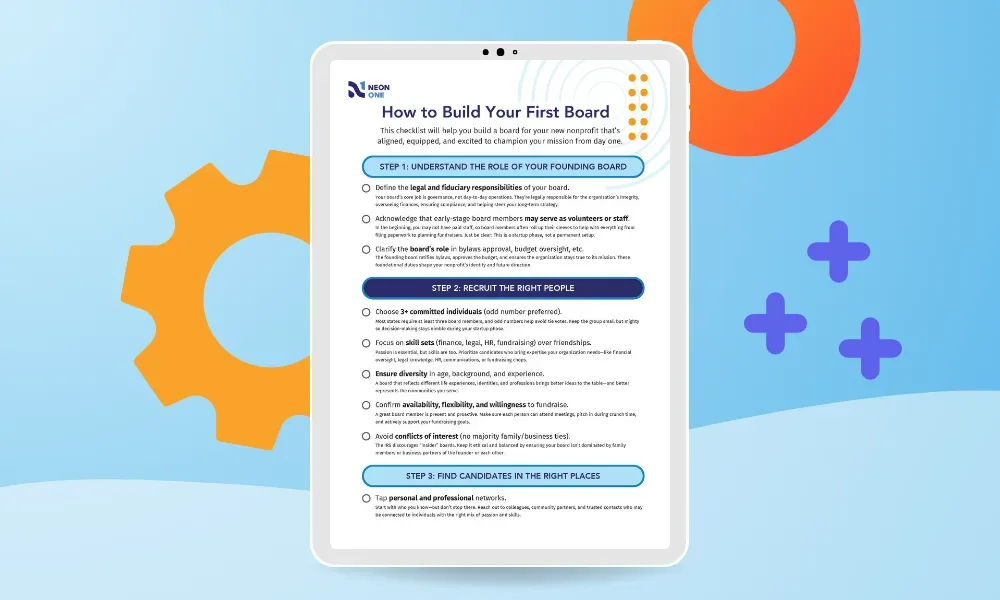
Plus, we’ve got a handy How to Build a Nonprofit Board checklist you can download to help you design the nonprofit board that your mission deserves. Okay, there’s a lot to cover, so let’s get moving!
Table of Contents
- What a Nonprofit Board Actually Does (And Why It Matters)
- Nonprofit Board Structure: Roles, Terms, and Committees
- Recruiting Your Founding Board: Where to Start
- How to Effectively Onboard & Train Board Members
- Defining Board Member Expectations & Accountability
- How to Run Productive, Engaging Board Meetings
- Your Board Fundraising Plan: Play to People’s Strengths
- Looking Ahead: Board Development & Succession Planning
- Get Your Free Nonprofit Board Checklist
What a Nonprofit Board Actually Does (And Why It Matters)
The board is the hub of your nonprofit, the central force that holds it accountable to the mission, ensures legal and ethical integrity, and helps it grow with purpose. They don’t handle day-to-day nonprofit operations—that’s the staff—but they are accountable for the results.
Broadly speaking, your nonprofit’s board is responsible for … everything your nonprofit does. Speaking more specifically, board responsibilities fall into three core categories: legal, strategic, and practical.
Legal Duties: Governance, Fiduciary Oversight, and Compliance
Your board’s legal duties boil down to ensuring that the organization adheres to state laws, federal tax requirements, and its own governing documents. Practically, this includes filing and approving key documents like the Articles of Incorporation and bylaws, maintaining proper financial records, and fulfilling obligations tied to 501(c)(3) status.
The board also has fiduciary responsibilities—”fiduciary” is a term that basically means “being placed in a position of trust”—that are similar to those assumed by the board of a for-profit company. Those three fiduciary responsibilities are:
- Duty of Care: Directors must actively participate in decisions, read reports, and ask questions. Their role is to bring informed judgment to the table, not to rubber-stamp proposals.
- Duty of Loyalty: Board members must put the nonprofit’s mission above personal or professional interests. Any conflicts of interest must be disclosed and addressed.
- Duty of Obedience: The board ensures the organization stays aligned with its mission and follows all applicable laws and ethical standards.
By fulfilling these duties, the board protects both the public trust and the organization’s ability to operate legally and transparently.
Strategic Duties: Mission, Leadership, and Planning
The board is the keeper of the mission. It defines the long-term vision and ensures that the organization’s work stays focused and effective.
One of the most significant areas where this duty manifests is in hiring, supporting, and evaluating the Executive Director or CEO. A strong board provides clear expectations, conducts regular evaluations, and steps in if leadership changes are necessary.
Beyond executive oversight, the board works in partnership with leadership to set goals, approve strategic plans, and respond to external changes. They help chart the path forward, assess progress, and ensure the nonprofit can adapt as needed to serve its community well.
Practical Duties: Budgeting, Fundraising, and Community Engagement
While boards don’t manage programs or staff, they play a vital role in the nonprofit’s operations through high-level involvement in finances, fundraising, and advocacy.
- Financial Oversight: Boards approve annual budgets, review financial statements, and help maintain the nonprofit’s long-term fiscal health.
- Fundraising: Every board member is expected to contribute financially and help raise funds. This might mean hosting a donor event, making introductions, sharing the organization’s story online, or simply writing a check.
- Community Engagement: Board members also serve as public champions. They help raise awareness, speak at events, and open doors to new partnerships and supporters.
When everything’s clicking, a thoughtful, well-informed board can elevate a nonprofit’s impact, protect its integrity, and help it thrive through change.

Nonprofit Board Structure: Roles, Terms, and Committees
Boards are like any other institution; they function best when they have a structure that’s clear, balanced, and thoughtfully designed. It’s easy for early-stage organizations to overlook this step in favor of getting things done quickly.
Fight that urge. Hard. Investing in the right board structure from the start helps prevent confusion, burnout, and power struggles later.
Board Officer Roles
Most nonprofits designate three core officers:
- Chair (or President): The chair leads the board and serves as a key partner to the executive director. They set meeting agendas (often in collaboration with staff leadership), facilitate discussion, and help ensure the board stays focused and effective.
- Secretary: This role is about accountability and documentation. The secretary keeps official records, takes meeting minutes, tracks board resolutions, and ensures the organization stays compliant with its bylaws.
- Treasurer: The treasurer oversees financial reporting and helps the board understand the organization’s fiscal health. They may present budgets, interpret financial statements, and chair the finance committee.
Some boards also designate a Vice Chair/President, who can support the chair and take on special assignments. As your board gets bigger and more involved, a VP role will really help make sure nothing falls through the cracks.
Term Lengths & Continuity
Setting term limits helps ensure healthy turnover on your board while giving members enough time to contribute meaningfully. A common model is one- to three-year terms, with members only being able to serve a maximum of two or three terms in a row.
Just as important is staggering your terms. You don’t want your entire board to roll off at once. When terms are staggered, you retain valuable institutional knowledge and ensure smoother transitions. This is especially vital during leadership shifts or major campaigns.
Make sure your bylaws spell out how terms work, how officers are elected, and what happens when someone resigns or isn’t meeting expectations.
Committees
Committees allow board members to dive deeper into specific areas and contribute more effectively. There are two types of committees to consider: standing committees and ad hoc committees.
Standing Committees are permanent and address ongoing needs. Common examples of a standing committee include:
- Finance Committee: Oversees budgeting, audits, and financial planning.
- Governance Committee: Handles recruitment, orientation, and board evaluations.
- Development Committee: Supports fundraising strategy and donor engagement.
Ad Hoc Committees, meanwhile, are temporary and created for specific projects. These might include:
- Search Committees for hiring a new executive director.
- Event Planning Committees for major fundraisers or anniversaries.
- Strategic Planning Committees during a major organizational pivot.
Committees should have clear charters, meet regularly, and report back to the full board. Not every board member needs to sit on a committee, but every committee should be made up of people with relevant skills and an interest in the topic.

Recruiting Your Founding Board: Where to Start
Before your nonprofit can even become a nonprofit, it needs a board of directors. Beyond co-signing your application, the people you choose at this stage will shape how the organization grows—and whether it lasts.
Start by aiming for a small, committed group of three, five, or (max) seven individuals. This keeps decision-making efficient, allows everyone to stay engaged, and—since three, five, and seven are all odd numbers—avoids tie votes.
Most states require at least three board members, and many nonprofits start with this minimum and expand as needed.
Legal Foundations and IRS Requirements
The IRS expects public charities to operate independently, which means a majority of your board cannot be made up of related individuals or business associates.
Some states impose their own restrictions on board composition, term limits, or conflict-of-interest rules, so it’s critical to check your local nonprofit statutes before finalizing your roster.
Choosing the Right People: What to Look For
More than anything, your founding board members need to be all-in. At this stage, enthusiasm matters as much as experience. Look for people who believe in your mission, are ready to contribute time and resources, and are willing to learn and adapt.
Here’s what to prioritize:
- Mission Alignment: You want people who show up because they care, not just because they were asked.
- Availability & Commitment: Members may need to help with incorporation, fundraising, planning, and community outreach. Choose people who have time and energy to give.
- Diverse Skills & Backgrounds: To improve decision-making, aim for a mix of experiences, whether that’s professional (lawyer, accountant, marketer) or social (age, race, gender, worldview).
Avoid the temptation to simply stack your board with high-profile names or wealthy individuals unless they’re also ready to work. A prestigious title won’t help if someone’s checked out.
How to Effectively Onboard & Train Board Members
In a brand-new nonprofit, “onboarding” doesn’t mean handing someone a polished packet and running a formal orientation. It means figuring things out together, setting shared expectations early, and making sure everyone understands what they’ve signed up for.
Here are three things conversations with your founding board members should focus on:
- What’s the mission, and why now?
- What are the immediate priorities (e.g., filing 501(c)(3), launching a pilot program, fundraising)?
- What’s expected of each board member in terms of time, giving, and advocacy?
If your board is small (and it probably is), mentorship programs and “buddy systems” can wait. Instead, focus on building trust and transparency across the whole group. That might mean group calls, shared documents, and open discussions about who’s handling what.
As your nonprofit grows, so will the need for skill-building. Founding board members often take on tasks they’ve never done before: reading financials, helping with grant applications, and making donor asks.
So help them! Make space for learning, bring in guest speakers, and share resources. You can even do something as simple as swap articles or podcast episodes. Even 15 minutes during a meeting can build new confidence and understanding.

Defining Board Member Expectations & Accountability
Defining expectations for board members upfront and reinforcing them regularly is essential to building a board that is dependable, mission-focused, and prepared to lead. And one of the simplest and most effective tools for doing this is a Board Member Agreement.
This agreement isn’t a legally binding contract; rather, it’s a mutual understanding. A well-crafted agreement outlines the essential commitments every board member makes when they accept their role. This includes:
- The anticipated number of board and committee meetings per year
- Expected participation in fundraising activities
- A clear personal giving expectation (often called a “give or get” policy)
- Responsibilities related to strategic oversight, fiduciary duties, and public advocacy
- Ethical standards, including conflict-of-interest disclosures
Having every board member review and sign this document means that you don’t have to worry about what’s expected of your members. It’s all right there, written down in pixels and ink.
Monitor Performance & Provide Feedback
Now that you’ve set expectations, you’ve got to track whether or not they’re being met.
One effective, relatively low-tech method young nonprofits can use is a simple spreadsheet that tracks data points like meeting attendance, committee involvement, and fundraising activity (including personal contributions).
This data can be shared privately with each board member and reviewed as part of regular check-ins. It provides an opportunity to both celebrate wins and gently address gaps in participation.
Overall, when board members understand their role, see how their efforts contribute to progress, and feel recognized, they’re more likely to stay engaged. This also makes it easier to have hard conversations when expectations aren’t being met.
How to Run Productive, Engaging Board Meetings
Poorly run board meetings are an absolute nightmare. They don’t get much done, frustrate everyone involved, and leave your nonprofit worse off. Sadly, they’re also far too common.
Here’s how your nonprofit can avoid that fate.
Let’s start with frequency. While most states require at least one board meeting per year, that’s a legal minimum, not a functional one. Strong boards typically meet quarterly or monthly, depending on the size and stage of the organization.
Preparation is half the battle. Send agendas at least a week in advance to give members time to read supporting documents and come prepared to engage. Include a consent agenda for routine approvals (previous minutes, standard reports) so meetings can focus on bigger questions.
The other half of the battle happens in the meetings themselves. Once your board meeting starts, follow these best practices to ensure that it’s efficient, productive, and engaging:
- Start and end on time. Respecting the schedule builds trust and keeps energy high.
- Prioritize discussion and decision-making. Avoid turning the meeting into a staff update. Focus on the questions that need board input and direction.
- Leave space for education. Whether it’s a quick program update, a fundraising refresher, or a mission highlight, this time helps board members stay connected to the work.
- Encourage full participation, but don’t mandate it: Make space for thoughtful debate, invite quieter voices into the conversation, and gently steer things back when they go off-track.
Finally, document everything. The secretary (or a designated note-taker) should record decisions, action items, and any votes. Meeting minutes don’t need to be a transcript, but they do need to be accurate and timely. Store them in a shared, secure location so they’re easy to access for future reference or audits.
A well-run board meeting keeps your organization moving forward. It reaffirms the board’s sense of purpose, clarifies its priorities, and ensures every member feels engaged in the work.
Your Board Fundraising Plan: Play to People’s Strengths
Every member of your board should have a responsibility to fundraise. Whether they’re making introductions, sharing the organization’s story, or contributing personally, they all have a role to play in sustaining the mission.
The expectation is simple: Every board member should give, and every board member should help others give.
Personal giving is great; it demonstrates commitment and credibility, and some of your board members might be able (and willing) to give quite a lot. But, for the most part, most of your members are going to make an impact by helping with outreach and making appeals themselves.
Not every board member is a natural fundraiser, and that’s okay. Here are some practical options for how your board members can contribute to fundraising:
- Event Planning: Board members can help plan fundraising events, secure sponsors, invite guests, or speak at the event itself.
- Peer-to-Peer Campaigns: During your big campaigns, encourage members to create personalized fundraising pages and share them with their networks.
- Hosting Donor Meetings: Some members may be willing to host a small gathering in their home, invite friends to coffee, or sit in on major donor calls.
- Storytelling: Ask board members to share what the mission means to them in their own words. A short video, a personal post, or even a simple photo can go a long way.
To make these options feel accessible, not intimidating, equip your board with the right tools. Provide clear templates for donor emails, social media captions, and thank-you notes. Offer short scripts for donor introductions or quick ways to talk about the organization’s impact.
For more reluctant fundraisers, a brief workshop on how to make an ask—or how to simply open a conversation—can be a game changer.

Looking Ahead: Board Development & Succession Planning
Once your board is up and running—with members in place, committees meeting regularly, and agendas chock-full of important items—it’s time to turn your attention towards the months and years ahead.
Your board will have to grow and evolve alongside your nonprofit; that’s a given. But that’s only going to happen if you have the right practices and cultural touchstones in place. Here are the main priorities you should focus on.
- Regular evaluation. This includes both the board as a whole and its individual members. An annual self-assessment can help the group identify strengths, blind spots, and areas for improvement. Keep the process simple, honest, and useful. A short survey or structured discussion can reveal a lot.
- Board development. Even experienced members benefit from opportunities to learn and grow. Offer access to nonprofit conferences, governance workshops, or sector-specific education. Create informal spaces for mentorship and peer learning. Skill gaps are inevitable; what matters is having a culture that encourages growth.
- Succession planning. Don’t wait until a chair resigns or a committee leader burns out to start thinking about replacements. Build leadership pipelines early by identifying emerging leaders within the board and providing them with opportunities to lead a project, chair a committee, or co-facilitate a meeting. Document role descriptions clearly so transitions are smooth when they happen.
And don’t forget to celebrate your board members, too. Publicly recognizing someone’s service at the end of a term, highlighting contributions during a meeting, or sending a personal thank-you note from the executive director can go a long way.
Evaluation and succession aren’t nice-to-haves; they’re must-dos. They’re how a board stays sharp and grows alongside your mission. If you can achieve that kind of continuity—both of people and of culture—you’ll be ahead of a lot of other nonprofits.
Get Your Free Nonprofit Board Checklist
Building a board isn’t like putting together a jigsaw puzzle. Not all of the pieces have one “right” place where they fit in the big picture. It’s more like painting a picture yourself; there are certain best practices you can follow—most of which we’ve laid out in this article—but the final, best result is going to be something unique to you (or, really, to your organization).
This is one of the reasons creating an effective board is so hard! Putting together a puzzle is way easier than painting a picture yourself. As you navigate picking the right board for your nonprofit and then giving them the tools to grow and succeed long-term, having a guide on hand is incredibly helpful.
That’s where we come in! Our How to Build a Nonprofit Board checklist takes all the insights we included here and lets you put them into action, checking each item off one by one as you go.
The right board members are out there. Just remember to start small, choose people who actually show up, and then invest in their growth the same way you’d invest in your programs. It’s a lot of work, but it’s worth it, because a board that works well together is going to be one of your most powerful assets.
Ready to get started? Download our How to Build a Nonprofit Board checklist right now. Good luck!