Strategic planning is an important part of maintaining and growing a successful nonprofit organization. But knowing you want to grow is one thing—understanding how to strategically move toward that growth is something else entirely.
A community maturity model can help. Here’s a breakdown of what a community maturity model is, why it’s useful, and how you can use it.
What Is a Community Maturity Model?
Simply put, a community maturity model is a framework that gives you a structured approach to growth. It defines the different stages your organization will progress through as you grow a stable, engaged base of supporters.
You can use a community maturity model to:
- Benchmark your organization’s current state
- Identify what you need to do to reach the next growth stage
- Understand your organization’s strengths and challenges
- Set realistic growth goals
- Measure progress towards those goals
- Make better, more strategic decisions about how you’ll continue to grow
If this all sounds a little esoteric, try thinking about your community maturity model as just a roadmap for growth. You’ll use it to understand where you are now, where you want to go, how you’ll get there, and what might slow you down on the way.
Why Is a Community Maturity Model Important?
If you’re trying to grow your community of donors, members, volunteers, and other supporters, doing so without a plan is a recipe for disappointment. Using a community maturity model to guide this process, though, is going to set you up for real success.
Using this “roadmap” makes it easier for you to understand your community and how they engage with you, identify areas where you can improve your organization’s operations and community interactions, and even make a good case for future funding.
Our version of a community maturity model includes five phases of nonprofit growth. Each phase comes with unique challenges, proposed solutions to those challenges, and suggested steps for reaching the next phase of growth.
The 5 Phases of Our Community Maturity Model
There are lots of different maturity models out there, and some of them can get pretty technical. This model focuses on your community—the web of donors, volunteers, members, event attendees, and beyond that supports your nonprofit’s work.
Instead of focusing on optimizing revenue growth, our model is designed to improve relationships, produce memorable experiences, and design resilient fundraising.
This is important!
When you focus on the relationships you have with your community and how you can give them outstanding experiences every time they interact with your organization, growth will follow.
Here are the five phases in our model:
- Grassroots: Your community is your immediate network.
- Connected: You’re growing by simple means and collecting basic data on your community.
- Integrated: You’re communicating with your community using personalized content.
- Dynamic: You’re optimizing outreach and administrative tasks using automation tools.
- Engaged: Your community continues to grow with multiple revenue streams
Let’s dig into each of these!
Phase 1: Grassroots
If you were in the for-profit world during this stage, you would probably refer to yourself as a “startup.”
You’re brand new, and you’re passionate about your work. You saw a need, you came up with a way to address that need, and now you’re starting to recruit others who want to get involved.
Common Challenges for Grassroots Organizations
Getting started is fun, but it’s far from easy! Getting the word out about your organization and the work you’re doing is probably one of your biggest challenges right now, especially if you’re trying to raise money at the same time.
You’re also probably trying to do a ton of different things at once. You’re building community connections, launching a fundraising program, providing services, and managing volunteers—all at the same time!
To top it all off, you’re probably doing all of this (and a ton more) without any established processes, too. That takes up even more time.
Important Tech Tools for Grassroots Organizations
Right now, you need to focus on establishing the basics:
- A website
- Donation processing
- A basic donor database in Google Sheets or Excel
- An email platform
One of the most important tasks you’ll need to complete is setting up a nonprofit website so people can find you online. This should also include a donation page for people who want to give to you. That will also require a payment processor.
You can get both by pairing Neon CRM with Neon Websites. To learn more about how the two of them work together, book a personalized demo.
Once you’re online and raising money, managing relationships with the people who give to you will require a tool for capturing and managing their information.
Right now, something like Google Sheets or Excel is a good option for you. We have a free donor database template for both Sheets and Excel that makes for a great first CRM.
You can download that template here.
As you start communicating with donors and others in your community, you’ll need an email platform that lets you build and send messages to different groups of people. You can get one through services like Mailchimp, but it’s always helpful if you can find one that’s built directly into your donor database or CRM.
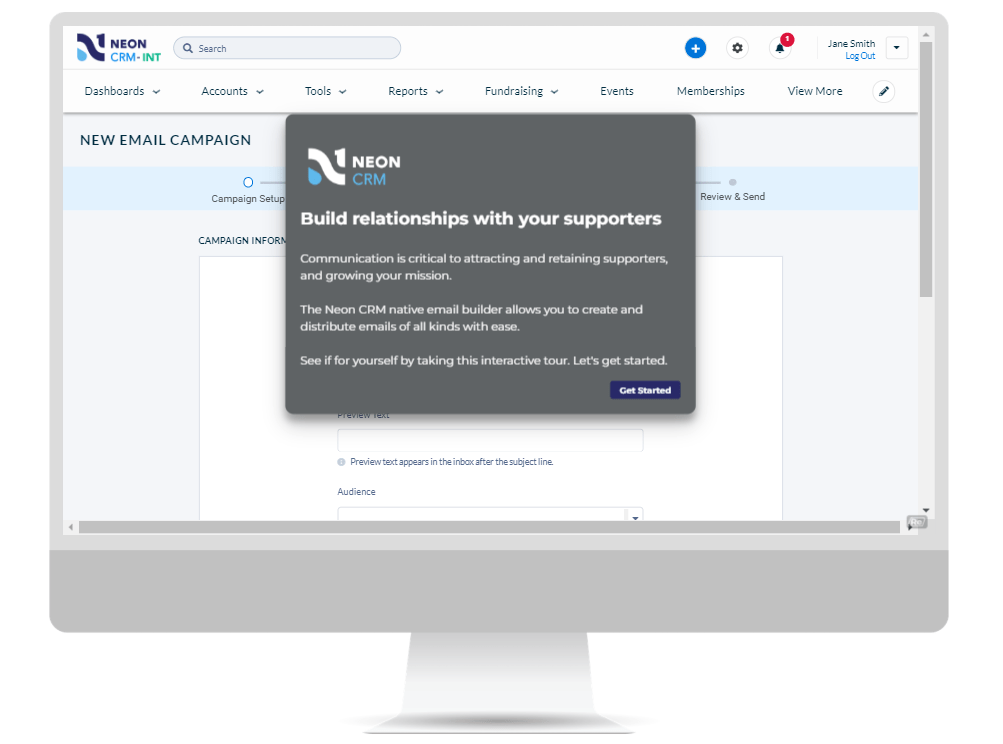
Send Emails That Don’t Get Ignored
Building a stable base of loyal, passionate supporters starts with great communication! With Neon CRM’s integrated email builder, creating compelling, impactful messages is as simple as drag, drop, and send.
Next Steps for Grassroots Organizations
As you work on a strategic plan for growing, you’ll want to focus on coming up with effective, repeatable tactics and processes. This means thinking through:
- Concrete goals for fundraising, donor acquisition, and other important activities
- A marketing and fundraising plan that will move you toward your goals
- How you’ll capture and store data in a single place so you can easily track your progress
Taking these steps now—when you’re still a relatively new organization—will make it much easier for you to avoid a lot of the growing pains many nonprofits encounter as they get bigger.
Phase 2: Connected
All of the work you do to establish your organization’s identity, grow your visibility, and attract supporters in the grassroots phase will eventually get you to the “connected” phase.
At this point, you’ve got a growing community of people who are involved in supporting your work. You’ve laid the groundwork for an effective fundraising program, and that makes it possible for you to focus more on generating revenue that you’ll need to serve your community.
Common Challenges for Connected Nonprofits
Even the most organized grassroots organizations use multiple tools or platforms to manage their activities. This includes you!
You’ve probably got data about your donors and other communities in multiple places. That makes it difficult for you to get a full picture of the people in your community and the overlapping ways in which they support you.
This disconnected data can make fundraising tricky. You’re also probably still dealing with limited time and resources, which complicates everything from fundraising to running events to communications—all of these things end up being more time-consuming than you’d like.
Important Tech Tools for Connected Nonprofits
At this phase, you’ll want to focus on scaling the tech stack you started building during your grassroots phase. This means:
- A website that addresses each of your community segments
- Donor management tools that capture all of your community’s data in one place
- Event management tools that connect to your community management platform
- Email tools you can use to communicate with different supporter groups
- A payment processor that connects with your other tools
Consolidating your tools so you can begin tracking all your different activities in the same place is going to be key here. As your organization grows, it’s going to be important that you can easily understand all of the different groups of people in your community!
Here are some other Neon One articles, reports, and guides that can help you out here:
- The Recurring Giving Report: Data-Backed Insights for Sustainable Generosity
- 6 Nonprofit Email Benchmarks You Need to Know
- Membership Management Software Buyer’s Guide
- The Ultimate Guide to Nonprofit Websites
- The Nonprofit Fundraising Event Planner
Next Steps for Connected Nonprofits
Now is the ideal time to launch a recurring giving program.
In addition to being an invaluable way to build predictable, sustainable revenue, it’s also a fantastic way to establish a base of committed donors. People who make recurring gifts have a higher lifetime value than those who make one-time gifts, and they tend to be much easier to retain.
Automating simple processes is going to be key for you during this phase, too.
Sending individual thank-you emails to donors, for example, is manageable when you only have a handful of supporters. But that process will become increasingly onerous as you expand your donor community, and automating that outreach can save you tons of time.

Phase 3: Integrated
You’re really getting the hang of this, now. You’ve got your data in one place. Any separate systems you’re using are connected to each other using different integrations.
This means you’re able to connect more closely with the people in your community, and you’re starting to notice how different groups of supporters are engaging with you in different ways.
Maybe your volunteers are donating. Maybe you have some donors raising money for you through peer-to-peer events. Maybe you’ve created a membership program in addition to your standard fundraising activities.
Common Challenges for Integrated Nonprofits
You’ve done a ton of work to establish your nonprofit and build a community of donors and other supporters. After that initial momentum, growth is probably slowing down a little bit. Reaching new community members or finding new donors is getting harder.
And, while you work to grow your community by connecting with new people, you also need to focus on retaining the people who are already active.
Important Tech Tools for Integrated Nonprofits
This is the ideal time to start looking for ways to create new revenue streams. You’ll want to find tools to support:
- Peer-to-peer fundraising
- Volunteer management
- Grant management
Finding new opportunities to engage your community through activities like peer-to-peer fundraising and volunteering is going to help you deepen your relationships with your supporters, but you’ll need to find solutions for managing those activities.
You may also want to start looking for tech that will help you keep track of any grant funding you receive and report your impact back to the grantmakers.
Here are some more resources to help you out:
- Peer-to-Peer Fundraising: The Complete Nonprofit Guide
- Grant Management for Nonprofits: Your Guide From Research to Reward
- How to Manage Volunteers: The Complete Nonprofit Guide
Next Steps for Integrated Nonprofits
Until now, most of your focus has been on building a community. Now, you’re going to want to focus on measuring your community’s health even as you continue to expand it.
Start keeping an eye on important community engagement metrics like donor retention rates, donor lifetime value, and how many people support you in more than one way.
Phase 4: Dynamic
At this phase, you’re starting to get more sophisticated. Because you’ve established solid processes to track and understand your data, you’re able to give the people in your community really personal-feeling interactions.
You’ve established scalable, repeatable workflows that include more complex automations that free you up to build deep relationships with your supporters.
Common Challenges for Dynamic Nonprofits
You’re probably looking for ways to guarantee continuous, year-over-year growth in a way that doesn’t fatigue donors but gets them even more passionate about your work.
You may be dealing with staff turnover, too, or you may be looking for ways to simplify your staff’s workload to avoid burnout.
Important Tech Tools for Dynamic Nonprofits
As you look for ways to encourage financial generosity in your community, it may be time for you to look for tools like:
- Wealth screening systems
- Software that gives you an understanding of community members’ affinity for your cause, in addition to their donation history
Both of these tools will give you even deeper insight into how you can connect with the people who love your mission. They’ll be important tools for any major gifts fundraising you’re doing, too.
For a quick look at the unique ways we help Neon CRM users better understand how someone is supporting their nonprofit, and their true potential for future support, check out the Generosity Indicator.
Next Steps for Dynamic Nonprofits
Your community is thriving. Now, you’ll want to spend some time and effort developing a crystal-clear understanding of the type of people who are most likely to engage with you and the ways in which they’ll do so.
This information will enable you to research and understand every part of your community’s journey, starting with someone’s first-ever interaction with you and culminating in long-term support.
You’ll use that community journey mapping to plan and launch campaigns that are tailored to different donor segments.

Phase 5: Engaged
Your organization is a well-oiled machine. Because your development and marketing staff are working closely together, you’re able to create amazing generosity experiences for the people who support you.
You may even be using AI tools to analyze your community dynamics, track your progress and identify opportunities to reach new people, and automate very complex processes.
You’re an important part of your local community, and you’ve got a highly diverse community. You’ve got donors, clients, volunteers, advocates, and others working together to make the world a better place.
Common Challenges for Engaged Nonprofits
You’re doing a lot. Maintaining and expanding your offerings—whether in the form of your programs, events, educational materials, or something else—is a constant area of focus.
And, as your community continues to grow, you’re constantly looking for ways to balance acquisition and retention of different supporter segments.
Deepening relationships and encouraging people to get involved with your work in new ways is also an important area of focus.
Important Tech Tools for Engaged Nonprofits
Look for AI-assisted technology that will give you a deep understanding of your community and help you identify opportunities to improve your activities.
This doesn’t need to be generative AI! Predictive AI tools are really useful while doing things like finding donors who could potentially take important steps (like creating a planned gift or making a major donation).
You may also want to look for tools with API access that will let you build custom systems or automate very complex processes.
You can read this article to learn a bit more on how we’re handing AI here at Neon One, plus a free AI readiness guide you can use to have constructive conversation about AI at your org.
Next Steps for Engaged Nonprofits
Your community is broad, diverse, and relatively stable. This gives you tons of room to experiment with new kinds of communications, events, programs, and even new technologies.
Have fun with it! Try something you’ve never done before, like creating custom chat tools your clients can use to find the perfect program, running an event you’ve never tried before, or setting up text messaging systems to accelerate advocacy.
Are You Ready to Grow? Here Are Some Practical Next Steps
Growing your nonprofit is an admirable task, but it’s not an easy one. In addition to your passion for your cause, you’ll need access to practical tools that will make it possible to grow your community and generate the revenue you need to fund your work.
Building a community and a resilient fundraising program can be tough, but it’s worth every bit of effort. Regardless of which phase you’re currently in, here’s what to do next:
- Assess your current community maturity
- Set goals that align with your mission and will get you to the next maturity phase
- Map out the specific steps you’ll take to reach those goals
- Evaluate your current systems and whether or not you have the tools you need
- Execute your plan
For more information on all the different ways that you can understand and nurture the support of your existing community, we can’t recommend enough that you download The Generosity Report: Data-Backed Insights for Resilient Fundraising.
Fuel Your Mission: Engage Everyday Donors
Learn actionable strategies to effectively connect with and cultivate the generosity of your everyday supporters—download The Generosity Report now!

Author Bio
Abby Jarvis, Head of Research and Editorial
Abby Jarvis is a writer, marketer, and speaker at Neon One, and she’s passionate about giving nonprofits the tools they need to connect with their supporters. Her 13 years in the nonprofit technology industry have been dedicated to understanding how and why donors support their favorite causes, studying donor trends and behavior, and sharing data-backed best practices that nonprofits can use to build successful fundraising programs.