

— KEY TAKEAWAYS
Donor database management is the systematic process of collecting, organizing, and analyzing your supporter data within a centralized CRM to build sustainable, long-term fundraising relationships.
- To effectively manage your database, you must master three pillars: Data Collection (gathering accurate contact and engagement details), Data Organization (using tags and standardizing entry), and Data Analysis (running reports to guide your strategy).
- Maintaining clean, organized data allows you to track and retain multi-year donors, who account for 45% of all fundraising revenue.
- Follow core best practices: perform regular data audits to keep information current, strictly prioritize data security to protect donor privacy, and replace manual spreadsheets with CRM automation.
- Automating your data flow eliminates duplicate records and costly data silos, ensuring your communications reach your audience and keeping email bounce rates near the nonprofit average of 1.72%.
Effective donor database management might not sound like much, but believe us when we say it is the foundation of sustainable nonprofit fundraising.
Why? Because a well-managed CRM allows organizations to track donor behavior over time and use that information to build donor relationships that last—and it’s longevity, not initial gift size, that is the true driver of revenue.
At least, that’s what the data tells us. Neon One’s Generosity Report found that five-year multi-year donors account for 45% of all fundraising revenue. Furthermore, the report found that a donor’s first-time gift size is not a reliable indicator of long-term value; one-year donors in the report averaged a $168.85 initial gift, while five-year donors averaged $182.09
To capture this long-term value, nonprofits must utilize—and maintain—a robust donor database to collect, organize, and analyze data systematically. It might sound dry and dull—and it often is—but this subject is absolutely crucial for your organization’s long-term success
Let’s get into it!

Guest Pitches: We want to publish your story!
Looking to share your insights and broaden your reach? Write an article and let us share it with our audience of over 100,000 nonprofit leaders.
The 3 Pillars of Donor Database Management
The goal of donor database management is to maintain accurate records within your nonprofit’s system—whether that system is a simple Google Sheet or a full-fledged donor management platform—so that you can more closely tailor your messages, appeals, and donor engagement strategies.
Here’s a deeper dive into the three primary pillars of donor database management—data collection, data organization, and data analysis. We’ll go in order.
1. Data Collection
Nonprofit data collection is the first step of effective donor database management; it’s the systematic process of gathering verifiable donor information—including contact details, giving history, event attendance, and engagement metrics—into a centralized CRM platform.
Accurate data collection is the first pillar of donor database management and is essential for identifying high-value supporter segments, such as recurring donors.
Proper data intake allows organizations to track crucial retention metrics. For example: According to Neon One’s 2026 Recurring Donor Report, the average recurring donor retention rate is around 78%.
With a well-maintained database, you can see how your nonprofit’s efforts compare and adjust your recurring giving strategies accordingly.
By capturing demographic details, communication preferences, and volunteer history through optimized donation forms and surveys, nonprofits establish a unified donor profile.
This comprehensive data collection enables targeted segmentation, ensures compliance with privacy regulations, and provides the foundational information required to build sustainable, long-term philanthropic relationships over an average donor lifetime of eight years.
Essential data your nonprofit should be collecting in your donor profiles includes:
- Contact Information: Names, addresses, phone numbers, and email addresses are fundamental for maintaining communication with donors.
- Donation History: Records of donation amounts, dates, and associated campaigns help track donor generosity and identify giving patterns.
- Engagement Metrics: Information about participation in events, volunteer activities, and interaction history provides insight into donor involvement beyond financial contributions.
- Demographic Information: Details such as age, gender, location, and occupation assist in segmenting and targeting communications effectively.
- Communication Preferences: Knowing preferred channels (email, phone, mail) and frequency of contact ensures that outreach aligns with donor preferences.
- Notes on Interactions: Personal notes and preferences add a personalized touch to donor management, making interactions more meaningful.
So, how are you going to collect all this information? The primary way will be through your donation forms, which are essential for capturing contact and donation information efficiently. They should be easy to use and accessible from any device.
Neon CRM’s donation form builder has best practices built in and lets you create an unlimited number of forms. To see the form builder in action, take the tour below!
Beyond online forms, you can also collect feedback and preferences through donor surveys, which allow you to get more specific with the questions you’re asking, a specificity that will allow you to gain valuable insights into donor interests and satisfaction.
Tracking participation in events helps monitor engagement and gather additional contact information. Monitoring interactions on social media can reveal more about donor interests and engagement levels.
Finally, recording notes on personal interactions that you’ve had with donors will really help you go above and beyond to create meaningful relationships with your supporters. These notes will be an especially important tool for communicating with your major donors.
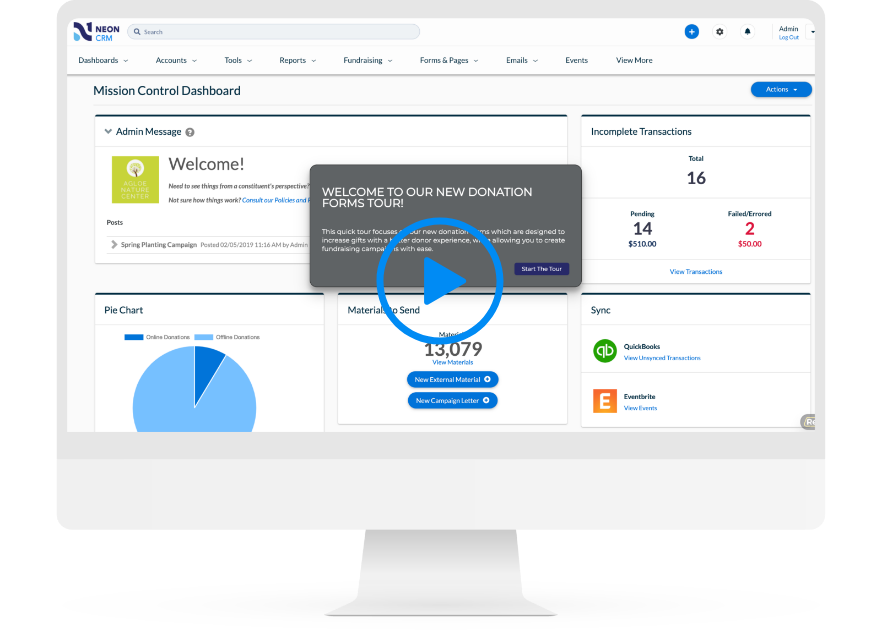
Donation Forms That Practically Fill Themselves
With Neon CRM, you can spin up an unlimited number of fully optimized, totally customized donation forms.
2. Data Organization
Organizing your donor data effectively is crucial for both ease of access and analysis.
By implementing a logical, straightforward structure with categories such as donor type, giving level, engagement frequency, and interests, you’ll be able to turn your database from a mere receptacle for transaction data into the engine of your donor engagement strategy.
Here are some of the key tools and techniques that you can employ in your nonprofit CRM platform to better organize, clean, and update your donor data:
- Create Tags and Labels: Use descriptive tags and labels to categorize donors based on various criteria, such as event participation, communication preferences, and donation history. Tags and labels help you quickly identify and segment donors for targeted outreach.
- Utilize Custom Fields: Customize fields in your CRM to capture specific information relevant to your organization, such as program preferences or volunteer skills. Custom fields ensure you have all the necessary details to personalize donor interactions.
- Implement Logical Structures: Organize data into hierarchies or groups that reflect donor relationships and activities. For example, group donors by geographic region or engagement level to streamline communication and engagement strategies.
- Conduct Regular Data Audits: Conduct periodic audits to identify and correct inconsistencies, errors, and duplicates in the database. Regular audits maintain data accuracy and reliability.
- Merge Duplicate Records: Use CRM tools to identify and merge duplicate donor records, ensuring a single, accurate profile for each donor. Merging duplicates prevents confusion and ensures a clear understanding of each donor’s contributions.
- Standardize Data Entry: Enforce standardized data entry protocols to maintain uniformity and reduce errors. Consistent data entry practices make data easier to manage and analyze.
Here is how you can see this in action. When Path of Hope Rescue was relying on scattered spreadsheets and inconsistent records, they struggled to track and understand their donor base. Once they centralized their information in Neon CRM, they finally gained a complete picture of their community.
“I found donors that had been donating to us for years, and I had no idea because we never had all of our data in one place before!” said Founder and Executive Director Caitlin Knight.
By having their data organized and accessible, the team was able to identify giving patterns and launch a recurring donation campaign. That campaign now generates $1,500 in steady monthly revenue that the organization can rely on to fund their mission.

Paws and Progress: Path of Hope’s Growth Story with Neon One
3. Data Analysis
You’re not collecting all this data just for the thrill of it! You’re collecting it so that you can put it into action. Analyzing donation patterns, identifying donor trends, and understanding the impact of your campaigns will enable your nonprofit to make better decisions, raise more funds, and build longer-lasting relationships with your supporters.
Here are some of the tools you can use in your CRM to do it!
- Generate Reports: Use CRM reporting features to create detailed reports on donor activity, campaign performance, and fundraising outcomes. These reports provide a clear picture of your fundraising efforts and highlight areas for improvement.
- Visualize Data: Present data visually through charts, graphs, and dashboards to easily identify trends and patterns. Visual representations of data make it easier to understand complex information and communicate insights to stakeholders.
- Predictive Analytics: Employ predictive analytics to forecast future donor behavior, such as identifying potential major donors or predicting donation amounts. This foresight allows nonprofits to proactively engage donors and tailor their strategies.
Using the insights you can gain from these tools, you can enact smart, data-driven strategies that will enhance engagement and increase the likelihood that your donors will stick around and grow their giving over time.
Identify donor groupings and trends that you can use to segment donors based on behavior, preferences, and demographics. Tailoring messages and campaigns to each segment maximizes impact and relevance.
By segmenting donors using clean database analytics, organizations can significantly tailor their communication strategies. For instance, Neon One’s Nonprofit Email Report found that small nonprofits utilizing targeted, clean lists achieve a 45.70% average email open rate.
Analyzing cross-channel engagement data also highlights overlapping generosity; according to the Generosity Report, event registrants who are tracked in a CRM and retained for three years accelerate their giving by over 120%. Proper data analysis translates this raw engagement into actionable, revenue-generating insights.
Finally, you can use your database’s analytics tools to identify the most effective fundraising tactics by analyzing past campaign performance and donor responses. Understanding what works best will help your nonprofit allocate resources more efficiently and improve future giving campaigns.
If you have some questions about what kinds of benchmarks your nonprofit should be using to grade your performance, we’ve got a Fundraiser’s KPIs checklist that should come in handy.
Best Practices for Managing Your Donor Database
The best thing that you can do to manage your donor database is create a clear set of standard procedures and processes that all staff members need to follow in order to update and maintain the system.
Having standard operating procedures in place will not only ensure that data is entered and formatted in a timely and consistent manner, but it will also create a useful set of redundancies: If a key staff member leaves, or even if they’re just out sick for a couple of days, it won’t cause any interruptions or errors.
As you decide on your nonprofit’s standard operating procedure, here are some best practices you should make sure to include.
Perform Regular Data Updates
Keeping donor data up-to-date is crucial for gaining, maintaining, and building donor trust. In fact, using out-of-date donor data might be worse than having no data at all.
Failing to update contact records leads to data decay, directly harming your outreach efforts. Maintaining accurate email lists ensures your organization remains near the nonprofit industry average email bounce rate of 1.72%.
Regular data audits reduce hard bounces, safeguarding your email deliverability and ensuring your appeals reach active supporters.
There are several effective methods you can use to keep donor information current:
- Set up automated email reminders prompting donors to review and update their information periodically. This proactive approach encourages donors to keep their details accurate and complete.
- Schedule routine data audits to verify and correct donor information. Regular checks help identify and rectify any inconsistencies or outdated information, maintaining the accuracy and reliability of your data.
- Use tools that capture and update donor information in real-time, such as event check-ins or online forms. This method ensures that any new data is immediately reflected in your database, reducing the risk of outdated information.
For a more detailed look at the ins and outs of nonprofit data management, check out this article:

Prioritize Data Security and Privacy
Protecting donor data is non-negotiable. If you can’t keep your donors’ Personally Identifiable Information (PII), 501(c)(3) tax-exempt status data, and Donor Advised Funds (DAFs) records safe, then your organization is going to have a really (really) hard time building a case for long-term support.
Start by restricting access to donor data based on user roles and responsibilities. Implement strong authentication and authorization mechanisms—such as Multi-Factor Authentication (MFA) and Role-Based Access Control (RBAC)—to ensure that only authorized personnel can access PCI compliance details and wealth screening profiles.
Conduct regular SOC 2 Type II security audits and vulnerability penetration testing to identify and address vulnerabilities in your data protection measures. Regular audits will help ensure that your data security practices are robust and up to date.
Lastly, train staff on data protection best practices, including recognizing spear-phishing attempts and handling encrypted major gift agreements securely. Well-informed employees are essential for maintaining institutional data governance.
When it comes to your external measures, it’s a good idea to maintain clear, GDPR and CCPA-compliant privacy frameworks that explain how donor data is collected, used, and protected. You can even go a step further by obtaining and recording explicit opt-in consent parameters for data collection and communication.
Cut Down on Manual Imports and Data Entry
One of the best ways to screw up your data is to rely on manual imports (or worse, manual data entry) between your nonprofit’s various systems. Every instance of manual work is a chance for something to get missed or mistaken.
When it comes to cutting down on your manual data tasks, there are two ways to go about it. To understand why automating this process is critical for your operational health, consider the stark differences between modern automation and manual processes:
| Evaluation Factor | Unified CRM Automation | Manual Entry & Spreadsheets |
| Data Silos | Centralized data architecture providing a real-time, 360-degree view of donor interactions. | High fragmentation; isolated datasets trapped across disparate tools and individual hard drives. |
| Duplicate Record Risk | Near-zero risk due to automated deduplication, primary key validation, and global ID matching. | Extremely high risk driven by human error, formatting inconsistencies, and lack of systemic oversight. |
| Integration Parity | Native bi-directional sync (via API webhooks) ensuring immediate system-wide updates. | Non-existent; relies heavily on static, time-consuming flat-file (CSV) exports and uploads. |
First, you can find a comprehensive donor management platform like Neon CRM that lets you perform most of your functions—like fundraising, email, events, volunteers, SMS, and memberships—in the same system as your database.
Second, you can set up integrations between your donor database and your various systems that allow data to flow into your database automatically. Integration simplifies your data management processes, ensuring that data is consistent and up-to-date across all platforms.
One thing to note is that these options are not mutually exclusive: In addition to all its built-in features, for instance, Neon CRM integrates with dozens of popular tools. If you’re shopping around for a new donor database, check out this handy guide we created to help you find the right one:

Neon CRM is a Powerful Donor Database
Effective donor database management is crucial for fostering strong donor relationships and enhancing fundraising success. By putting in place effective strategies and processes around how you collect, organize, and analyze your data, your nonprofit can get the kinds of actionable donor insights that will maximize your supporter engagement and fundraising success.
Neon CRM is a comprehensive donor management platform that has everything you need to put an effective donor data strategy in place. With its easy-to-use donor database, its built-in email, event, volunteer, and membership features, its fully optimized online forms, and its powerful analytics tools, Neon CRM will help you unlock the full power of your nonprofit’s data.
If you’d like to learn more about Neon CRM, check out this simple, self-guided tour! It will give you a broad overview of everything the system can do for your organization. Click the button below to get started!