
Let’s be honest: planning a capital campaign can be daunting. For most campaigns, the end goal is a physical undertaking like a new building or an extensive renovation, which is why they come with financial goals that reach six figures (or more).
Managing everything that goes into a campaign of that size can be pretty overwhelming for any nonprofit, so we’ve created this straightforward, 10-step guide to capital campaign planning and execution.
Do You Know Your Donors?
They’re more generous than you might think … and we have proof. Download The Generosity Report today!
But First, What Is a Capital Campaign?
A capital campaign is a major fundraising initiative with a concrete goal and defined timeline. Organizations typically use capital campaigns to raise funds for larger projects like new construction, building renovations, or equipment purchases.
Unlike other types of donations, capital campaigns are always linked to a dedicated project. Depending on the size of the project and the fundraising goal, campaigns might take place over several years and involve many phases.

These campaigns also differ from typical fundraisers in terms of scale. If your organization is looking to fund a large-scale expansion, for example, a capital campaign is a great way to make that happen.

Capital Campaign Planning: 10 Essential Steps
A capital campaign plan is typically divided into two parts: The quiet phase and the public phase.
During the quiet phase, you’ll reach 50% to 70% of your goal by asking your major donors for contributions. The public phase will occur when you finally announce your campaign to the world. You can start collecting smaller donations from your broader pool of donors.
In this article, we’ll review the key capital campaign planning stages needed to launch successfully. Here are the steps we’ll cover:
Step 2: Conduct a Feasibility Study
Step 3: Set Clear and Realistic Goals
Step 4: Create a Brand & Slogan
Step 5: Design a Campaign Specific Landing Page
Step 6: Launch the Quiet Phase
Step 7: Make Your Marketing Materials
Step 8: Plan Your Public Phase Launch Event
Step 9: Promote Your Campaign on Social Media
Step 10: Reach out to Donors Using Traditional Methods
Let’s get into it.
Step 1: Do Your Research
There are many factors to consider carefully during the planning phase. Feasibility, timing, goal setting, and donor analysis play a large role in building a worthwhile campaign.
Before diving in, make sure you ask the following questions:
Determine the Right Timing
If your organization is on firm footing within your community—or you’ve been in the game for a while—it could be time to fundraise for some capital.
If you’re just getting your organization off the ground, it may not be the right time for this type of campaign. Your efforts should instead go into bringing in new donors and building relationships with them to help establish sustainable, long-term growth.
Ensure Your Donors Are Ready
Knowing whether or not your constituents can contribute the amount of money you’re looking for can make or break a capital campaign.
If you raise only a few thousand dollars annually, your donors may not yet be ready to support a campaign that needs to raise millions of dollars.
Segment Your Donor List
In your research phase, you should segment your donor list. While your team will already know who your major donors are, segmentation will help you discover existing donors who have the capacity to increase their giving and deliver new major gifts.
Mid-level donors, for example, often have major gift capacity. Creating a donor segment specifically for that group will allow you to send tailored appeals that increase the likelihood they’ll give larger gifts.
But donor segmentation isn’t solely focused on acquiring major gifts. It will also give you a good idea of your overall fundraising capacity. If you notice that your small-dollar donor list is five times the size of your mid-level donor list, that may help you determine how much you’ll need to raise from each group.
A fundraising strategy aimed at engaging a donor base that’s made up mostly of smaller donors will differ from a strategy aimed at engaging large numbers of major donors. Segmenting out the larger donors from the smaller ones helps you craft an effective fundraising strategy while ensuring you’re not overworking your team. Plus, it can help you determine if a campaign is sustainable with your current donor base.
Step 2: Conduct a Feasibility Study
If you’ve started planning your campaign, you’re probably familiar with feasibility studies. A feasibility study is used to help determine your fundraising goal and can also help you develop a strategy for your campaign.
During a feasibility study, nonprofits will conduct interviews with supporters, current and previous board members, influential business owners, and volunteer leaders to see if they’d be interested in supporting the campaign.
Typically, nonprofits hire a third-party representative like a consultant to perform the interviews so that supporters feel comfortable giving their honest opinions.
Conducting a feasibility study will help you understand what your organization is capable of raising and determine what your pain points might be throughout the fundraising stages. As with any fundraising campaign, you need to be sure that your nonprofit has the infrastructure to handle this kind of long-term project.
If your staff alone cannot lead the campaign, consider selecting a board of constituents to help spearhead the fundraising efforts. Make sure that they are invested in the long-term plan and can dedicate enough time for meetings, though!
Step 3: Set Clear and Realistic Goals
When planning your capital campaign, setting goals sets you up for success. But not just any goals—you need goals that are realistically reachable and inspiring targets for your donors.
The feasibility study you completed in step two will be a huge help here by giving you a realistic dollar amount that you’re likely to raise. Identify measurable outlines and timelines that you can stick to. You’ll also want to outline what your specific objectives are for your campaign and attach goals and milestones to each one.
For example, if one of your capital campaign objectives is to build a new facility, you might set a goal to raise the specific amount of money you need for the first phase of construction by a specific date (“Raise $400,000 by July 1, 2025 to secure a building company to begin the first phase of constructing our new facility”).

Step 4: Create a Brand & Slogan
Reaching your campaign’s goal could take years. Therefore, you want your campaign to be memorable so donors will share it with their friends and family throughout the fundraising period. And who knows? Your supporters may give more than once during your campaign.
To help create an impression that lasts, create a brand and slogan for your capital campaign. Even if you already have a well-established brand for your nonprofit, the campaign’s brand should be slightly different to separate your campaign from the rest of your activities.
Your branding should fit the theme of your project while complementing your nonprofit’s overall brand. You’ll also need a catchy slogan to capture your donors’ attention, concisely communicate the capital’s purpose, and encourage them to contribute.
Here’s an important tip: Figure out what your overall message is for the campaign before you create your slogan.
For your slogan, you should go for something that:
- Is short and catchy: Create a slogan that’s quick and easy to read. Your phrase should stick in your donors’ minds.
- Describes your project: Make it clear what your campaign is looking to achieve. That way, donors can gain information as soon as they see your slogan.
Think about your brand and slogan as the main point that you want donors to take away from your communications, easily remember, and share with their networks.
Step 5: Design a Capital Campaign Landing Page
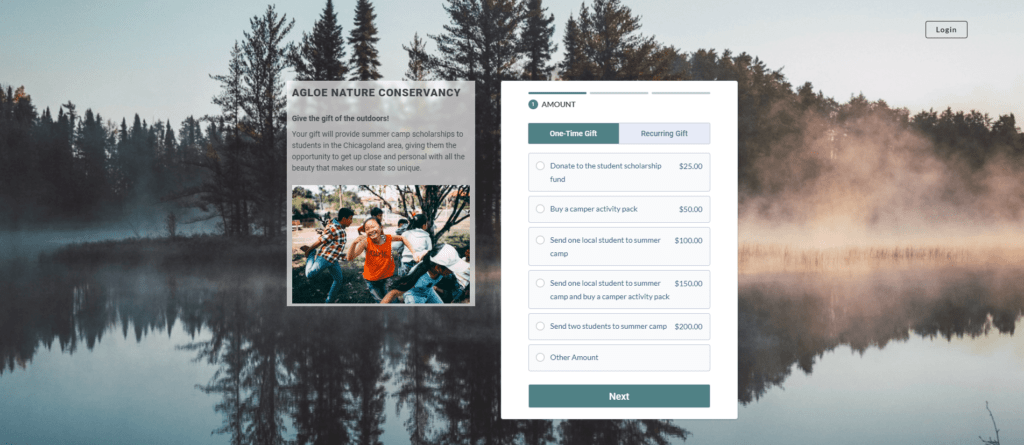
To differentiate your capital campaign from the rest of your fundraising efforts, you should create a dedicated campaign donation page that you use exclusively to support your capital campaign.
This page can include information about the capital campaign and details about the project the campaign supports.
During the quiet phase of your capital campaign, don’t promote the page on your website’s homepage. Instead, simply share the link with interested donors. Once you launch your public phase, you can give it the prime real estate it deserves.
Here are things you can add to your campaign page to build trust with potential donors:
- An easy-to-find space for supporters to donate
- Updates on the campaign’s progress
- Consistent branding and a slogan
- A section with donor FAQs
It’s important to have a well-designed website because it will be the place you direct donors to learn more about your campaign.You should also pay close attention to your donation form, as the design and layout of your form can increase conversion rates (or drive would-be donors away!). To learn more, check out our article on the donation form best practices that are built into Neon One.
Step 6: Launch the Quiet Phase
Immediately following the planning period, your team should begin seeking out key donors who may be willing to make sizable donations to your project. Typically, this is done before you officially announce the campaign to your wider donor base.
Depending on your organization’s size, the length of this phase—not to mention that of the entire campaign—can vary from several months to over a year.
This phase is also about using your previously cultivated relationships with large donors by asking them to make the first donations to your campaign.
Make sure you are offering adequate recognition to the major donors who support your initiative. This could be in the form of a plaque, named meeting room, or even an entire building, wing, or fund named after them, depending on your project.
The overarching goal of the quiet phase is to ensure that your campaign will be successful. You want to be able to raise the majority of your overall goal so smaller donors do not feel overburdened once the campaign goes public. Asking donors to help you raise the last $15,00 of a campaign, for example, feels much more manageable than asking them to help raise $2 million.
It also guarantees built-in goal protection—if you reach your goal before even leaving the quiet phase, you can easily slightly increase your goal to accommodate your donors’ giving.
During the quiet phase, you can build excitement among your donor base by announcing plans for a renovation, a building move, or the creation of an endowment. This is markedly different from launching the campaign publicly, though.
Begin including plans and other teasers in your ongoing communications, such as newsletters or bulletins, so your constituents know what you’re thinking and planning. This can help build support before you ever make an announcement.
Step 7: Create Your Marketing Materials
Raising awareness about your fundraiser goes much smoother when you’ve prepared the right information and materials to share with donors. Marketing materials are worth the investment, as they’ll play a big part in helping spread the word about your campaign.
Your materials can be physical documents you send or hand out, or they can be content you post on your website and social media accounts. Ideally, they’re both!
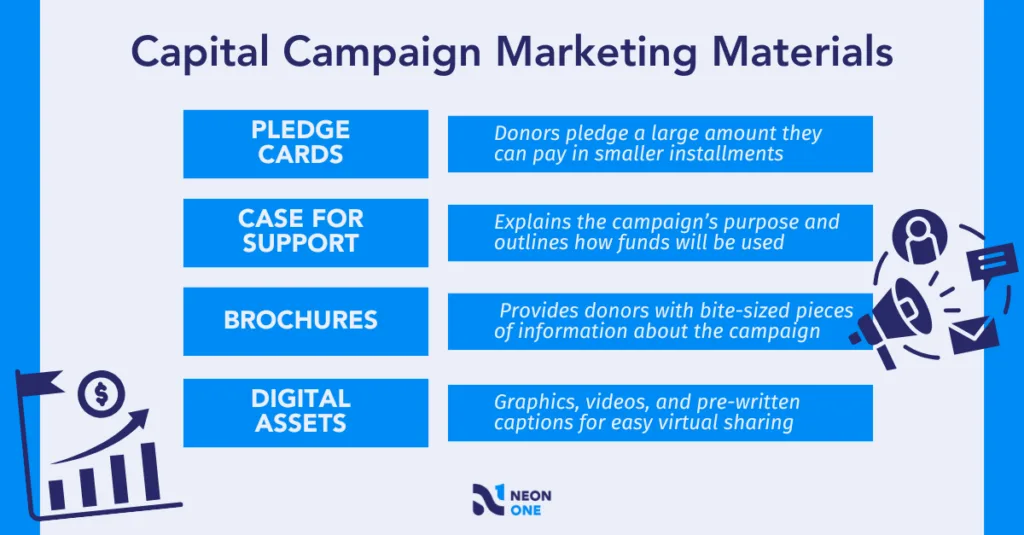
Here are a few marketing materials you can use during your campaign.
Pledge Cards
A pledge card is a donation form you can give to donors in person or send via direct mail. The great thing about pledge cards is that donors can pledge a large amount they can pay in smaller installments over a few months (like monthly payments!).
Your cards should match your capital campaign’s branding and have the slogan somewhere on the card. The card will be where donors can input their information, including their name, address, and payment information.
Case for Support
A case for support, sometimes known as a donor prospectus, explains your campaign’s purpose and outlines how you will use the funds.
The case for support should answer the most common questions donors will have about your project. You can send your case for support with your appeal letters or make it a resource donors can access on your website.
Brochures
You can use brochures to provide donors with bite-sized pieces of information about your capital campaign. In fact, most of the information you include in your brochures can come from your case for support.
Like your other marketing materials, your brochures should match your campaign’s brand. They should include information about suggested giving amounts and giving levels, any incentives you’re offering, and all the different ways to give.
Digital Assets
Since so much fundraising (and marketing) happens online and through our phones, it’s a good idea to create digital assets to promote your capital campaign.
You’ll use these assets to promote your campaign on your own channels, of course, but you can also share them with your staff, board members, volunteers, and donors to make it easy for them to market the campaign within their networks.
These assets could include graphics that match the campaign’s branding, pre-written social media captions or emails, or short videos that are easy to share on social media and via text.
Step 8: Plan Your Capital Campaign Launch Event
In between the quiet phase and the public phase, there is a stage known as the “kickoff.” This marks a critical part of your campaign, where you’ll announce your project to the world. After quietly soliciting gifts from your major donors, it’s time to let everyone know about your campaign.
Typically, this phase starts with an event that:
- Celebrates your campaign
- Thanks the supporters who have contributed so far
- Spreads the word about your campaign
- Gains media attention
- Inspires your supporters
Your event will allow you to interact with donors, get them excited about your campaign, and encourage them to give.
Depending on the type of project for which you’re raising money, you might want to have a formal event to recognize your donors. You could also host a:
- Charity Auction: You can host an auction as a part of a larger event or have it as a distinct fundraiser. Procure items from local businesses to auction off and raise additional funds for your campaign.
- Raffle: This fundraising event is a simple (and inexpensive) way to raise funds for your campaign. Have your volunteers start selling raffle tickets and then host an event where you will announce the winner.
- Walkathon: A walkathon is a great option—especially if you’re raising funds for a health-related campaign. You can raise money from your supporter’s pledges, through peer-to-peer fundraising, or by selling t-shirts and other nonprofit gear.
- Fundraising Gala: This type of event is a great way to kick off your campaign and thank your major donors. They usually consist of an award ceremony and dinner.
Invite your major donors who have already contributed and other supporters who will just be learning about your campaign. Having a mix of supporters can lead to more donations, as interacting with those who have already supported the campaign may encourage those who haven’t yet.
Step 9: Promote Your Capital Campaign on Social Media
Engaging with your supporters on social media is a great way to spread the word about your campaign. Since social media is a popular way to interact with donors, you can use your accounts to promote your campaign and encourage supporters to give.
You can use social media to:
- Share updates on your campaign’s progress
- Thank donors for contributing
- Post ways supporters can give to your campaign
When you make content for social media, make sure you use graphics or photos to make your posts more shareable. The more a post is shared, the more people will know about your campaign.
It’s also a good idea to keep track of the conversations surrounding your nonprofit and your campaign. You can do this by creating a campaign-specific hashtag. Use your hashtag on all the posts or tweets you create for your campaign and encourage donors to use it, too.
Plus, this will make it easier for you to thank donors when they make a contribution. If donors share their donations on social media with the hashtag, you’ll know about it.

Step 10: Reach Out to Donors Using Traditional Methods
Along with the other marketing tips we mentioned, don’t forget the traditional methods of reaching out to donors! We’re talking about mailing letters, sending emails, and calling to ask donors to support your campaign.
Since capital campaigns can last from anywhere between one to five years, make sure you’ve already outlined the strategies for tackling this final phase. These methods of communication are still great ways to reach out to your supporters. Not only do some donors prefer these methods, but you also have a chance to personalize your communications and explain what their gifts will support.
Make use of your volunteers, staff, and board members by asking them to get on the phone with potential donors. Speaking with people one-on-one will give your volunteers a chance to convey their passion for your cause to potential donors.
Whether you’re in the thick of capital campaign planning or just getting started, getting clear on your goals, creating memorable pages, branding, and marketing materials, and being strategic in your quiet and public phases will help you launch an effective campaign.
Supercharge Your Capital Campaign Plan with Neon One
Now, you know all the steps you need for successful capital campaign planning. Remember, acknowledging every donor—big and small—is a huge part of maintaining a great campaign.
With months (or even years) of outreach and donor tracking to consider, a comprehensive fundraising platform like Neon One can make all the difference in your capital campaign and future initiatives.
From segmenting audiences to building custom, branded donation forms and emails to tracking event attendance, Neon One’s CRM has the tools and features to make your capital campaign a success.
Ready to learn more about our CRM? Request a personal demo today!